
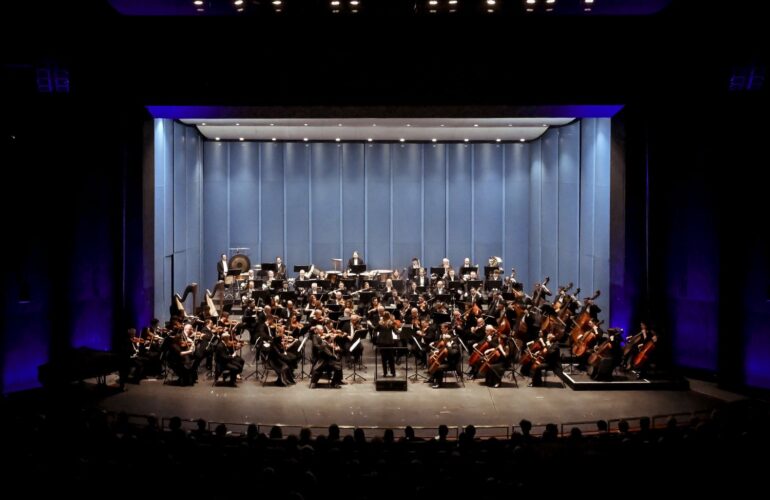

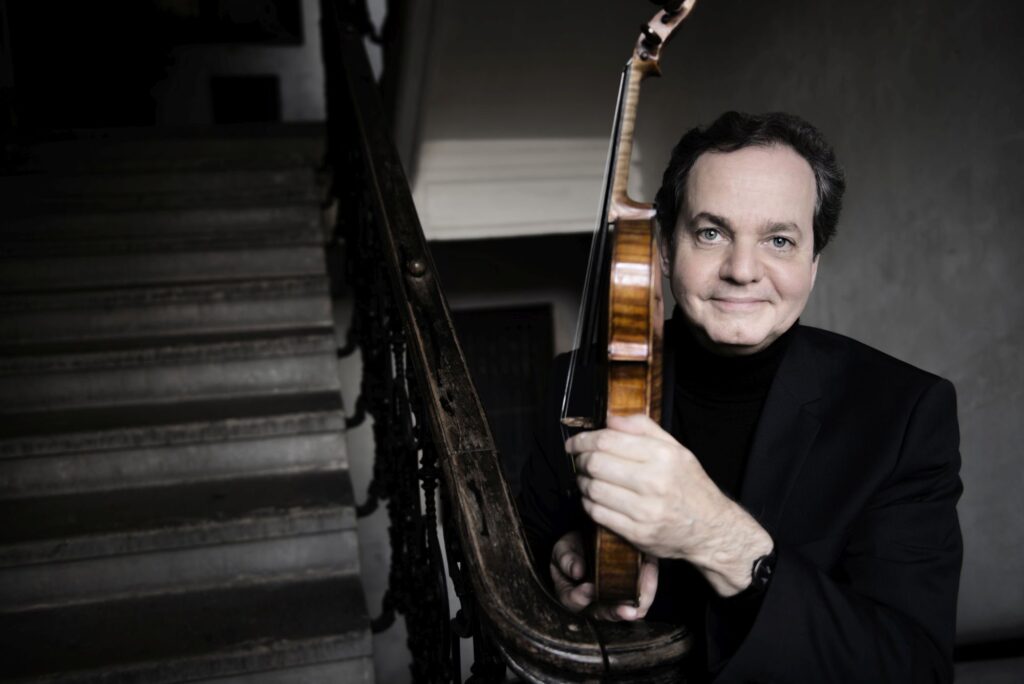
Filharmonie Brno will perform a special concert this Thursday and Friday, entitled “In Memory of an Angel”, bringing together two extraordinary musical worlds and two powerful personal testimonies in one evening, connecting an intimate tragedy with a magnificent image of heroism. The concert will feature the violin concerto of the same name by Alban Berg, with soloist Christian Altenburger, and the symphonic poem ‘The Life of a Hero’ by Richard Strauss.
“A large orchestra of 103 musicians will be on stage,” said Filharmonie Brno director Marie Kučerová. “This cast was a record for its time; Strauss prescribed eight horns, a large battery of drums and five trumpets playing partly behind the scenes in the composition.” pointed out. Kučerová added that the concert will be conducted by chief conductor Dennis Russell Davies.
Both Berg and Richard Strauss were among the most compelling composers of their time, said musicologist Jan Špaček, “But at the same time, they were also the most controversial. Both compositions are among their most successful and are built on musical quotations of a mostly personal nature,” he said.
Špaček stressed that the works are primarily connected by being closely tied to a specific person who was not only an inspiration, but also a direct creative impulse and the main reason for their creation. Berg composed the violin concerto ‘In Memory of an Angel’ to honor the memory of Manon Gropius, Alma Mahler’s daughter, who died at the age of seventeen.
“Of the three stars of the so-called Second Viennese School, Berg was the most lyrical and romantic, which is confirmed by this profound work,” said Filharmonie Brno dramaturg Vítězslav Mikeš.
While Berg composed the piece to honor the memory of the prematurely deceased Manon, Strauss celebrates heroism embodied in the person of the creative author in his work. Strauss admitted that he meant to refer to himself by this hero, which is also suggested by some musical quotations from his earlier works. The work captures episodes from the composer’s life, such as his wife Pauline, as well as ironic passages that, according to the author, embody his Viennese critics.
“The final movement is a true cathartic finale with Strauss’s typical magnificent slow fading into silence,” Špaček noted, adding that Claude Debussy described Strauss’s composition as a visual publication or a film cut.
The contrast between the two pieces is striking: while Berg’s concerto grows out of personal pain and moves towards a quiet reconciliation, Strauss’s ‘Die Zeit’ offers a magnificent, sometimes ironic fresco of human destiny. The common denominator of both compositions is a strong connection to specific human stories, which are transformed into a universal musical statement.
The concert takes place on Thursday and Friday from 7 pm at the Janáček Theatre, and is the penultimate philharmonic concert of this season. Tickets are available in advance on the Filharmonie Brno website, or at the venue before the concert begins.