

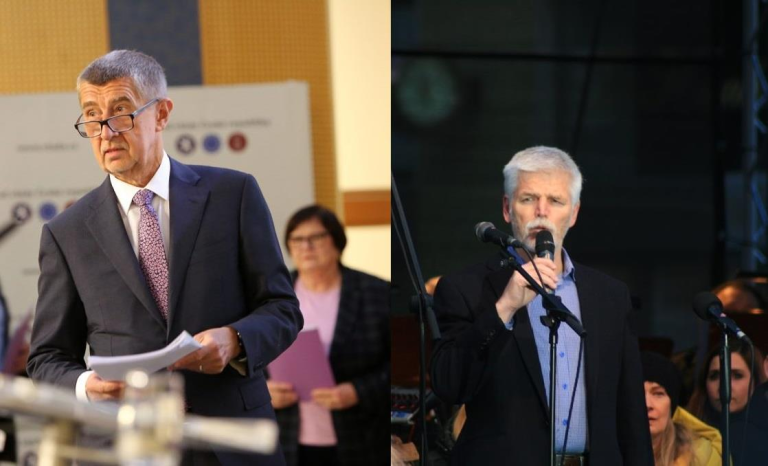

In a letter to President Petr Pavel on Tuesday, Prime Minister Andrej Babis (ANO) said he saw no reason for a meeting between the two men to discuss the North Atlantic Treaty Organisation (NATO) summit in Ankara, as his government has complied with all of the Constitutional Court’s orders.
Pavel told Denik.cz yesterday that he had offered Babis a face-to-face meeting several times, most recently on Tuesday. However, Babis declined because, from his perspective, everything had already been decided, the president said. Pavel also said that the cabinet had reduced the size of his delegation and specifically designated its members, which he described as “unprecedented behaviour”.
After several months of disputes, the government finally decided to exclude the president from the delegation to the July summit. However, Pavel was able to secure his participation thanks to a preliminary injunction issued by the Constitutional Court.
“Given that you unfortunately decided earlier to file a petition with the Constitutional Court and the Czech government subsequently complied with everything the Constitutional Court ordered in its preliminary injunction, I see no reason to hold a face-to-face meeting on this topic. I am open to meetings on other topics after my return from the summit in Ankara,” Babis wrote.
He added that, according to his information, the Ministry of Foreign Affairs was not preventing the president’s participation in the NATO summit, nor complicating it in any way. “On the contrary, support for the President of the Republic will be fully provided within the framework of the current composition of the unified Czech delegation, which, according to the government’s decision, will be led by the Prime Minister,” Babis said.
Babis said this year’s summit was crucial, given the current geopolitical situation. “At the same time, this is our government’s first NATO summit, which is why I consider it essential that we personally present our foreign and security policy in Ankara from the perspective of the government, which is constitutionally responsible for it,” he noted.
Babis added in a post on Facebook last night that a proposal to provide 70 billion euros annually to Ukraine would be discussed in Ankara. “One can assume that the president will take a different stance on this issue as well. After all, the president has repeatedly distanced himself from our policies, not only at home but also during foreign negotiations,” the prime minister wrote.
He reiterated that he regretted the entire situation surrounding the summit. “We would never have ended up in this situation if the president had not filed a constitutional petition, which escalated and complicated everything – in terms of protocol, economy and logistics,” he noted. He again claimed that no one was preventing the president from carrying out his duties.
Babis said he had asked Pavel again to reconsider his participation in the talks in Ankara next week, and “show generosity toward the Czech Republic, whose reputation is being damaged by this entire dispute and will likely continue to be damaged.”
The PM added that the cabinet was prepared to appoint Pavel to lead the delegation to the upcoming NATO summit in Tirana.
The president rejected the prime minister’s previous request. On Monday, he stated that attending the summit is his constitutional and official duty. Pavel also said on Monday that, in his view, the government’s stance on the head of state’s participation in the summit was at odds with the Constitutional Court’s preliminary injunction.
He said it would be customary for the president to have the opportunity to represent the Czech Republic as head of the national delegation to the NATO summit, both at the informal leaders’ dinner and at the subsequent meeting of the North Atlantic Council.
STAN leader Vit Rakusan and MP Ivan Bartos (Pirates) told journalists yesterday that Pavel should lead the delegation to the NATO summit in Ankara, and criticised the approach taken by Babis’s government. They said the government should not further escalate the dispute.
Rakusan said the president should travel to the summit as the head of the delegation, not as a hostage of the government. “Following the Constitutional Court’s preliminary injunction, Babis’s government had an opportunity to defuse the dispute with the president. Unfortunately, it decided instead to escalate it; this is a huge mistake and a sign of the cabinet’s political immaturity and irresponsibility. It is placing its own ego above the interests of statesmanship and above the benefit and good name of our country,” said Rakusan.
“As head of state and supreme commander of the armed forces, the president should naturally lead the Czech delegation. No one is really enjoying this embarrassing squabbling that the government is putting on anymore,” said Bartos.
According to Bartos, the president is trying to deal with the government fairly and constructively, but he is not receiving the same treatment from the government. “This is not only childish, but it also undermines the citizens’ trust in politics,” he added. In his view, the government should stop making a spectacle of itself and focus on what matters most: ensuring that the Czech Republic presents a united front at the summit and takes a clear stance toward its allies.
Foreign Minister Petr Macinka (Motorists) told reporters in the Chamber of Deputies yesterday that Pavel had not yet received a mandate for the upcoming summit in Ankara. According to Macinka, the mandate is part of a government resolution and will also be included in a more comprehensive document that will serve as a guide for all members of the delegation.
In the interview with Denik.cz, Pavel said the cabinet also reduced the size of the delegation and specifically designated its members, which Pavel considers unprecedented behaviour.
The president said the Presidential Office had intended to send a skeleton team of seven people to Ankara from the foreign affairs, communications and protocol departments. He denied ever having requested 35 places.
“The government decided to give us room for one plus four, three of whom are security guards,” said Pavel. Furthermore, he said, the government decided on the specific members of the entourage by name.
“Instead of giving us the opportunity for the president to decide for himself who to take along, they dictated it to us directly. I consider this unprecedented behaviour,” Pavel said.
Macinka told reporters that this was not the president’s delegation, but the prime minister’s.
“The Constitutional Court told us that we must re-accredit or include the president and his entourage in this delegation. And the delegation was structured so that there is a head of the delegation, then the members of the delegation, among whom the president of the republic was also included, and then the entourage,” he said.
Macinka said the president had originally requested three security guards. “In addition to what the Constitutional Court ordered us to do, one more staff member from the foreign affairs department of the Presidential Office was included in the delegation,” he added.
However, according to Macinka, the composition of the President’s entourage changed yesterday at the request of the Presidential Office.
“This morning, the Presidential Office contacted us to say that the President does not need three bodyguards, that one is sufficient, and asked if we could at least replace the bodyguards with some officials, which we were able to arrange,” he stated. Pavel chose the official photographer and press secretary to join the delegation, Macinka added.