

The recent Open House Brno event both reinforced – and totally upended – visitors’ traditional perspectives on architecture. It prompted startling revelations on what can be included in the definition of “architecture”.
The biggest surprise was how sometimes more vulnerable art outlasts bricks and mortar. Sometimes it is these ephemeral art forms – paper plans, drawings, photographs and music – which reconstruct the gaps in missing architecture and archaeological sites.
And what about us, the viewers? Is it possible that we humans, watching and witnessing, can influence the architecture in some way?
That somehow if we admire it, empathise with it, love it and long for something lost, we leave something of ourselves behind? Some new foundational residue? Do we become additional invisible buttresses and bridges?
Kleinův Palác: A bricks & mortar monument to family and business
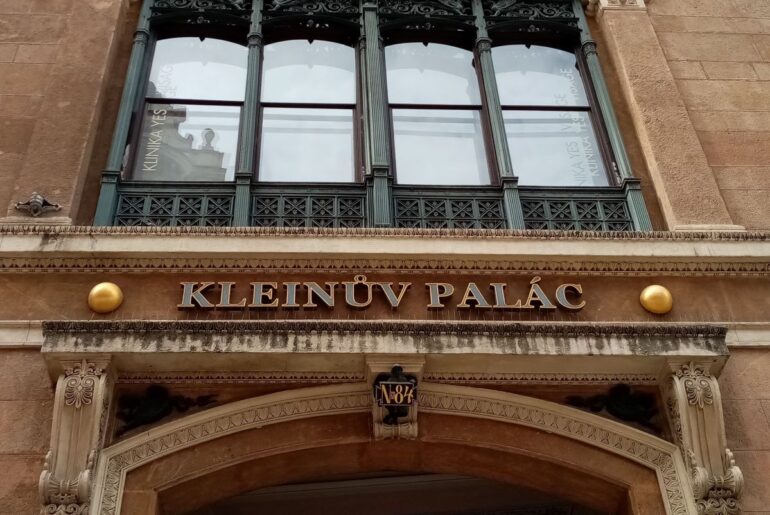
The Kleinův Palác on Náměstí Svobody is an amazing testimony to great structure, enduring materials and fine finishes. It was built as a two-apartment townhouse by Franz Klein. He and his brothers owned a cast-iron works company, specialising in producing railway tracks.
Franz Klein built the Palac from 1847 to 1848 as a family home. He shared it with his sister Maria Kleinová and her family. The iconic building simultaneously served as a powerful advertisement for the Klein company’s products.
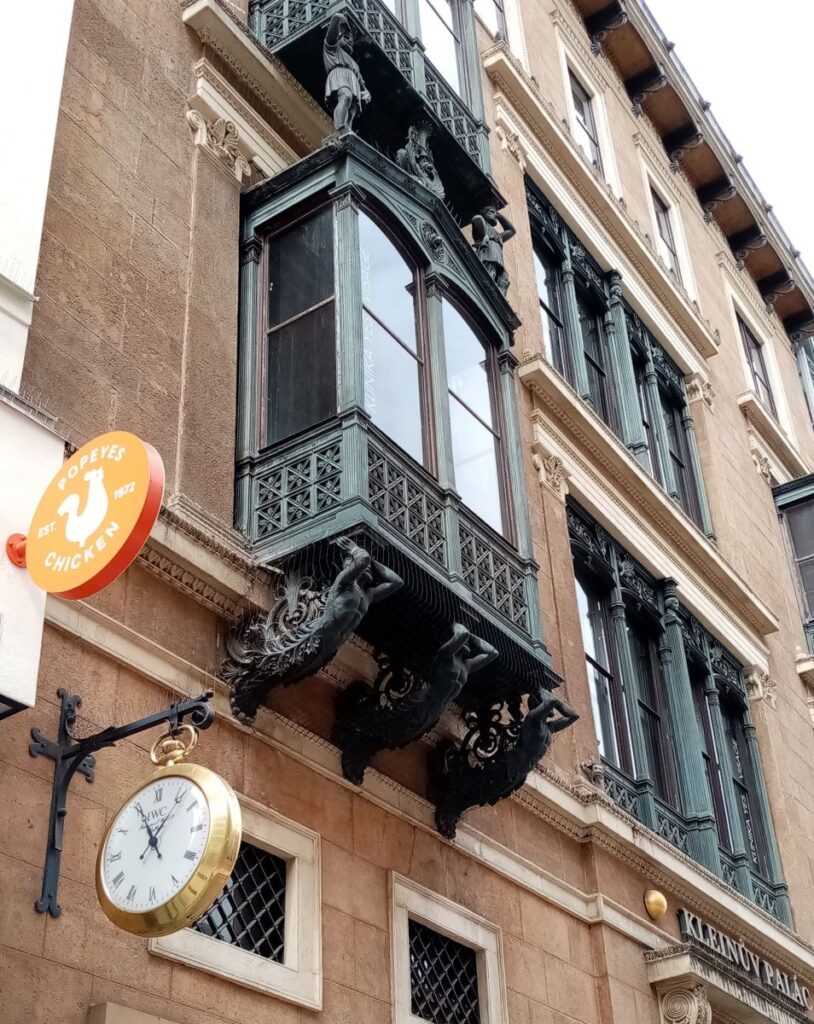
And wow – what an advert! Their cast-iron balcony supports are still structurally intact, elegant and beautiful, 178 years later. The support figures of the balconies are mythical and classical. The detail on the human figures and animals is meticulous and charming, right down to the sharp fangs on the winged lions.
The human figures in classic Greek tunics can be identified as ironworkers by the sledgehammers they carry in one hand. They casually reach up to adjust their headgear/crowns with their free hands, and this cleverly connects them as additional supports for the balcony above. Tiny lion heads also embellish the sides of the balconies, and serve as functional gargoyles on the little balcony roof guttering.
A place of architectural freedom and innovation
Our tour guide, Don Sparling, shared many historic and familial details. He helped us to hear the sounds of the house again – the business negotiations between the Kleins and their clients, the social occasions, and the cousins laughing and playing together.
Sparling explained that while the owner insisted on the use of cast-iron in the construction, he otherwise gave complete artistic freedom to the two Austrian architects, Ludwig Förster and his assistant Theophil Hansen. The architects introduced several innovations, and then having tested them at Kleinův Palác, confidently used them in many prestigious homes in Austria.
These innovations included installing a rain-water tank in the loft, flushing toilets, and automatic drinkers for the horses in the basement. How forward-thinking, back in the 19th century! The architects also introduced a special ventilation system for removing odours, both from the toilets and the stables.
Another innovation was the installation of a special non-slip ramp on the right side of the entrance passage, so that the horses could descend safely to their underground stables. The mezzanine level above the ground floor was partly used to store the horse feed.
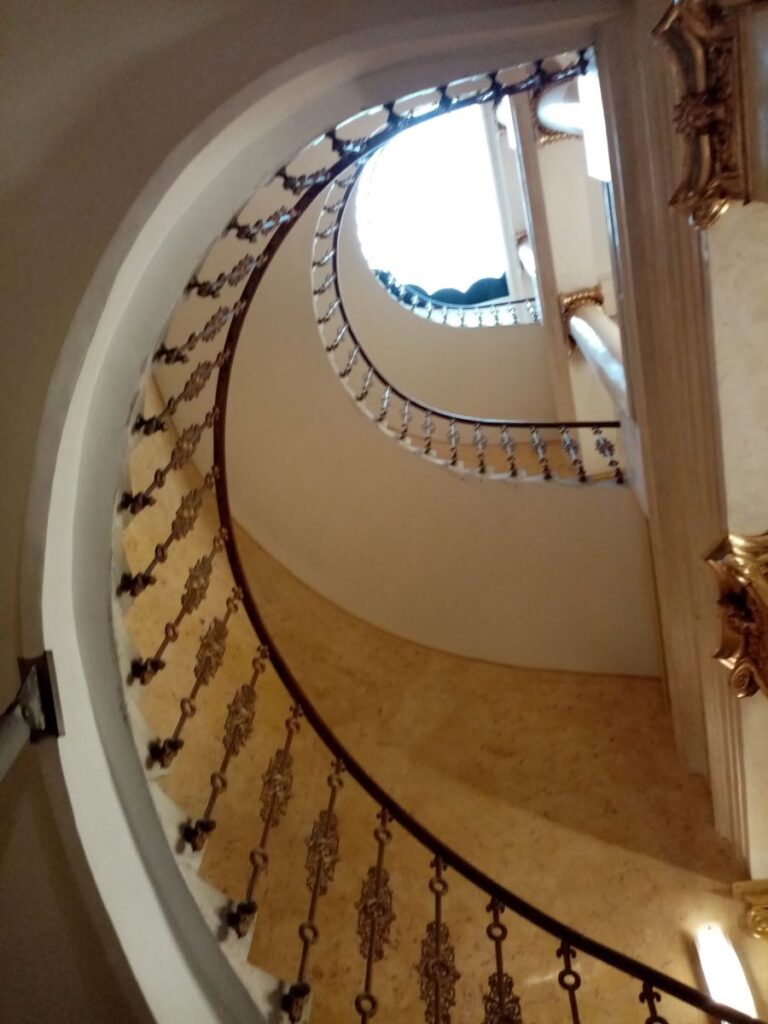
The family used an impressive horseshoe staircase to get up and down the building, while the servants used a less ornate staircase at the back of the house.
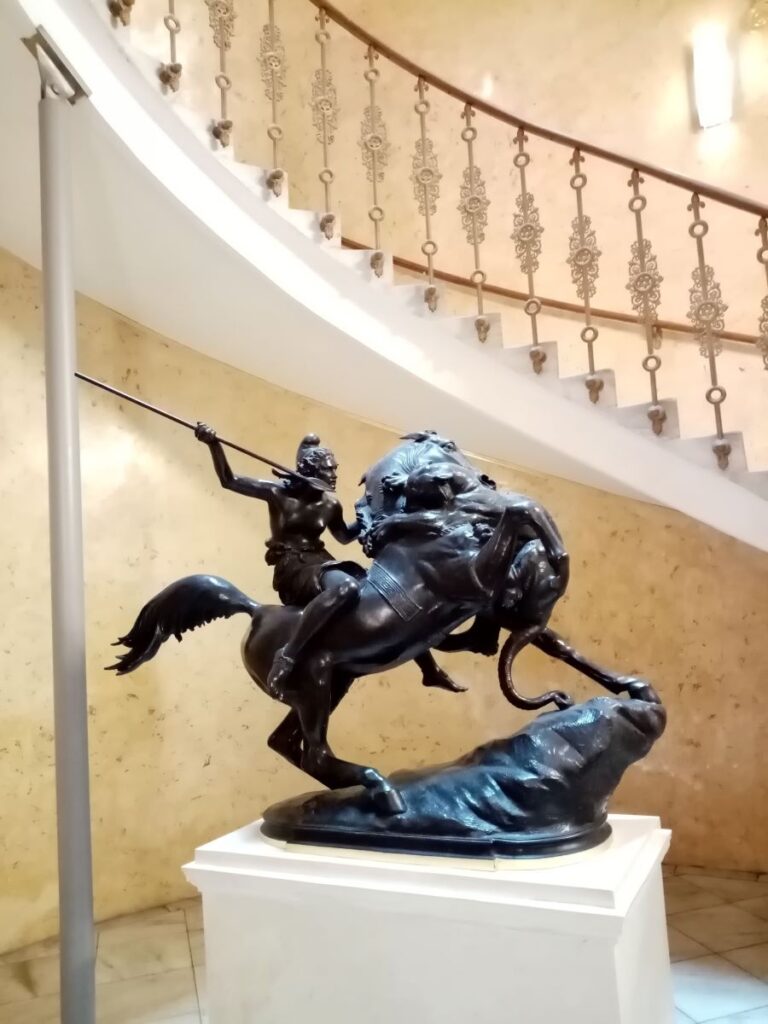
At the base of the horseshoe staircase, Klein commissioned a smaller scale copy of a fashionable equestrian statue by a German sculptor, August Kiss, called Amazon Hunting a Panther. It was an impressive statement piece, both then and now.
We were unfortunately unable to visit the first floor, where more of the original ceiling decoration and other elements survive, as it is a plastic surgeon’s business premises.
We were, however, able to visit the second floor, and see the elegant rooms with the replica huge wooden doors and decorative wooden inlaid floors, and the bay windows, originally decorated with fine marble finishes. This floor is now home to the Jiří Mahen Library’s 3-D Maker Space.
Here we were also able to examine copies of the original comprehensive paper plans of the building. These plans filled in the gaps, and enabled faithful restoration – right down to the shape of the door handles, and window openers.
The Klein family
The plans also reveal that Franz Klein shrewdly incorporated two small shops on the ground level, which he rented out, and hence always had as a source of ongoing passive income.
His family’s descendants lived in the building until 1904, when they sold it to a manufacturer of musical instruments, Karel Buchta. He lived and worked there for 28 years, and his descendants continued to live there for another 13 years, until the end of World War II in 1945. Despite being Czechoslovakian citizens, because of their German descent they were expelled, and their property was confiscated by the city.
The building became state property, and suffered substantial damage over the years until a bank, Crédit Lyonnais Bank, leased it in 1994, and undertook necessary repairs in exchange for a 90-year lease.
_______________
The site of the Great Synagogue: A monument of memories inspiring art and music
Architecture of a very different, and deeply poignant kind, is evident on the site of the burnt down and demolished Great Synagogue, at the corner of Spálená and Přízova. This is two streets behind the Vlhká tram stop, in what was an industrial area at the time the synagogue was built.
A concert of two unusual and wonderfully appropriate musical performances by the Brno Contemporary Orchestra was held on site in the early evening.
Kol Nidre for a String Quartet by John Zorn
The first was a performance of the Kol Nidre for a String Quartet by Jewish American composer John Zorn, who is famous for combining different musical genres, fusing hard rock, classical music, jazz, traditional Jewish Klezmer music and other global musical elements.
In the Kol Nidre, however, instead of Zorn’s characteristic layering and concatenation of sounds, there is a yearning fugue which echoes and then subsides, and then surfaces again. It is inspired by the traditional Jewish prayer – Kol Nidre – said before the start of Yom Kippur, the Day of Atonement. This is an ancient Jewish prayer, which has some echoes of traditional Ashkenazi (Eastern European) prayer chanting rhythms.
The function of the prayer was to give the singer a fresh start, to release them from their self-imposed vows, including those they were unable to fulfil.
The language of the original Kol Nidre was Aramaic – an ancient language shared by Jewish and some Arabic peoples, including the Lebanese and the Syrians.
Jewish Prayer by Miloslav Kabeláč
The second performance was the Jewish Prayer by the Czech composer Miloslav Kabeláč. This work was dedicated to his Jewish wife, the pianist Berta Rixová, on their 40th wedding anniversary.
During the Nazi regime Kabeláč was fired from Czech Radio, for refusing to divorce his wife. Under the subsequent communist rule, his compositions were mostly rejected as they did not fit the state’s musical propaganda requirements. His exposure to the global musical world was restricted, and his international reputation was suppressed. Despite all of this, Kabeláč continued to compose music, and he also managed to keep his family safe through those dangerous times.
Kabeláč’s composition is based on another Jewish prayer in Aramaic, the Kaddish. This is a prayer recited by the cantor in the synagogue, or by a relative mourning the death of a loved one.
This prayer clearly resonated with Kabeláč towards the end of his life, as he instructed that the Jewish Prayer should be identified numerically as his last major work, or opus.
It was composed for a bass-baritone, male solo and choral recitation.
Kabeláč refers to the format of the Kaddish prayer, as the bass-baritone fulfils the role of the chazzan or cantor, beginning the prayer, which is then continued with other assenting choral voices.
The Kaddish prayer honours God, as eternal and blessed for ever, and also asks for God’s blessing and mercy.
A historically resonant concert
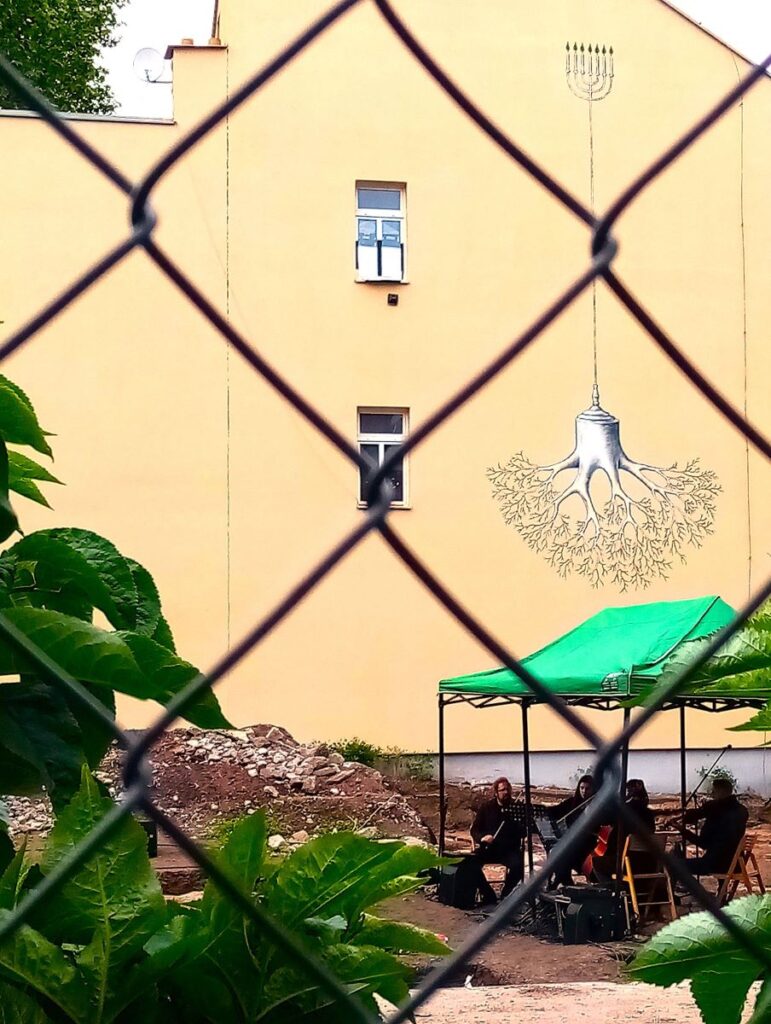
The musicians stood or sat under a light-weight green roofed gazebo, in the middle of the large flattened, excavated site. An insubstantial structure, the gazebo created a moving contrast to photos of the monumental architecture of the Great Synagogue, as shown in banners displayed along the site’s enclosing wire fence.
Large black speakers were arranged on the ground around the site, like the sound equivalents of solid pillars which once stood in the original building.
While the music played, a young man in a vest and trousers came out onto the balcony of a neighbouring building. He leaned over and listened intently. When the music ended, he went back inside.
People from another building formed a small group on the pavement. They were intrigued, and commented quietly among themselves. They too watched, and then left quietly after the music.
During the concert, some people listened while standing inside the site. Others stood outside, on the pavement behind the mesh fence. Some rocked gently back and forth to the cadence of the music and the voices.
Many plastic banners cable-tied to the fence illustrated the history of this synagogue. They showed detailed architectural plans, drawings and photos.
The banners also showed photos of many other synagogues around the Czech Republic being burnt and destroyed. The images are horrific. Particularly shocking are the images showing burning buildings, and smoke billowing from roofs and cupolas. It is the antithesis of incense, and a chilling presage.
The geography of loss
One poster described how this site has remained empty since the destruction in 1939. This does not surprise. Without equitable compensation, nothing other than another synagogue or Jewish monument could possibly be successfully built here. Just as equally, without restitution, nothing can be built on other destroyed sacred sites – churches or mosques.
This site by its very emptiness emphasises that a spiritual property can only truly belong to the community who saved up for it, negotiated to buy it, paid for it, struggled to maintain it, and worshipped in it reverently.
When we mourn the loss of a significant piece of architecture, it highlights how everyone is impoverished. The loss will be most deeply suffered by the immediate community.
But the surrounding community, deprived of this spiritual and creative structure, is also deprived of all the ways it could potentially have impacted positively on their own lives.
There are still some vacant, undeveloped properties around this area. How differently might it have evolved with a vibrant synagogue community in its midst?
Hopes of Restitution
There is a mural on the wall of an adjoining building. It is a painting of the sturdy roots of a tree stump, which forms the surface supporting the base of a very tall Menorah – a 7-branch candelabrum. This is a traditional, ancient emblem of Judaism. Instructions for its design as given to Moses are described in detail in the Torah, which also constitutes the first five books of the Bible.
The Menorah identifies this site unequivocally as a Jewish temple. The candles are lit. It is a sign of hope, and the possibility of restitution.
The green tendrils of the creeper on the fence stretch upwards, and from some angles appear to be trying to touch the roots of the painted tree stump. The plant life – both painted and biological – seem to want to make some connection.
This organic life prompts thoughts of new life, restitution and restoration. Not just the recreation of the actual structure, but also what the structure and the encompassing history around it has inspired.
We celebrate the multiform expressions of art that become the new edifices. From prayers, chants and songs, new art and music has been born.
The site might have been levelled, but not everything is destroyed.
We celebrate the composers of the music, the performers, the mural artist, and also – the audience. Bless all these different builders, who partake in connectivity, creation and preservation.
Musical bridges
Both the concert composers – John Zorn and Miloslav Kabeláč – understood the value and richness of diversity, and the delight in building creative, inclusive and echoing musical bridges and buttresses.
Zorn said “All the various styles are organically connected to one another. I’m an additive person—the entire storehouse of my knowledge informs everything I do. People are so obsessed with the surface that they can’t see the connections, but they are there.”
Architecture – in its many forms – teaches that when we preserve, we also keep alive what we have in common, our connectivity and history. Listening to someone else’s sacred songs, respecting them, we hear the echoes of our own.
There is one last Aramaic song, the Kadishat Aloho. Like the Kaddish, it has a similar progression. God is honoured and praised, and his mercy is implored.
Kadishat Aloho, Kadishat Hayeltono, Kadishat Lomoyouto. ItraHam ‘alain.
Holy are you, O God; Holy are you, O Strong One; Holy are you, O Immortal One. Have mercy on us.
This prayer, however, comes from the Lebanese, Catholic Maronite rite.
Shalom. Salaam.