

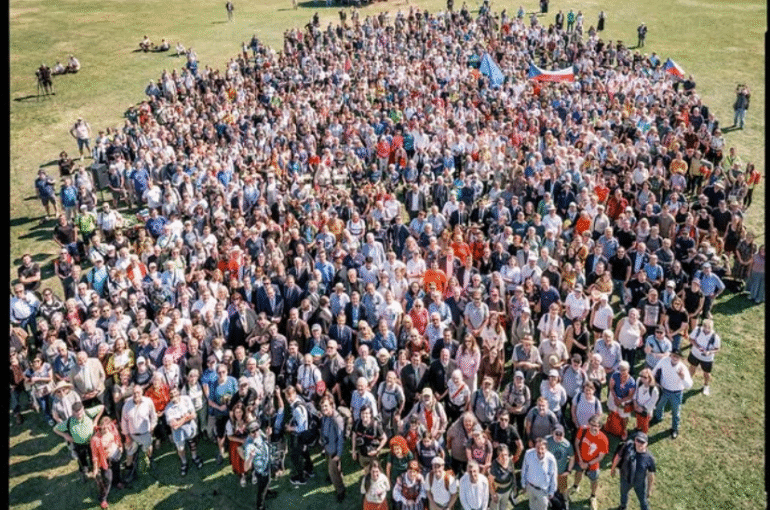

Around 2,000 people arrived in Pohorelice, South Moravia, yesterday morning, to take part in the March of Reconciliation to Brno. This year’s commemoration of the “death march” of Germans expelled from Brno in late May 1945 is exceptional because the Sudeten German Congress is taking place in Brno at the same time, being held in the Czech Republic for the first time in its 76-year history.
Most of those who have come to Brno are descendants of the Sudeten Germans who were expelled after the war. From the outset, the event has been met with protests highlighting the victims of the Nazis and warning against questioning the postwar order.
The March of Reconciliation took place for the first time in 2016, as part of the Meeting Brno festival, a year after Brno’s leadership officially apologised for the violent expulsion of the German population.
German politicians spoke at the event in Pohorelice, including Federal Interior Minister Alexander Dobrindt (CSU), Bavarian Family, Labour, and Social Affairs Minister Ulrike Scharf (CSU), and Bernd Posselt, chair of the Sudeten German Association (SdL). The participants were welcomed by Pohorelice mayor Miroslav Novak (ODS). Other national, regional, and local politicians were among the attendees.
Around 30 protesters against the presence of the Sudeten Germans also gathered in Pohorelice.
“Thanks to their resilience, our friends from Meeting Brno have turned expulsion into reconciliation,” said Dobrindt. “That takes courage, a willingness to listen, understand, and trust. And among us there are many bridge-builders, and we are building them where the trenches were very deep.” He expressed his appreciation that so many young people had gathered in Pohorelice, who want to live together in a peaceful Europe.
“The fact that the Sudeten German Congress can be held in Brno is a historic event and a source of joy for the younger generation,” said Dobrindt. “I am grateful that we are neighbours and friends, which serves as a bulwark against new nationalism. Something positive can emerge from the darkest chapters of our history when people find the courage to understand one another.”
After World War II, approximately three million Germans were expelled from Czechoslovakia. According to a Czech-German commission of historians, between 15,000 and 30,000 people lost their lives during the removal. During the preceding six years of Nazi rule, approximately 320,000 to 350,000 inhabitants of the former Czechoslovakia perished.
On 30-31 May 1945, three weeks after the end of World War II, approximately 19,500 Germans were forced to leave Brno in a single night. Women, children, and the elderly walked from what is now Mendlovo namesti to Pohorelice and on to the Austrian border. The expulsion was marked by acts of violence, and an estimated 1,700 Germans died in the process. Sudeten German historians cite a higher number of casualties.
The march followed the same route as the Germans did during the Brno Death March in 1945, but in the opposite direction. Mayors of the municipalities on the route issued a joint statement in support of reconciliation. “It is time for us to put aside what divides us once and for all and find the courage to accept our past,” read the statement. “The Sudeten Germans have already done so. Now it is our turn. As mayors of the region through which this march passed, we would like to express our conviction that mutual forgiveness and understanding is the only right path to building a shared future. We reject all attempts to revive hatred, which are merely a desperate effort to gain a few extra votes. It is a dangerous game with fire, one that has burned us many times in the past.”
The march arrived at Brno’s Mendlovo namesti shortly before 6pm, an hour later than planned, where they lit candles in memory of the victims of the death march.
They were met in the square by 200-300 opponents of the Sudeten German Congress, who had gathered to await their arrival. Several small groups of protesters were waiting along the final kilometre of the march route, among them people who had already protested against the Sudeten German Days on Thursday and Friday, or who had spoken out against the event at a Brno City Council meeting.
Some of the protesters carried Czech flags and chanted to express their opposition to the event, with slogans including: “The Czech Republic comes first”, “Stop the Sudeten German Congress”, “Shame, shame”, and “Go back.” They also carried banners with slogans such as: “Only if our borderlands remain Czech will our entire homeland remain Czech.”
The Sudeten German Congress began on Thursday with a memorial ceremony at the Brno train station, from where transports of Jews departed for concentration camps. On Friday, a neighbourhood festival was held at Moravske namesti in Brno, and in the evening, the ethnic association presented cultural awards. The main programme is taking place at the Brno Exhibition Centre, where Sudeten German culture, organisations, and associations are being showcased over the weekend.
The congress is continuing today at the Brno exhibition centre, with Bavarian Prime Minister Markus Soder (CSU) and Sudeten German leader Bernd Posselt addressing the delegates.
Speaking at the opening of the main assembly this morning, Steffen Hortler, deputy chair of the Sudeten German Association (SdL) and chair of its Bavarian branch, said the holding of the Sudeten congress in the Czech Republic has opened a new chapter in the history of relations between Czechs and Sudeten Germans.
South Moravia governor Jan Grolich (KDU-CSL) welcomed the congress attendees to Brno, addressing them as fellow countrymen. “You are welcome here. You are our friends,” he said.
In his speech, Grolich spoke about how Czechs and Germans have come a long way since World War II. “We do not want to rewrite history. We want to demonstrate the true power of truth and love, which leads to reconciliation, friendship, and freedom,” he said.
The Sudeten German Congress in Brno will continue until tomorrow. The Sudeten Germans were invited to the Moravian capital by the Meeting Brno initiative. The congress is organised by the SdL, which represents the interests of Germans transferred from Czechoslovakia after World War II and their descendants.