


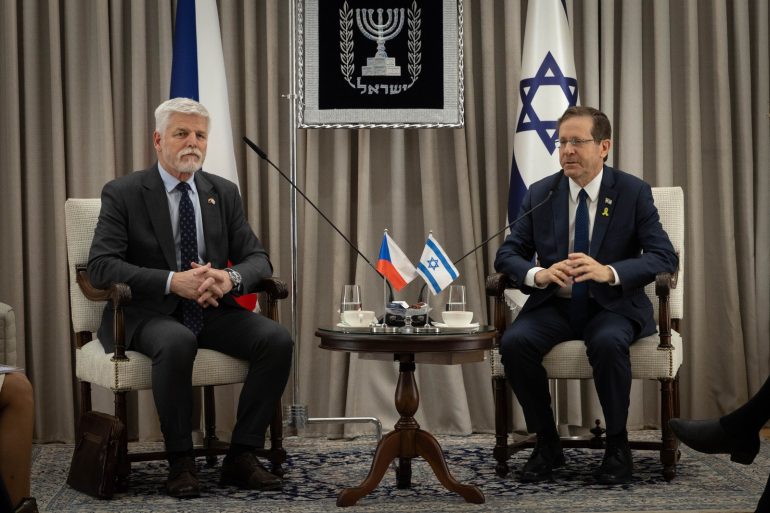

Public support for Israel in the Czech Republic has not changed significantly after more than two years of war in Gaza, according to a survey by the Herzl Center for Israel Studies. One-third of those surveyed approve of Israel’s military actions in Gaza, while about 40% disapprove
The Herzl Center for Israel Studies, at the Faculty of Social Sciences of Charles University in Prague, has surveyed the views of Czechs on the conflict in the Middle East between 2023 and 2025.
The study found that respondents did not have a clear-cut position on a number of questions. One example is the ambivalent stance on who holds historical responsibility for the Israeli-Palestinian conflict. The largest group (41%) could not say who had played a greater historical role in the conflict. Another 27% believed that both nations bore roughly equal responsibility. Compared to 2023 and 2024, the distribution of responses remained relatively similar.
Although one-third of those surveyed approve of Israeli military actions against its neighbours, opinions vary on its scope. One-quarter of respondents said Israel’s actions were appropriate given the circumstances, while the same percentage considered the response excessive.
“Czechs generally remain rather sympathetic toward Israel, but it is evident that the younger generation, in particular, is significantly more critical of how Israel conducted the war in Gaza,” said Irena Kalhousova, an expert on Czech-Israeli relations from the faculty. She said that, compared to surveys from other European Union countries, the Czech Republic is a relatively unique case of a country where pro-Israeli attitudes still predominate.
The survey data also show that the number of Czechs without a clear opinion on the current conflict in the region is declining. A segment of the Czech public is gradually clarifying its stance, mostly towards greater sympathy for Israel. On many questions, however, the proportion of “don’t know” responses remains high.
Younger people and women tend to be more critical of Israel, while the older generation and men are more likely to express support for Israel.
The Czech public’s attitudes toward Israel vary according to party preferences. Voters of centre-right parties, particularly of the Spolu coalition, have long held the most positive views of Israel and Czech-Israeli relations. Conversely, among voters for parties such as Freedom and Direct Democracy (SPD) or Stacilo!, a higher degree of critical or reserved attitudes are evident. Among ANO voters, indecision tends to prevail, with a higher proportion of respondents not having a clear opinion.

The Herzl Center for Israel Studies organised the survey in cooperation with polling agencies Ipsos (2022-2024) and STEM (2025). The survey was carried out in the country on 1,000 people aged over 18.
The most recent outbreak of violence in the region began on 7 October 2023, with an attack on Israel by the Palestinian militant group Hamas. Israel’s massive military response, which is still ongoing and has expanded to include attacks on many other countries in the region, has been criticised by many international agencies and NGOs as disproportionate and excessive, and possibly constituting genocide. The Israeli government routinely defends all of its military actions as “self-defence”, and characterises any criticism as driven by anti-semitism.
According to Kalhousova, the conflict between Israel and Hamas has significantly influenced international politics, public debate and the media agenda in many countries.