
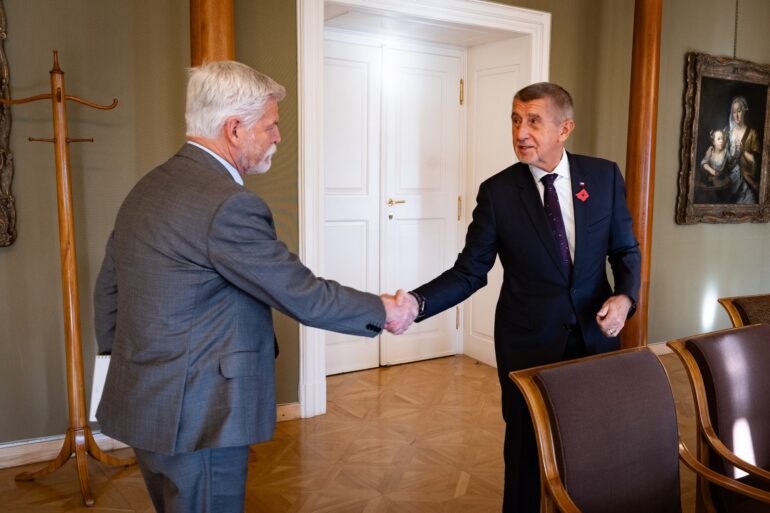

The public conflict between Prime Minister Andrej Babis (ANO) and President Petr Pavel continued to escalate yesterday. In an interview with Denik.cz, Babis accused Pavel of interpreting the Czech Constitution however he wants, and said that the president is harming the Czech Republic’s international reputation through his actions and his insistence on attending the upcoming NATO summit in Ankara. In response, Pavel said Babis should either provide concrete evidence of his allegations, or retract his statements.
Babis told Denik.cz that Pavel had invented an “unconstitutional condition” when he demanded that Babis should resolve his conflict of interest prior to his appointment as prime minister. He also criticised the president for refusing to appoint Motorist MP Filip Turek as a minister, and for his handling of the NATO summit.
According to Babis, Pavel is behaving like the leader of the opposition, and is already campaigning for his re-election as president. “Not a day goes by without him taking a swipe at us in some way,” he said.
Babis said that if Pavel flies to Ankara to the NATO summit, he will harm the Czech Republic abroad. Although presidents have historically attended these events, Babis argued that this year’s NATO summit will focus on economic matters and finances, issues over which the head of state has no influence and which are the sole competence of the government.
“We are trying to convince the president that this summit will be different from the previous ones,” said Babis. “It is important for the new government to be present there to advocate the fulfilling of commitments to NATO and to challenge [Petr] Fiala’s [previous] government, which never met those commitments, while also defending the Czech Republic’s position. We hoped the president would understand this.”
Babis added that he had publicly declared that he would approve the president’s attendance at the upcoming summit in Tirana, Albania. He noted that the government had also approved the president’s representation of the Czech Republic at the United Nations General Assembly in New York this autumn, though he added that any speech given there by Pavel would be provided by the government.
In his response to Babis’s remarks, Pavel asked whether he was “harming the country by striving, over the long term, to ensure the safety of Czech citizens and fulfill our alliance commitments? Or by wanting our country to be a trustworthy ally and partner? Or perhaps by striving for the actual combat capability and readiness of our army instead of mere accounting exercises?”
After several months of dispute, the government initially excluded the president from the NATO summit delegation, prompting Pavel to file a petition with the Constitutional Court. In a preliminary injunction, the court ordered the government to ensure the head of state’s participation.
However, the Czech delegation will be led by the prime minister instead of the president. On Wednesday, Pavel stated that the president should be the head of the delegation, according to all rules of protocol.
In 2014, NATO members pledged to spend 2% of gross domestic product (GDP) on defence by 2025. However, the Czech Republic failed to meet this commitment last year, and will likely fail to do so this year as well.
Babis noted that the declaration for this year’s summit included a point, clearly stating that the allies would support Ukraine with 70 billion euros a year. “The major countries that met in Berlin had already agreed on this,” he said. These countries included the UK, France, Germany, Poland and Italy.
“Since we will not meet the 2% target, we cannot give money to Ukraine; we need it for our own military to fulfil our commitments,” Babis told Denik.cz.
Deputy Prime Minister and Industry and Trade Minister Karel Havlicek (ANO) told reporters after a meeting on support for companies operating in Ukraine that the government had stated its position many times. “We’re not turning this into a battlefield, and we’re certainly not trying to show who has the better weapons,” he said.
Havlicek said he believed the Presidential Office and the Government Office were currently working out the details to ensure that the Czech Republic’s participation in the NATO summit is dignified. “The government is going