

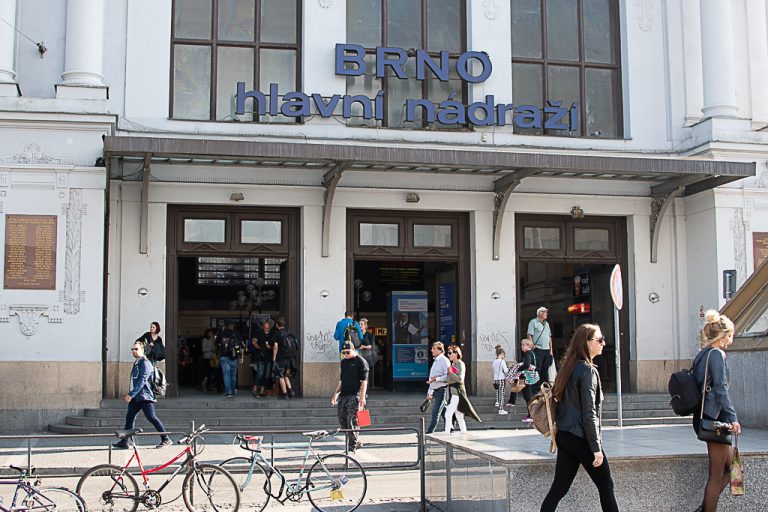

On Wednesday, 24 June, the City of Brno assembled representatives of social services, healthcare providers and the police to address the social problems associated with homelessness around Brno’s main train station. The meeting evaluated the measures taken in recent months, with the aim of improving the situation in public spaces, increasing the perception of safety among the public, and finding a comprehensive solution for the homeless people who often congregate in this area. Brno is one of only a few Czech cities to discuss the issue on such a broad platform.
“In recent weeks, the city has been approaching the issue of homeless people who gather around the main train station more closely than before,” said Brno Mayor Markéta Vaňková. “This is a complex situation, the solution to which is being worked on by the Department of Social Care and other organizations dedicated to social work, members of the city and state police, and healthcare professionals.”
She said the situation in front of the station had already improved significantly, but that further cooperation was required to address persistent issues.
The area in front of the main station has long been a problematic location in Brno. Homeless people often congregate there, and problems with drug addiction, especially alcohol, are often apparent. The sentiment map project revealed that the public has a strong negative perception of the area, and many people do not feel safe.
Although social workers operate in the area around the station, they often encounter reluctance among the homeless community to accept help. Restrictive measures from law enforcement agencies only have a limited effect, as punitive fines for antisocial behaviour are impractical and often counter-productive.
Since April, more municipal police patrols have been deployed at the main station, and are monitoring the area around the clock. At the same time, social work in the field has also increased, both by municipal staff and non-profit organizations. The situation at the main station has calmed, and the area has been improved aesthetically, thanks in part to increased cleaning efforts by the Brno-střed municipal district. Monitoring suggests that homeless people are beginning to move to other parts of the city center.
“We must realize that the issue of homeless people, whether at the main station or anywhere else, must be addressed comprehensively and in the long term,” said Robert Kerndl, Deputy Mayor for Social Care. “At the same time, experience from large cities around the world shows us that we will never achieve a complete solution. Of course, that does not mean that help and quality social services are not a priority for us.”
Last week’s discussion platform brought suggestions from various fields that deal with homeless people. Police agencies cited the results of their increased activity, though in practice this means moving homeless people elsewhere, and the long-term enforcement of sanctions for misdemeanors is ineffective.
However, statistics show that the main station is not primarily dangerous in terms of crime, but the main problem is rather its aesthetic and functional value. This factor is also being taken into account by the city district authorities, who have stepped up the intensity of cleaning efforts. In the future, the city plans to place flower beds and other street furniture that will beautify the area, but is also intended to discourage rough sleeping.
Experts from non-profit organizations and the Department of Social Welfare argued that it is necessary to address alcoholism and other addiction issues, and how these phenomena interact with homelessness. The contact center for people with addiction on Vlhká, run by the Podané Ruce organisation, works with hundreds of people a year, but has limited capacity. There is a need for more low-threshold facilities that offer comprehensive assistance for homeless people, including those who do not wish to accept further help, but are simply looking for a place to exist. Such centres should ideally also be accessible at night.

“We repeatedly encounter the problem that these and similar services dedicated to homeless people with addictive behavior, are really only found in Brno in the whole South Moravian region,” said Vaňková. “People with these problems travel here and overwhelm social services. In the long term, it is necessary for this type of assistance to be developed in other cities. The City of Brno cannot provide social services to the entire region.”
Emergency medical responders are introducing a new approach for homeless people who do not agree to being taken to hospital or treated. Thanks to cooperation with non-profit organizations, they are now providing information about services that provide showers, food, and basic healthcare. These people are therefore left where they are after a basic assessment of their condition, and can turn to appropriate social services and contacts themselves.
The only anti-alcohol detention centre in the region operates from the psychiatric hospital in Cernovice, where the capacity of 13 beds has long been inadequate. Recently, the facility has had to increase the number of staff and rearrange the premises, due to increasing aggression among clients. Statistics show that the number of people from the wider region is double the number of clients from Brno; last year, the detention center treated 2,396 clients, of which just 1,099 were residents of Brno.
At last week’s meeting, participants agreed on the need to continue coordinating their institutions’ work and developing additional capacity in the social and health services provided. The City of Brno intends to continue these interdisciplinary meetings in the future.