


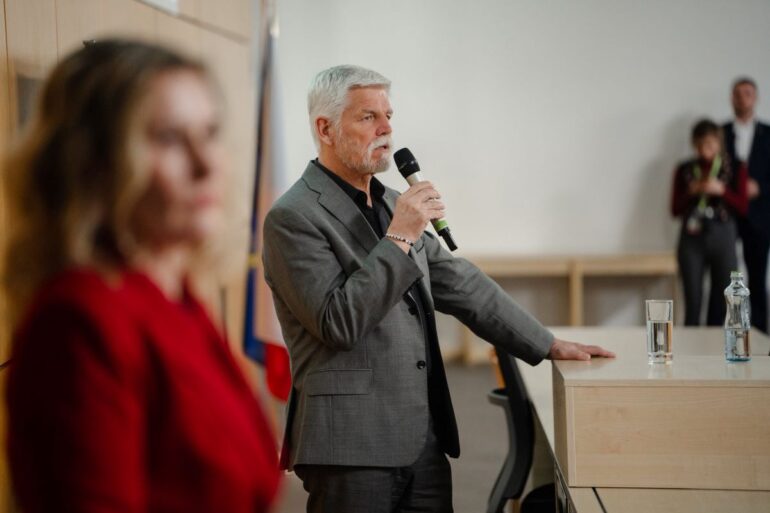

President Petr Pavel has asked the Constitutional Court for a preliminary injunction that would clear the way for him to attend the NATO summit in Ankara even before a final decision is reached on the competence lawsuit he filed on Monday, according to his motion, which the court published on its website.
According to the docket, Pavel Samal has been assigned as the judge-rapporteur in the case, but the decision will be made by the court’s plenary session, ie. the full bench of judges.
On Monday, the government decided to exclude Pavel from the Czech delegation to the NATO summit. That same evening, the president appealed to the Constitutional Court, which began considering the petition at a closed-door plenary session today.
Prime Minister Andrej Babis (ANO) today called the president’s behaviour “ridiculous”. He said in an interview with Blesk.cz that Pavel is campaigning to be re-elected, but this will not improve relations.
The summit in Ankara is taking place on 7-8 July. The court would therefore have to rule on the competence complaint unusually quickly for the ruling to have a direct impact. However, the court could theoretically issue a preliminary injunction even before the summit. Specifically, Pavel is requesting that the court order the government and the Ministry of Foreign Affairs to immediately notify the summit organisers that the President will be part of the delegation.
Pavel is also demanding that the government and the Foreign Ministry ensure that he and his entourage receive accreditation and that they neither prevent nor in any way complicate his participation in the summit.
If the court were to grant the request for a preliminary injunction, it would address the competence lawsuit only afterward.
In the lawsuit itself, Pavel proposes that the court rule that the state authority competent to decide on the President’s participation in NATO summits is the President himself. He also proposes that the court annul Monday’s government resolution on the composition of the Czech delegation to Ankara. In addition, he expects the government and the ministry to cooperate in securing accreditations and air transportation.
“Furthermore, given the specific nature of this dispute over competences, I propose to expressly prohibit the government, the Foreign Minister and the Foreign Ministry from obstructing or hindering the President of the Republic in the exercise of this authority,” Pavel’s motion states.
Pavel wants the court to rule on a priority basis, with the highest priority, and following an oral hearing, which is faster than an exchange of written statements. In the proposal, he summarised the government’s communication and actions to date. He described the postponement by the cabinet of its decision on the delegation’s composition from 8 June to 22 June as obstructionist behaviour, and said the government had acted in bad faith.
The Constitutional Court law does not explicitly provide for the possibility of a preliminary injunction in competence disputes. However, in his complaint, the president makes a comprehensive effort to demonstrate that this possibility exists and that the Civil Procedure Code may be applied by way of analogy.
On Monday, the government announced that Babis would lead the mission to Ankara, accompanied by Defence Minister Jaromir Zuna (SPD) and Foreign Minister Petr Macinka (Motorists). Pavel had previously indicated that, in such a case, he would appeal to the Constitutional Court, since representing the state abroad is his constitutional authority and because presidents attended NATO summits in the past.

Pavel considers this to be a “long-standing, established, and consistent practice,” he wrote in his petition.
Babis, for his part, stated that under the previous government, President Pavel had assumed the role of leader in foreign policy, but the current cabinet has sufficient authority and intends to actively lead foreign policy on its own.
In the interview on Blesk.cz, Babis characterised Pavel’s actions as part of his re-election campaign. “People are talking about him, and he’s running a great campaign, but that doesn’t help improve relations,” Babis said, reiterating that the talks in Ankara would not be a pleasure trip.
He again mentioned the president’s frequent trips abroad.
The Czech Republic will hold presidential elections in early 2028. Pavel’s first five-year term will end in early March 2028. In an interview this year marking his three years in office, he did not clearly confirm his candidacy. He stated that, with sufficient support from citizens and good health, he would seriously consider running for a second term.
Babis noted on Blesk.cz that the government wants to cut costs, which is also reflected in the size of the delegation to Ankara. While, according to Babis, the president proposed a 35-member delegation for two days, the government has decided that the delegation will consist of 12 people plus members of the government.