

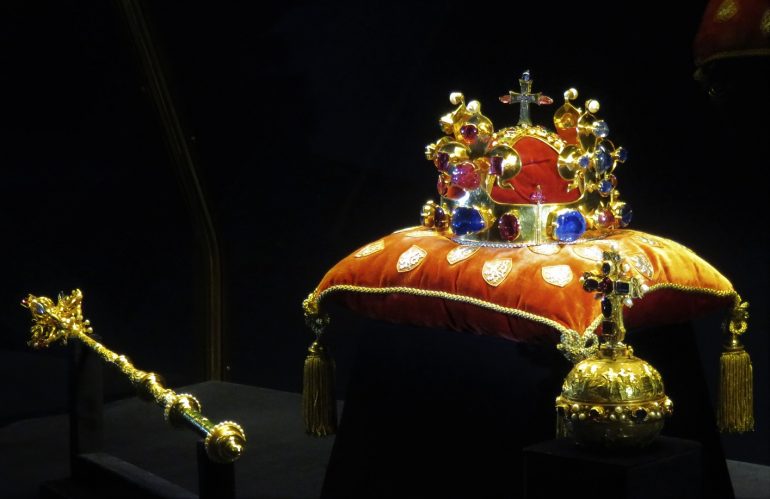

The Czech Crown Jewels will be on display in Prague Castle’s Vladislav Hall from 18-28 September this year, free of charge, and the Habsburgs 500 exhibition will present the history of the crown jewels from 1526 until the end of the 18th century, according to the Presidential Office.
In 1526, Ferdinand I of Habsburg acceded to the Bohemian throne.
The jewels will be ceremonially taken from the Crown Chamber of Saint Vitus Cathedral on 14 September. School groups will be able to view them for the subsequent three days.
Two years ago, President Petr Pavel decided that the jewels would be put on public display every year. The jewels were seen by 46,609 visitors in the autumn of 2024, and last year by 51,553 visitors, including children from schools all across the country.
In 1791, the crown jewels were permanently returned to Prague Castle and became one of the key symbols of Czech statehood, historical tradition, and national identity.
This year, the jewels will also be complemented by the coronation robe from 1653 and other rare artifacts, the Presidential Office said.
“The spotlight will be on the richly decorated royal scepter and orb, which Ferdinand I commissioned in 1533 from the Augsburg goldsmith Hans Haller,” said curator Stepan Vacha from the Institute of Art History at the Czech Academy of Sciences.
Until 2024, the jewels had been displayed at Prague Castle eight times since the establishment of the independent Czech Republic in 1993 – twice under Presidents Vaclav Havel (1993-2003) and Vaclav Klaus (2003-2013), and four times under Milos Zeman (2013-2023). The exhibition had a record duration in May 2016, when it lasted 15 days. Tens of thousands of visitors saw the jewels each time.
The tradition of exhibiting the Crown Jewels dates back to inter-war Czechoslovakia. The first public exhibition was held in 1929 on the occasion of the 1000th anniversary of the death of St. Wenceslas.