



Most 15-year-olds in the Czech Republic have no sexual experience, according to a 20-year study analyzed by scientists from the Institute for Psychological Research (INPSY) at the Masaryk University Faculty of Social Studies (FSS MUNI). Teenagers are increasingly postponing their first sexual experiences to a later age, with the most significant shift evident among girls. The research describes trends in sexual behavior and the timing of the first sexual experiences of almost 20,000 pupils of Czech schools. Experts are also warning of a decline in the use of condoms among adolescents.
Psychologists from FSS MUNI analysed the results of 20 years of collected data on the sexual behavior of Czech 15-year-olds, as part of the international study ‘Health Behaviour in School-aged Children (HBSC)’ from 2002 to 2022, which involved pupils of the 9th grade of Czech primary schools. In total, almost 20 000 pupils were surveyed during six phases of research, which allowed researchers to monitor long-term trends in the timing of the first sexual experience and the use of protection during sexual intercourse.
The trend of postponing the first sexual experience comes despite the widespread perception that young people are becoming sexually active earlier, due to the significantly greater availability of pornography and sexual content on the Internet.
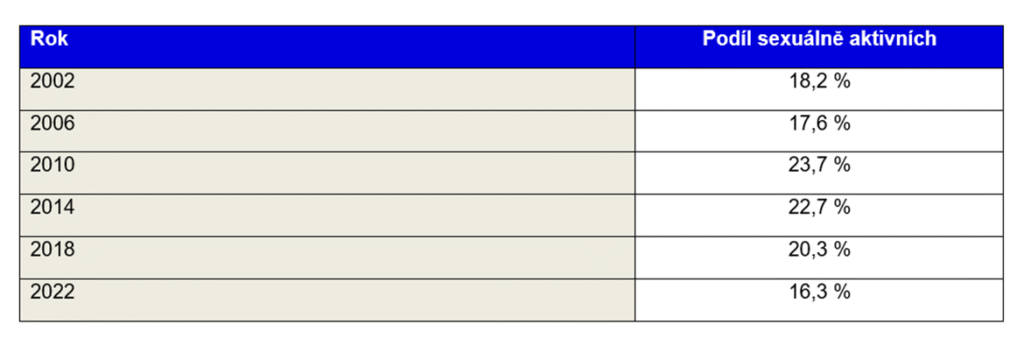
“The latest data show that only 16.3% of 15-year-olds surveyed already have sexual experience,” said psychologist Anna Ševčíková from INPSY. “This is the smallest share in 20 years. For those who have it, the first sexual intercourse occurs most often around the age of 15.”
At the same time, the research showed a significant difference between the sexes. 13.9% of 15-year-old girls reported having had sexual experiences, compared to 18.7% of boys. In 2018, the proportion was similar for both.
Changes in adolescent lifestyle and the influence of digital media
Experts believe that the postponement of sexual activity is related to broader changes in the lifestyle of adolescents and the growing importance of digital media. “Spending time online for most adolescents reduces opportunities to establish relationships in an offline environment, but for some, online sexuality can be a precursor to a sexual experience,” explained Ševčíková.
At the same time, she said, the way young people spend their free time is changing – they spend less time outdoors with their peers and the space where they could naturally meet informally is decreasing. The attitudes of parents, who sometimes prefer them to spend their time ‘safely’ at home rather than ‘dangerously’ outdoors, can also play a role.
The decline in alcohol consumption among young people, which has been evident in other studies in recent years, may also contribute to the change in sexual behavior. Ševčíková said there are multiple factors, which need to be examined comprehensively.
“For example, the consumption of pornography in some can serve as a means of sexual discharge and thus delay sexual initiation,” she said. “In other cases, such as sexting, it can serve as an accelerator of sex life. However, our data show that even the frequent experience of adolescents with online sexual content, which is one of the highest in our European comparison, does not lead to young people starting having sex earlier. We see a similar trend of postponing first sexual experiences in other European countries and in the USA, where the share of experience with online pornography is lower.”
Experts from Masaryk University are also warning of a decrease in the use of protection during sex. The use of contraception in adolescents dropped significantly between 2014 and 2022, from 81.2% to 69.6%. The same trend was present for both girls and boys.
The use of protection from condoms is also decreasing. While in 2014, 70.5% of 15-year-olds reported using condoms in their last sexual intercourse, this had dropped to 58.4% by 2022.
“The decline in the use of condoms in adolescents is worrying from the point of view of sexual health, especially with regard to the increasing number of sexually transmitted diseases, as evidenced by further research in the Czech Republic,” said Ševčíková. “This is a significant risk for the future, which demonstrates the need for sexual education in schools.”
Psychologists say that it is important for parents to communicate openly about sexual health and promote safe and respectful relationships. The data obtained through the study could be useful for the Czech Ministry of Health, the Ministry of Education, and for educational programmes, non-profit organizations and experts working in the field of prevention. The data continues to be analysed by scientists, particularly in the context of mental health, reproductive health and the digital environment. They expect further output this year.
“It will be crucial to see whether the differences between girls and boys will deepen further and whether the trend of lower use of contraconception and increasing sexually transmitted diseases will continue,” concluded Ševčíková.
The study is based on data from the international project Health Behaviour in School-aged Children (HBSC) from 2002 to 2022, which takes place under the patronage of the World Health Organization (WHO), and monitors the health and lifestyle of schoolchildren every four years. In the Czech Republic, the collection of data was conducted by the Institute of Social Health of Palacký University in Olomouc, within the project wwww.zdravagenerace.cz. The analysis of the data and preparation of the study was carried out together by Anna Ševčíková, Vít Suchý and Lukas Blinka from the INPSY. The study was co-financed by the European Union.
Proportion of sexually active 15-year-olds in the Czech Republic between 2002 and 2022