


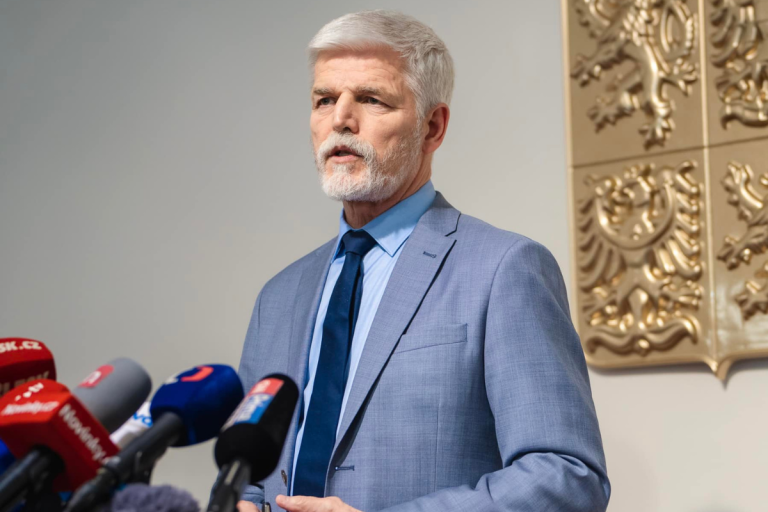

The Czech Constitutional Court yesterday issued a preliminary injunction ordering the government to ensure President Petr Pavel’s participation in the NATO summit in Ankara in July, and not to place any obstacles in his way.
The president wants to attend the summit, but the government has excluded him from participation. Pavel has repeatedly emphasised that representing the state abroad is a constitutional power of the president, while Prime Minister Andrej Babis (ANO) argues that his cabinet wants to actively lead foreign policy, which is why he did not include the president in the delegation to the summit.
The decision was a one-off ruling and applies only to Ankara. The court has yet to rule on Pavel’s competence lawsuit, but will do so as a matter of priority. A decision is expected within a few months.
Two judges dissented from yesterday’s court decision, arguing that the approaching summit date was not sufficient grounds for a preliminary injunction.
The judge-rapporteur in this case, Pavel Samal, said that the Czech president’s participation in NATO summits is established practice. Provided they were in good health, all previous presidents attended. For the time being, this practice must be maintained, not least due to time constraints, according to the court’s decision.
The preliminary injunction requires the government, the Ministry of Foreign Affairs and Foreign Minister Petr Macinka (Motorists) to “immediately notify NATO and the summit organisers that the President is also part of the official Czech delegation, and to secure the appropriate accreditation for him and his entourage.” Furthermore, they are to refrain from any actions “that would prevent or hinder the participation of the President and his entourage at the summit.”
The summit will take place on 7-8 July. The deadline for accreditation is Friday, 26 June.
President Pavel welcomed the Constitutional Court’s decision, writing on social media that it reflects the current practice and ensures the continuity of the Czech Republic’s representation at NATO.
Prime Minister Andrej Babis (ANO) initially responded that he respected the court’s decision, while describing the verdict as “unusually swift”.
However, in a later statement to CTK, he described the ruling as “absurd”, running counter to the interests of the Czech Republic, as the government should defend the country’s foreign policy at the summit, and complained that the government had not been given the opportunity to explain its position before the court.
Chamber of Deputies speaker Tomio Okamura, leader of the far-right SPD, accused the judges of the Constitutional Court of bias, and said the court had become President Petr Pavel’s vassal. Pavel’s predecessor as president, Milos Zeman, also questioned the neutrality of the court.
The President nominates Constitutional Court judges, who are then approved by the Senate for a term of ten years. The Constitution does not prohibit reappointment. The President appoints the chair of the Constitutional Court and the two deputy chairs from among its judges.
Of the court’s 15 current judges, 13 were appointed by the current president, while two were appointed by Zeman. The two Zeman-appointed judges, Pavel Samal and Jan Svaton, voted in favour of yesterday’s preliminary injunction, while two of Pavel’s appointees, Dita Repkova and Jan Wintr, were the dissenting votes on the panel.
Another former president, Vaclav Klaus, described Pavel’s lawsuit as an indirect attack on parliamentary democracy. “This is an unprecedented move. It is the President of the Republic completely crossing the Rubicon,” he told Nova TV.
Foreign Minister Macinka went further, describing the president’s lawsuit and the court’s preliminary ruling as an attempted “constitutional coup”. He described the president’s actions as an act of hostility, which had dramatically escalated the situation. “There is no question of smoothing the disputes,” Macinka added.
However, he told reporters that Pavel will be added to the delegation on Thursday, adding that the government would decide on Monday what role the president will play at the summit.
The Constitutional Court has yet to rule on the competence lawsuit filed by Pavel regarding the cabinet’s decision to exclude him from the delegation, and on the scope of the president’s powers when representing the state abroad.
Yesterday’s preliminary injunction does not prejudge the outcome, Court President Josef Baxa noted, adding that the judges will now request further statements and will also consider the possibility of holding a public hearing.

Baxa expects the government to respect this one-time decision regarding Pavel’s participation in Ankara. This is not the first time the court has imposed an obligation on the government, parliament or the president. “These decisions have always been respected. I do not expect this to be any different,” Baxa said.
He emphasised that the Constitutional Court is independent and is “neither for nor against anyone”.
Samal added that the Constitutional Court did not intend to interfere with the government’s powers through yesterday’s decision. “We respect that the government is the highest representative of the executive, and we also respect that it has the final, decisive say precisely in this area – foreign policy. This decision is not about the government being subordinate to the president in foreign policy. It is merely a matter of participation in the summit. Even the content of what will be discussed at the summit falls primarily within the government’s authority,” Samal stated.
On Monday, the coalition government of ANO, Freedom and Direct Democracy (SPD) and the Motorists stated that it does not plan for Pavel to attend the summit, and that the Czech Republic will be represented by the prime minister and the ministers of defence and foreign affairs. That same evening, Pavel filed a competence lawsuit with the Constitutional Court and requested a preliminary injunction.
The Constitutional Court published the motion on its website. Samal was appointed as the judge rapporteur, but the decision must be made by the plenary session, which is the full body of judges.
In the vote on the preliminary injunction, dissenting judges Repkova and Wintr stated that preliminary injunctions in disputes over the scope of competences should be exceptional, especially when they interfere with political events, and when it is not yet clear at all how the court will interpret the President’s authority to represent the state abroad.
“Unlike the majority of the plenary, we believe that much stronger grounds than the upcoming summit are required to order a preliminary injunction,” wrote Repkova and Wintr.
They remained in the minority. Twelve of the Constitutional Court’s 15 members participated in the decision, according to the ruling.