

The Sudeten German Congress began in Brno today and will continue until Monday. At the invitation of the Meeting Brno festival, it is being held in the Czech Republic for the first time, which its supporters hail as a landmark moment of reconciliation in Czech-German relations. However, the festival has also been criticised by politicians from the government parties, who passed a resolution in parliament expressing their opposition. On its first day, both sides of the festival were visible, with cross-community outreach events taking place in the city centre, but accompanied by loud protests.
Around 200 people gathered at the Brno Exhibition Centre this morning to protest against the congress, building a symbolic barricade out of cardboard boxes and holding banners and flags. The “Silent Barricade” rally was organised by the Communist Party (KSCM).
The cardboard boxes forming the barricade are covered with historical photographs intended to commemorate the victims of World War II, and also maps of the Sudetenland, the Czechoslovak border regions where the German population prevailed before WW2.
The morning protest began at 9 am, when the medieval Hussite hymn “Ktoz jsu bozi bojovnici” (Who Are God’s Warriors) was played through a loudspeaker.
“Anyone who speaks of the suffering of the Sudeten Germans must also speak of the suffering of the Czechs, the Roma, the partisans and all the victims of the Nazi terror,” said one of the speakers at the rally. “We want to symbolically show the line beyond which we cannot retreat. Photographs of the occupation, of those expelled and murdered, photographs of people who can no longer speak for us, will speak for us.”
The barricade was built in about fifteen minutes. The protesters confronted one man, apparently a supporter of the congress. At one point, they surrounded him and shouted at him, demanding that he leave and labelling him a “provocateur”.
After 10 am, the protesters set out on a march in front of the G2 entrance to the exhibition area, where the Sudeten Germans will pass on Saturday to attend the congress. The protesters’ march was accompanied by occasional booing.
The protesters briefly engaged two Austrian congress delegates they encountered at the entrance, and shouted at them across the tram tracks. South Moravian police spokesman Pavel Svab said one person had been arrested during the incident.
The Austrian men told reporters that the protesters had the right to protest. They said the congress is not a provocation but a gesture of reconciliation.
The protesters concluded the event by returning to the main gate of the exhibition grounds, before dispersing. An anti-conflict team oversaw the entire event.
KSCM leader Katerina Konecna was also among the protesters at the exhibition grounds. She wore a T-shirt with the slogan ‘Stacilo!’ (‘Enough!’), and was criticised by one protester for exploiting the event for her pre-election campaigning.
Other opponents of the congress arrived in namesti Svobody during the afternoon, where they built a similar barricade with photos depicting events related to WW2. Speakers read the names of World War II victims.
Meanwhile, a few hundred metres away, on Moravske namesti, the festival’s spirit of reconciliation was more evident, as hundreds of people, both old and young, Czech and German, sat down together at long tables for a ‘neighbourhood festival’.
People began sitting at tables with white tablecloths around noon. Petr Stika, the secretary of the Brno-centre city district, estimated the attendance at 600 people shortly before 2pm, the official start of the event.
At 2pm, folklore performances by children and adults from Germany and the Czech Republic began, as well as dulcimer and brass band music. A private security agency and police officers kept order.
Students from Brno universities, who brought their own food and approached the event like an open-air picnic, told CTK they were curious and did not understand the fear of Sudeten Germans.

Several dozen people came to express their disapproval with Czech flags and banners, warning of the crimes of Nazism and defending the post-war presidential decrees that led to the expulsion of Germans from the former Czechoslovakia. One man carried a banner of the name of the Sudeten German leader, Bernd Posselt, with the two “s” in his surname replaced by swastikas.
The two camps exchanged views, mostly peacefully, but the dialogue was complicated by the language barrier. One man instigated several arguments, which were resolved by members of the police anti-conflict team. The protest concluded just before 3:30 pm with the singing of the national anthem, and people began to disperse.
The protest was organised by the “National Defence 2” group, which includes representatives of the Communist Party and others, as well as individuals. According to Stika, around 150 protesters were present.
According to Svab, police investigated one problematic sign featuring an image resembling a swastika: “We have identified the man with the banner. According to initial information, this does not appear to be a criminal offence, but we are still investigating the situation.”
“We are very grateful and happy so far,” said David Macek, co-founder of the festival. He said he did not mind the protesters: “At least they will see with their own eyes who Sudeten Germans are and who they are not, what it looks like when they meet somewhere… Please, this is what Czech society has been terrified of in some parts of its society for over 35 years,” he added.
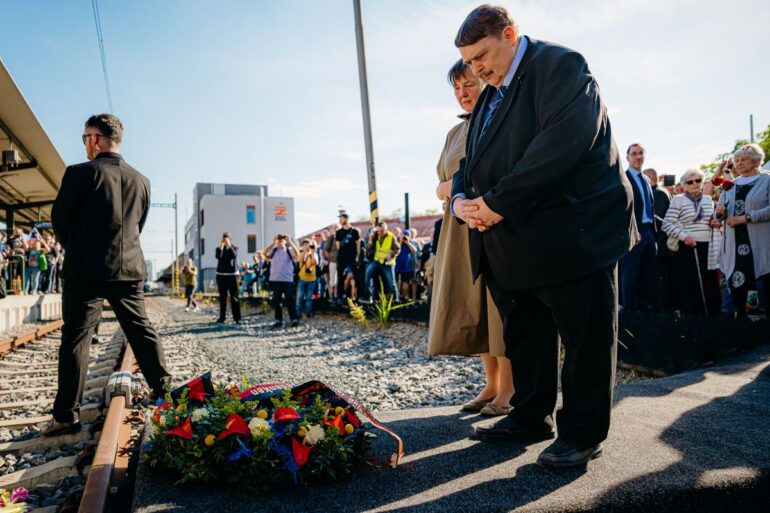
The Meeting Brno festival and the Sudeten German Congress were preceded by a joint memorial service for the victims of the Holocaust at Brno’s main train station on Thursday. According to police, about 500 people attended, including 100 protesters.
The main festival programme will take place over the weekend. In addition to speeches and traditional events, such as a costume parade, representatives of the Sudeten Germans will also pay tribute to the victims of Nazism at Brno’s Kounic dormitories, where the Nazis executed Czech patriots during World War II. Further protests are expected.