


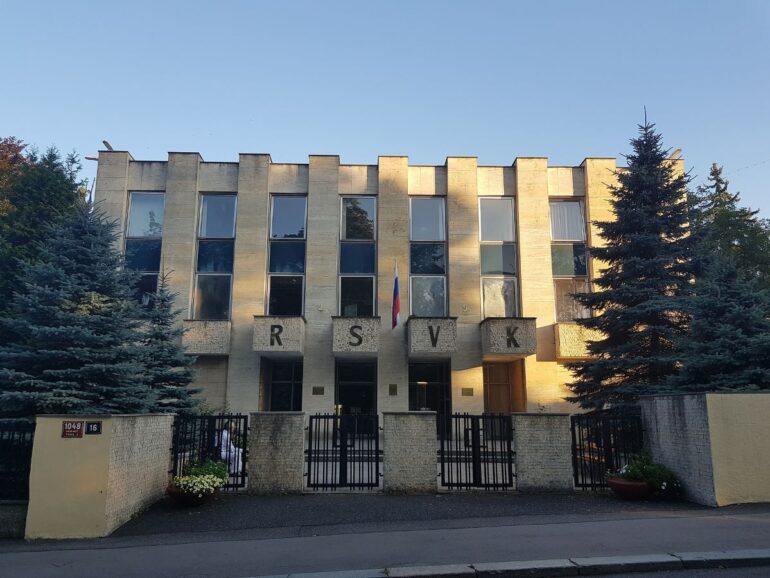

According to police reports released this morning, several Molotov cocktails were thrown at the building of the Russian Centre for Science and Culture in Prague on Thursday evening. Police are now searching for the perpetrators, on suspicion of property damage.
“Since yesterday evening, we have been investigating an attack in which someone threw several Molotov cocktails at the Russian House on Na Zatorce Street in Prague’s 6th district. We are searching for the perpetrator, who is suspected of the crime of property damage,” the police said.
The Russian Centre for Science and Culture in Prague-Dejvice, known as the Russian House, has been operated by the Russian state agency Rossotrudnichestvo since 1971. To Moscow’s displeasure, the Czech Republic does not recognise the diplomatic status of the building in which the centre is located.
In a statement posted on Facebook, the Russian Embassy in Prague described the attack as “an unprecedented act of violence that posed a threat to the lives and health of employees” of the Centre. “We will insist on a thorough investigation of the incident and punishment for those responsible, on compensation for damages, and on ensuring that similar incidents do not occur in the future,” the embassy said.
The Centre’s director Girenko told TASS that there were a total of six Molotov cocktails, and three of them exploded. He said that the bottles aimed at the interior of the building had not exploded. The windows the perpetrators targeted belong to the institute’s library. He described the attackers as “inhuman creatures” and “terrorists”.
The director added that he believed the timing of the attack to be no coincidence, as the closing events of the Russian Culture Days were scheduled to take place at the institute today. He also thanked the Czech law enforcement agencies and firefighters, who arrived at the scene within minutes.
According to Alexander Brod, a member of the Russian Presidential Council for Civil Society and Human Rights, the attack is the result of years of aggressive anti-Russian propaganda by Western politicians and media. “They are inciting people to hate everything associated with Russia and the Soviet past,” TASS quotes Brod as saying.
Interior Minister Lubomir Metnar (ANO) wrote on social media to condemn the attack. “I consider any attack on any building to be unacceptable without exception, regardless of its nature or ownership,” he said. “This is a serious criminal act that poses a threat to security. The Czech police are investigating the case, we are continuously assessing the security situation, and we are prepared to respond if further measures need to be taken.” The Czech Ministry of Foreign Affairs also condemned the attack.

The centre’s core activities include organising programmes in the fields of science, culture and education, as well as promoting the Russian language and Russia, according to information on its website. Its mission is to familiarise the Czech public with the history and culture of the peoples of the Russian Federation, and with its cultural, scientific and economic potential. It also aims to strengthen ties with compatriots who reside permanently abroad.
Russia has previously complained about the Czech Republic’s stance toward the centre. In an interview with the newspaper Izvestia last May, Alexander Zmeyevsky, Russia’s former ambassador to Prague, stated that there was an “unhealthy atmosphere” surrounding the Russian House.
Zmeyevsky said at the time that calls to close the Russian House regularly appeared in the Czech media and that it was also the target of “hooligan attacks” by various organisations, including in connection with the Russian war in Ukraine.
Last April, dozens of people protested in front of the Russian House against the spread of Russian culture. The protest was organised by the Voice of Ukraine initiative. Critics point out that these institutions serve as tools for spreading Russian propaganda and disinformation. Some European countries have ordered them to close.