


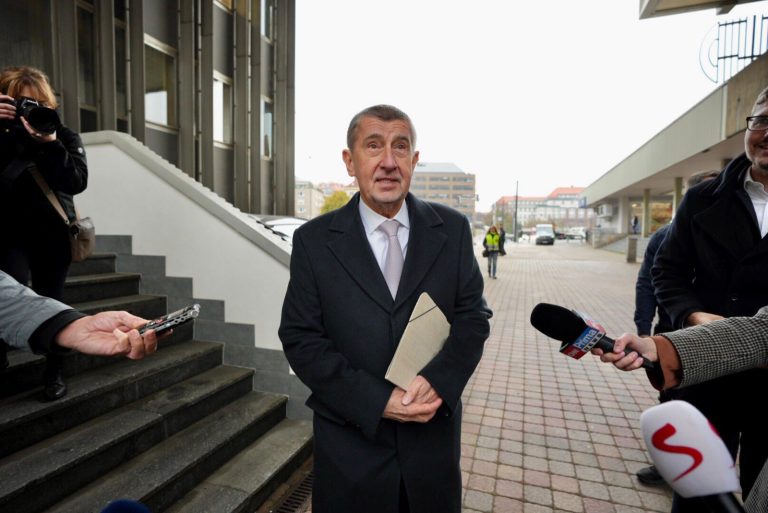

The Chamber of Deputies yesterday voted against releasing Prime Minister Andrej Babis (ANO) and parliamentary speaker Tomio Okamura (SPD) for criminal prosecution.
All MPs from the government coalition of ANO, SPD and the Motorists voted to reject a court request to release the two politicians for prosecution. This decision was earlier recommended by the mandate and immunity committee of the lower house, in which the three parties have a majority.
Out of the 186 MPs present, 104 supported the committee’s recommendation in the cases of both ANO leader Babis and SPD leader Okamura. In the vote concerning Babis, one opposition MP, Michal Kucera (TOP 09), abstained from the vote. All the 82 opposition MPs present voted in favour of lifting Okamura’s parliamentary immunity. The opposition Pirates failed to push through a secret ballot.
Babis and Okamura once again described their prosecution as politically motivated. Babis asked MPs not to release him, and insisted that the criminal charges were politically motivated. “If I hadn’t gone into politics, no one would have heard of Capi hnizdo,” he said.
Opposition politicians, meanwhile, argued that these were not political trials and that the lower house should allow an independent court to decide on the merits of the case. They also argued that if Babis and Okamura were convinced of their innocence, they should take the opportunity to defend themselves in court. They distanced themselves from any questions of trust in the judiciary or undermining the rule of law. The debate lasted for around ten hours.
Babis and his former adviser Jana Nagyova, now an ANO MEP, were charged over a CZK 50 million subsidy for the Capi hnizdo (Stork Nest) farm and conference centre in Central Bohemia. The Prague Municipal Court acquitted them twice, but both verdicts were annulled on appeal by the Prague High Court. In its latest ruling from last June, the court also ordered the Municipal Court to find the defendants guilty based on the evidence presented.
The European Parliament stripped Nagyova of her immunity in April 2025. The court may therefore separate the proceedings against her.
Okamura has faced criminal prosecution over posters from the SPD campaign before the Senate and regional elections in 2023. Controversy was sparked in particular by a poster featuring a dark-skinned man with a bloody knife and a blood-stained shirt, along with the text “Shortcomings in the health care system will not be solved by imported ‘surgeons'” and “Stop the EU Migration Pact”.
Prosecutors brought charges against Okamura and SPD on suspicion of inciting hatred last August, proposing a suspended sentence and a fine for Okamura, and a further fine for the party. The previous parliament released Okamura for prosecution in February 2025.
Yesterday’s decision by the lower house does not mean that the criminal cases against Babis and Okamura are over. The proceedings can continue once they are no longer protected by the immunity as lower house members.

Opposition figures said the refusal to release the two for prosecution undermined confidence in the courts.
“This sends a bad signal to all citizens, because the laws do not apply equally to everyone. The impunity of the powerful elite has prevailed,” Pirate Party chairman Zdenek Hrib told reporters shortly after the vote.
Former Prime Minister Petr Fiala (ODS) wrote on social media after the vote that it should be part of political culture that a politician charged with a serious crime should immediately resign. “Unfortunately, Andrej Babis does not respect any political culture and, worse still, he says that he does not trust the courts and that everyone is conspiring against him,” said Fiala. “As expected, ANO, Motorists and SPD showed today in the Chamber of Deputies that their main goal is to protect the prime minister from criminal prosecution. This is sad and dangerous for the future.”
“What we saw was that some people are equal and some are more equal,” said STAN leader Vit Rakusan. “What I find very regrettable is the attack on institutions. We cannot say that the judicial system works well when it decides as we want it to and is politicised when it decides otherwise. Politics should be clear: trust the courts and respect their decisions, whether they rule in my favour or not.” He said his party was preparing a proposal to amend parliamentary immunity laws.