
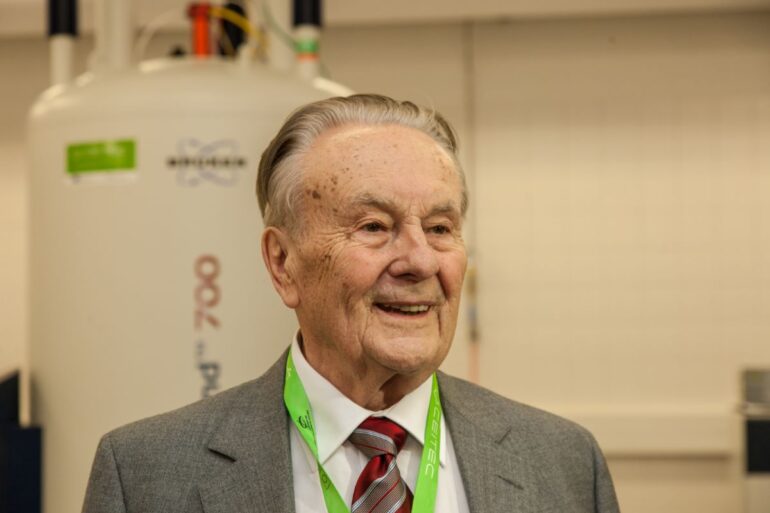

Last Saturday, 28 February, was the 100th anniversary of the birth of scientist Josef Dadok – a graduate of Brno University of Technology and a pioneer of nuclear magnetic resonance (NMR) who fundamentally shaped modern NMR spectroscopy.
Today, NMR plays a crucial role in biomolecular research, drug development, materials science, and medical diagnostics. In the 1950s and 1960s, Josef Dadok was instrumental in developing the first high-resolution NMR spectrometers in Brno, at the Institute of Instrumentation of the Czechoslovak Academy of Sciences. These were later mass-produced by the national company Tesla Brno, which became only the third manufacturer of industrial NMR spectrometers in the world, and made Czechoslovakia one of the world leaders in NMR technology. Dadok’s technical solutions for magnetic field stabilisation paved the way for higher resolution and more precise measurements.
After 1968, he continued his scientific career at Carnegie Mellon University in the United States, where he contributed to the development of superconducting magnets and the design of the first practically usable NMR spectrometer, operating at a magnetic field strength of 14.1 T, one million times stronger than the Earth’s magnetic field. His rapid-scan correlation method became an important contribution to the advancement of modern NMR.
The Dadok Centre: An International Research Hub in Brno
Today, Dadok’s legacy is commemorated by the Josef Dadok National NMR Centre at CEITEC Masaryk University. Despite the name, the centre has a strong international reach and is part of the European Research Infrastructure Consortium (Instruct-ERIC) as well as the Czech Infrastructure for Integrative Structural Biology (CIISB). Its services are used by researchers from around the world; scientists come to Brno for the state-of-the-art instrumentation and the expertise that enables experiments not routinely available elsewhere.
“I started working in NMR in 1984 at the institute founded by Josef Dadok. Although he had long since left, he was still remembered as the person who set the direction,” says Radovan Fiala, former long-serving head of the centre. He met Josef Dadok personally after 1990, including at the inauguration of the laboratory in 2013. In 2021, at the age of 95, Dadok learned how to present via MS Teams so that he could join an online conference organised in honour of his jubilee.
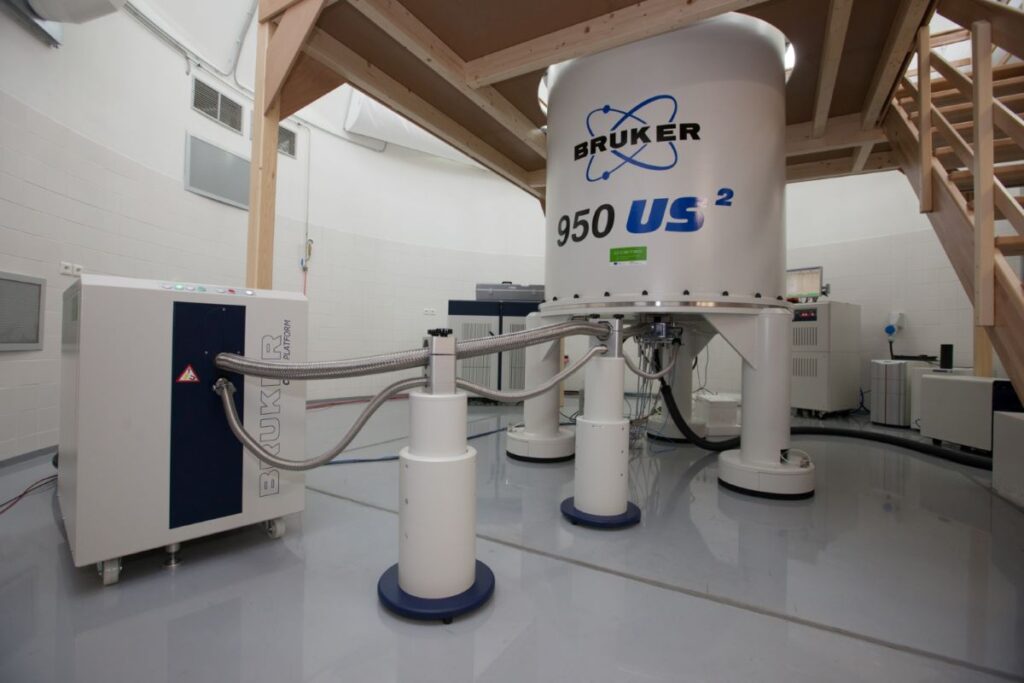
Today, the centre operates commercial instruments, but its core mission lies in methodological development, student training, and providing open access to NMR measurements for academic and industrial uses. Among its major contributions is the Watergate method developed by Vladimír Sklenář, which is now the most widely used approach worldwide for measuring NMR spectra of biomolecules in water, their natural environment. Unique techniques continue to be developed at the centre to improve measurement outcomes and provide new insights into the molecules under study.
Looking to the Future
Josef Dadok’s legacy is also visible at CEITEC BUT, where the research team led by Petr Neugebauer has developed and constructed a new spectrometer, FRASCAN II, enabling combined measurements of electron spin resonance (ESR) and NMR using extremely fast scanning (the so-called ‘fast-sweep technique’, on which Josef Dadok himself once worked).

This spectrometer generates a magnetic field ten times stronger than those used in industrial scrap-sorting magnets. Such immense power allows researchers to study microscopic interactions that are essential for understanding complex biological and chemical processes.
“We are methodologically building on Dadok’s pioneering work – combined scanning should enable scientists to better understand protein structure and potentially design drugs that combat diseases at the molecular level,” explained Neugebauer. The new instrument is now located at the Josef Dadok National NMR Centre at CEITEC MU, and available to researchers.
Professor Dadok died in the United States on 4 October 2024, aged 98, a prominent figure internationally in the field of NMR. On the centenary of his birth, Brno’s tradition in magnetic resonance remains vibrant, and is still led by CEITEC’s NMR centre that bears his name.