

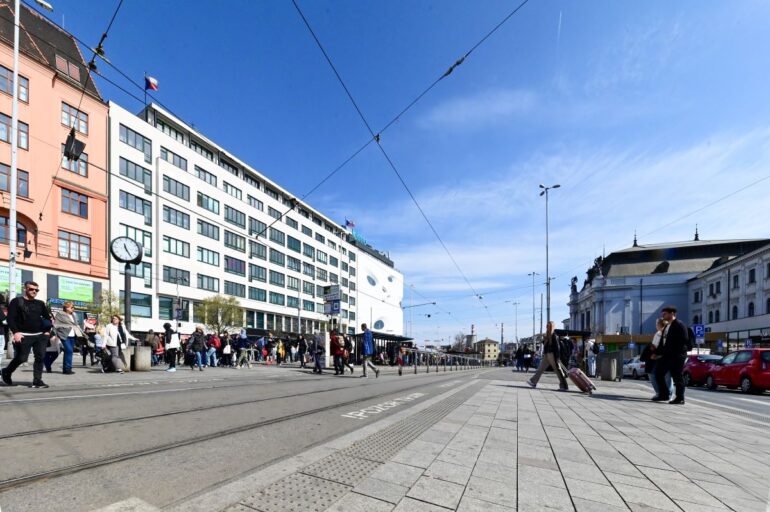

The City of Brno has been increasing its efforts to address the situation of unhoused people in the city, offering help through social curators. Unfortunately, this is not successful in all cases, and unhoused people often gather in front of the main train station, violating regulations and sometimes even laws. In order to improve the situation at the train station, police officers will increase the frequency of patrols, and will be physically present on site most days of the week. This measure is to be accompanied by an increase in the number of social workers in the field.
Unhoused people often gather around places such as train stations or squares, as the high amount of pedestrian traffic increases their chances of getting food or money.
“The situation of homeless people is, on the one hand, deplorable, and the city spends considerable resources and human resources to help them ensure more dignified living conditions and, ideally, a gradual return to normal society,” said Brno Mayor Markéta Vaňková. “However, the difficult life of some cannot be a threat to others. With the arrival of spring, the number of homeless people near the train station increases, and cases of harassment or other criminal activities multiply. In order for passengers and passers-by to feel safer here, I have asked the Brno City Police to strengthen patrols in this area. In addition, the patrols will often be supported by social workers who will try to contact homeless people and offer them help.”
Two patrols will now be on duty at the main station around the clock on weekdays. Each of them will be in charge of one side of the site.
“The area in front of the station has long been one of the most monitored places in Brno,” said Luboš Oprchal, director of the Brno Municipal Police. “We have carried out approximately 20 targeted checks here daily and we record up to 1,000 interventions here per month. However, we are limited in our solutions by current legislation, which, for example, does not allow the use of residence bans, which were abolished in 2017.”
According to Oprchal, Brno also ‘pays extra’ for the fact that, as a large city with high-quality social services, it functions as a magnet for people who did not live in Brno before they found themselves in an emergency situation. The city thus provides assistance to people from the wider region. Some of them arrive in the city when they are taken to the local detention station, the only one in the South Moravian Region, and then stay in Brno on their release.

The city and police officers will evaluate the effectiveness of the measures after a few weeks.
City representatives will continue to address the topic of unhoused people and their conflicts with the rest of society in the near future, with various partners: city districts, state and city police, and social service providers. The goal is also to open the entire issue of homelessness on a broader platform, with the region and possibly with ministries.