
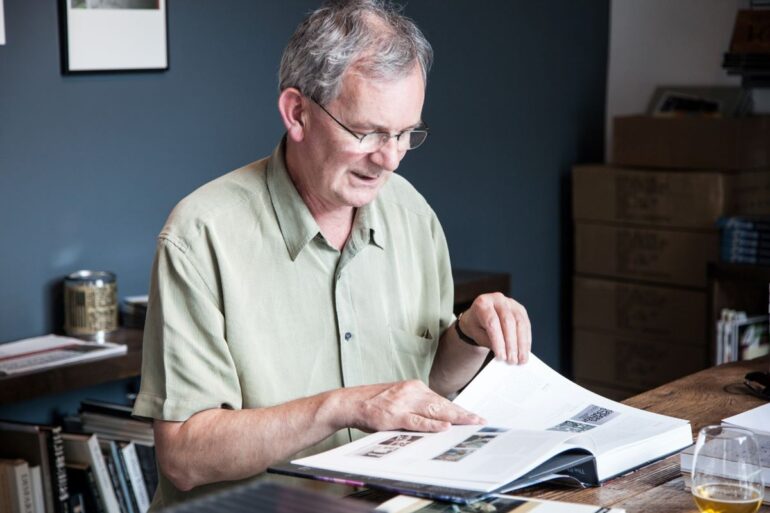

Last weekend, the iconic British photographer Martin Parr, known for his humorous yet intimate depictions of class, wealth, and social behaviour through the capture of everyday scenes, visited Brno for a series of public meetings and talks. Brno Daily’s Emanuele Ruggiero went along to speak to Parr about his life and his craft…
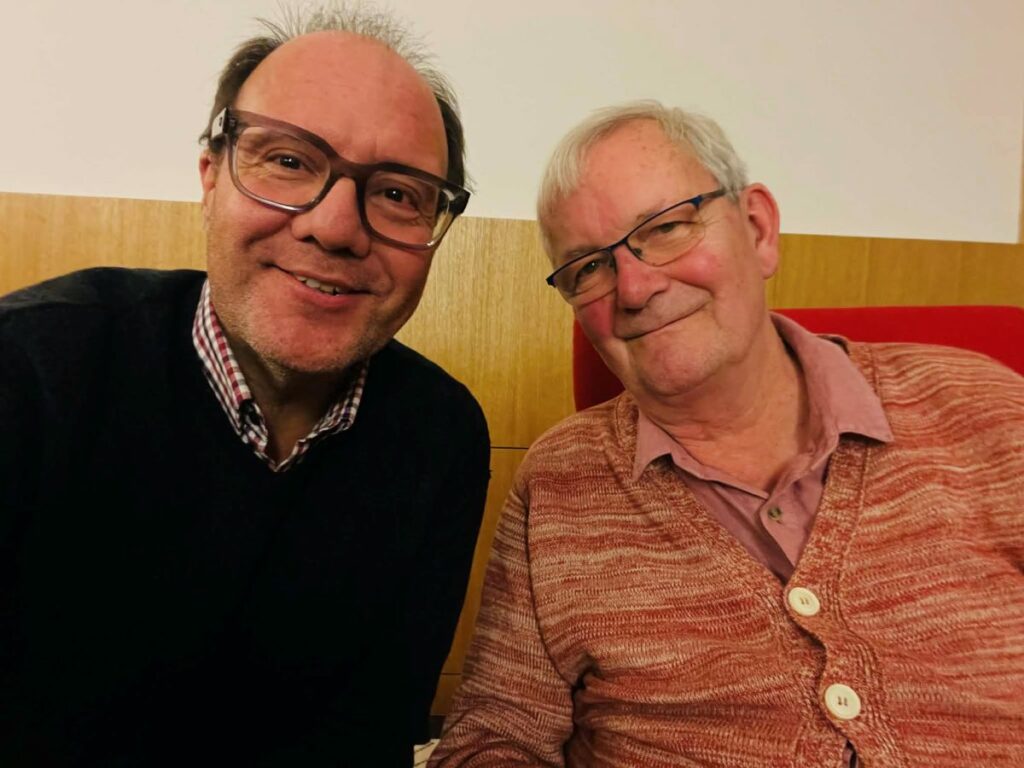
Although I am primarily a filmmaker and documentary director, my journey began as a photographer back in 1987, when I bought my first analog camera, a Nikon F20, in Cologne, Germany. Photography—something I passionately love, and continue to practice—is a cornerstone of my visual approach. I vividly remember the two years I spent in Milan at a documentary photography school in the early 1990s. It was there that I first encountered a great photographer whom I have always admired: Martin Parr. The chance to meet and have a conversation with him here in Brno has truly been one of the highlights of my experience as a photography advocate.
BD: Martin, many people describe you as fundamentally obsessed with images. Is this true?
MP: Absolutely. I am happily obsessed. I believe it is impossible to be a good documentary photographer without a touch of mania: I spend my life observing, looking for that fraction of a second where everything aligns—the absurd detail, the involuntary posture, the everyday gesture that reveals an entire story. The world we live in is so crazy and so interesting that I constantly want to photograph it. If you want to be any kind of artist, you have to be obsessed, because it is a very competitive world.
BD: Your photographs often operate on a thin line, mixing satire, empathy, and social critique. Do you view yourself as a visual anthropologist, collecting evidence of human behaviour?
MP: That is a great way to put it—I am gathering evidence. I photograph as if I am building an infinite archive of the ways we live, consume, and move. I never take anything too seriously, but I am very serious in the doing of it.
I am merely highlighting the absurd; I haven’t invented anything. My work stems from accepting that the human being is fundamentally ridiculous, fascinating, and incoherent. I simply point the camera and say, “Look how curious the world is.” As someone from the left, I have empathy for people. I allow my photography to combine these contradictions—the things I appreciate about the UK versus the right-wing gangs, for instance.
BD: You’ve always defended “low culture” subjects. Why do you focus so intently on the mundane—the queues, the buffets, the tourists?
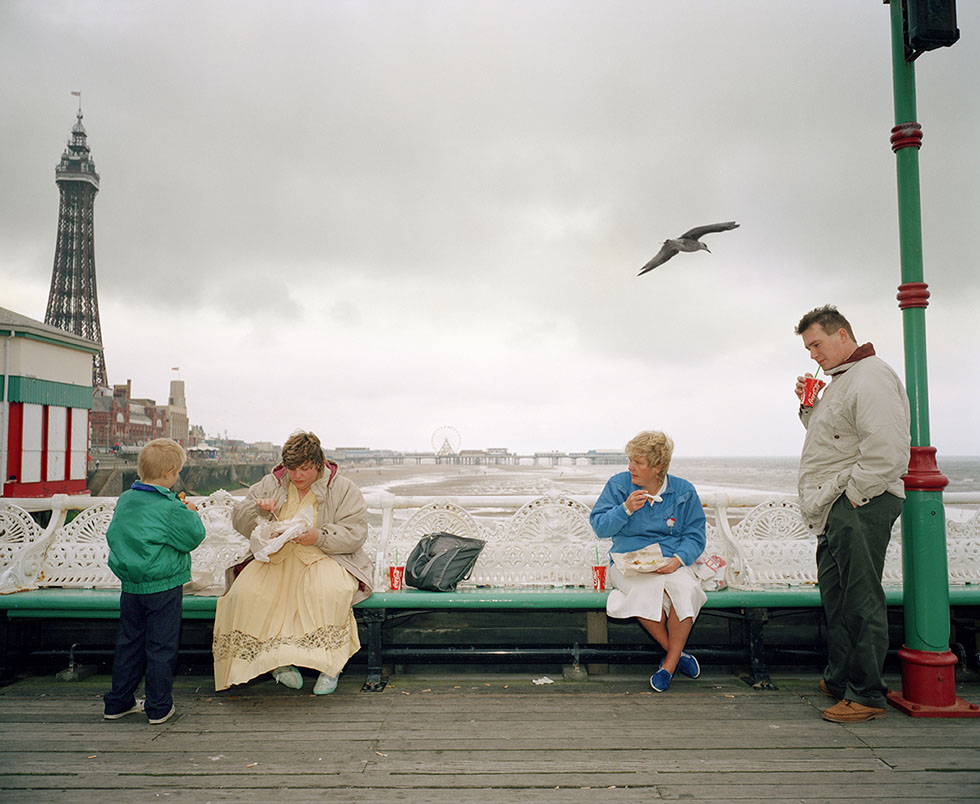
MP: I find there is more truth in the queue outside a fast food restaurant than in a thousand intellectual discourses about society. Photography should go where people truly live, not where they pretend to live. The things that seem frivolous today—the flip-flops on the beach, the ridiculous hats, the endless buffets—will become cultural documents in twenty years. This is the value of documentary photography: recording social history. I am quite obsessed with photographing very ordinary things and making them extraordinary, whether it is domestic activities, shopping, or people filling their car up with petrol. That last one might seem pointless, but after 35 years, the car, the pump, and the clothes have changed, and the image becomes very interesting.
BD: You’ve mentioned that you never tire of photographing people, yet you bore easily when people try to look perfect. What captures your interest?
MP: I am interested in what escapes control: a forced smile, a funny posture, or a jarring detail. Real people are photogenic without wanting to be. The moments I look for are often those that are awkward or spontaneous.
BD: The story of your admission to Magnum Photos in 1994 is infamous. Can you recount that controversial period?
MP: My admission was extremely turbulent, and I was the most controversial photographer they ever had. There were many people vehemently against me joining, led by Philip Jones Griffith. I actually got in not just once, but twice on the same day in 1994. Peter Mara, the president, phoned to congratulate me, but half an hour later, he called back to say I was out because someone had turned up and voted against me. An hour after that, Bert Glenn, who had food poisoning, showed up and voted for me, and I was back in. I think my getting in opened the gates for a different type of photographer at Magnum, moving beyond just the traditional humanistic photojournalist.
BD: You made a distinct shift from black and white to a highly saturated colour aesthetic around 1982. How did you develop that visual language?
MP: If you were a serious documentary photographer in that period, you were almost obliged to work in black and white. Colour was the domain of commercial or snapshot photography. When I switched to colour negative film and flash, I encouraged the resulting high saturation. That palette, or language, was essentially stolen from commercial photography and applied to documentary work. It gave my photos a more saturated look, which contrasted with the paler language used by American masters like Eggleston and Steven Shaw.
BD: Another major obsession is the photo book. Why do you hold this format in such high regard?
MP: The photo book is the purest form of photographic expression and the definitive home for a set of images. Exhibitions are dismantled, digital files vanish, but the book remains—it’s an object, a controlled sequential narrative. As a collector, I take the mission seriously: collecting them means conserving the visual genealogy of the world. We must ensure we look beyond Europe and America to find books from Eastern Europe, Japan, Australia, and Iran. I look for originality, not imitation. It takes me about 20 seconds to work out if a book is any good. I often find many books are “lazy”; they haven’t resolved their subject matter or recognized their best work.
BD: Regarding your process, you mentioned that you only take around ten “great photos” a year. Given that volume, what’s your strategy for curating?
MP: You have to take many, many bad pictures to get the few good ones. If you decided you were only going to take good pictures today, you would never start. Curation is about recognizing that alignment and trying to find the momentum in a situation. With photo books, it’s about the whole idea of the production and how the book comes together. It must have great pictures, but the way it is presented—whether simply or very differently, like my deliberately bad design for Playa—is essential.
BD: Do you have any major regrets about moments you missed with your camera?

MP: Yes, my biggest regret is detailed in my new book. During the Black Lives Matter events in Bristol, I was photographing the march, thought I had enough, and went home. Five minutes later, the crowd tore down the statue of slave owner Colston and threw it into the harbor. I missed the biggest event in Bristol for years. The lesson I learned is: Never go home until the scene is finished. I try to focus on the leisure pursuits of the Western world, but that moment of spontaneous history was one I deeply regret missing.
BD: What motivates you today, now that you have your foundation and continue creating books and shows?
MP: Curiosity. As long as people keep surprising me—and believe me, they never stop—I will keep photographing. The goal is to stay curious and sharpen the gaze. The day I am no longer surprised, I will stop. Meanwhile, I will continue to immortalize ridiculous hats, confused tourists, and excessive buffets—they are the beating heart of Western civilization after all.
BD: Many young photographers imitate your style. How do you feel about that?
MP: If they imitate too much, it means they haven’t found their own voice yet, which is a limitation. But if they look to my work to understand how to tell personal stories, then I’m pleased. I myself have “stolen” a lot from photographers I loved, then tried to turn those influences into something recognizable as mine.
BD: How do you define photography in one sentence?
MP: Photography is a way to explore our humanity and the world we inhabit, organizing chaos into small fragments that, put together, tell us who we are.
BD: Thank you.
MP: Thank you. Now let’s go photograph something terribly interesting and apparently banal.