


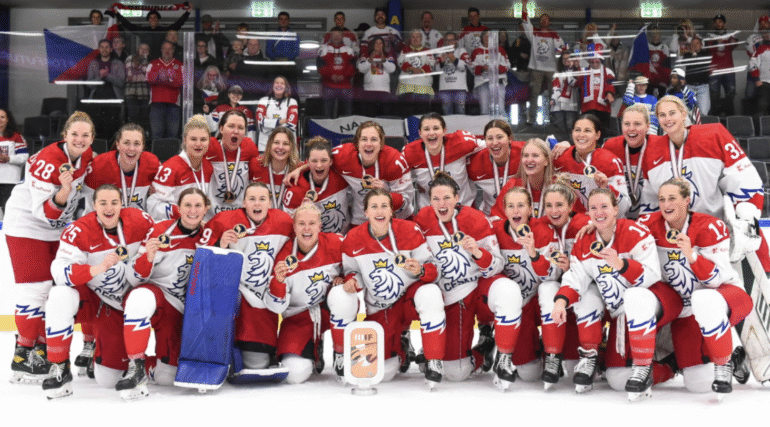

The growth of women’s hockey is undeniable. Worldwide participation has increased by more than 30 percent over the past two decades, with more girls than ever taking up the sport. In the Czech Republic, that momentum has been reflected in the success of the national team, which has made 21 appearances at the IIHF Women’s World Championship, earning bronze medals in 2022 and 2023, as well as two Olympic appearances, finishing seventh and fifth.
That momentum extends beyond the ice. The 2025 IIHF Women’s World Championship attracted record-breaking attendance, highlighting the growing interest in women’s hockey both in the Czech Republic and around the world.
Czech players are also becoming increasingly visible on the professional stage through the Professional Women’s Hockey League (PWHL). Most recently, Tereza Pištěková was selected in the league’s draft and will join fellow Czech national team player Kateřina Mrázová in Ottawa. She joins a growing group of Czech players in the league, including Aneta Tejralová and Tereza Vanišová.
However, the numbers also reveal the challenges that remain. Of the Czech Republic’s roughly 110,000 registered hockey players, just over 4,000 are women. Taken together with increasing competition for ice time and limited resources, these figures illustrate the barriers that continue to shape the experiences of female athletes in the Czech Republic and around the world. Many of the sport’s biggest challenges remain behind the scenes; speaking to Brno Daily, the co-founder of Women’s Power, Sárka Strýhalova, explained that one of the greatest obstacles is not a lack of talent, but a lack of visibility.
“I would say media coverage in the Czech Republic is not good enough,” she said. “It is getting better, but if you read the biggest national newspapers or online news, you are not able to see any women.”
She points to a media landscape where women’s achievements are often overlooked in favour of less significant stories in men’s sport. In one example, a colleague wanted to write about a Czech women’s hockey player scoring a hat trick internationally, but editors instead chose to cover a Formula One driver who missed a race because of illness.
For Strýhalova, these editorial decisions have consequences far beyond a single news cycle.
“If people don’t see women’s sports, they don’t know the athletes, they don’t follow their stories, and they don’t become fans,” she explained.
To help change that, Strýhalova launched Women’s Power (IG: @womenspower_cz), the Czech Republic’s first and largest online platform for women in sport. It connects female athletes from different disciplines and shares inspiring and empowering stories that create change. What began as a small initiative has already attracted nearly 10,000 followers on Instagram, demonstrating what can happen when women’s sports are given a dedicated platform.
The PWHL is also a strong example of how media coverage can amplify the visibility and achievements of women’s hockey. The league has experienced remarkable growth in audience reach. During the 2025–26 season alone, YouTube viewership increased by 77% compared with the previous season, with fans from 154 countries tuning in—up from 106 countries the year before. Across all broadcast platforms, the PWHL also saw a 61% increase in new viewership. In addition, the league welcomed more than 1.1 million fans across its 120 regular-season games, highlighting the growing global interest in women’s hockey.
So, it’s clear that audiences want to watch women’s hockey. The growing success of leagues like the PWHL demonstrates that interest in the women’s game is stronger than ever. But media attention is only one piece of a much larger puzzle.
For many young hockey players, opportunities become limited long before they reach the professional level. Unlike boys, girls often lack access to dedicated girls’ teams throughout their development, forcing them to compete in mixed environments or seek opportunities elsewhere. For those hoping to play at an elite level, that can mean leaving home at just 15 or 16 years old to join stronger programs abroad.
Countries such as Canada, the United States, and Sweden offer some of the world’s most established women’s hockey systems, with greater access to competitive leagues, high-quality coaching, modern facilities, and well-developed pathways for player development. For many athletes, pursuing those opportunities requires significant personal and financial sacrifice.
“The facilities in hockey are not ready for girls’ teams,” Strýhalova said. “We know that. We are pushing it, but it’s tough to change everything. It has to happen step by step.”
Women’s hockey organizations are well aware of these challenges. Radek Husák, head manager of the Brno Valkyries, explained that securing ice time remains one of the club’s biggest obstacles. During the summer, available rink time is often prioritized for boys’ teams, while the high cost of renting ice further limits opportunities for the women’s program.
Šarka Strýhalova contrasts hockey with Czech football, where girls have access to multiple competitive divisions across the country. That structure allows young players to compete against other girls throughout their development without having to leave home. While girls’ football still faces challenges of its own, she believes its league system offers a model that other sports, including hockey, could learn from.
Beyond facilities and competition, however, Strýhalova believes the future of women’s hockey ultimately depends on something less tangible: community. Creating an environment where girls feel supported, welcomed, and inspired to stay in the sport, she says, is just as important as improving infrastructure or expanding competitive opportunities.
“In the past, if you had the community and the trust of the people, you could do anything,” she said. “We’re trying to build that community in women’s sports.”
She points to countries like Canada and the United States, where passionate fan bases have helped transform women’s sport into thriving professional environments. As new supporters fill arenas and rally behind female athletes, the visibility created by those communities encourages more girls to play and gives federations greater confidence to invest.
For Czech women’s hockey, Strýhalova believes that same momentum is possible.
Looking ahead, she hopes to see a fully professional domestic women’s league, stronger fan support, and equal opportunities for young girls pursuing the sport.
“We need to be sure that every girl has the same opportunities; we need to go even further and do everything that we can to achieve this small step.” she said. “I really believe we can achieve it.”
Progress, she argues, is already underway. But lasting change will require more than medals and record-breaking crowds. It will depend on sustained investment, equal opportunities, stronger media representation, and communities willing to champion women’s sport long after the final whistle.