

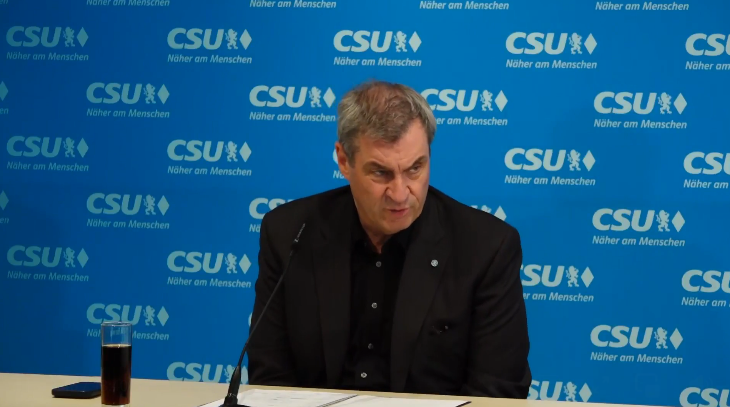

Bavarian Minister-President Markus Soder will attend the Sudeten German Congress in Brno next week, despite the heated debate about the event in the Czech Republic, he said at a press conference today following a meeting of the executive committee of his Christian Social Union (CSU). His announcement came despite unspecified threats from Czech Foreign Minister Petr Macinka that Soder and German Interior Minister Alexander Dobrindt “would not enjoy” their visit to Brno.
The Sudeten German congress will take place from 22-25 May in Brno, as part of the Meeting Brno festival. It is being held in the Czech Republic for the first time.
After the congress, Soder will head to Prague to meet Czech President Petr Pavel, who has invited him to Prague Castle.
“I want to make this clear once again, following some debates in the Czech Republic: Of course I will attend the Sudeten German congress in Brno,” said Soder. “It is an expression of support for the Sudeten Germans.”
In his capacity as Bavarian minister-president, Soder is the patron of the Sudeten Germans, who have been considered one of the tribes of Bavaria since 1954, along with Bavarians, Franconians and Swabians.
Soder has not yet officially confirmed his participation in the congress. In February, at a press conference following a meeting with Czech PM Andrej Babis (ANO) in Munich, he told CTK that he would likely be there. At the end of April, Dobrindt, who is also a member of the CSU and whose ministerial portfolio includes issues related to the displaced, confirmed his participation in the congress to CTK
The programme on the website of the Sudeten German Landsmannschaft (SdL) states that Soder will deliver a speech at the congress on Sunday, 24 May.
“I also received an invitation from Czech President Pavel. And on the same day, at his invitation, I will visit him at Prague Castle…I was very pleased by this, because I think it is a very good sign of reconciliation,” Soder said.
The government coalition of ANO, Freedom and Direct Democracy (SPD) and the Motorists has proposed a resolution to the Chamber of Deputies opposing the holding of the Sudeten German congress in the Czech Republic. Furthermore, based on the proposal, the Czech parliament would call on the organisers to abandon the event. The draft resolution will be debated again on Thursday after a pause of several days. The organisers have said that the congress will take place regardless of how the deputies vote.
The Sudeten German Congress was also the subject of talks between Macinka (Motorists) and his German counterpart Johann Wadephul in Berlin on Friday, as well as between Macinka and Stephan Mayer, chair of the Czech-German Parliamentary Group in the Bundestag. Mayer confirmed the topic of the discussions to CTK, but declined to provide details, stating that it was a confidential discussion.

In an interview in Berlin with the German daily Frankfurter Allgemeine Zeitung (FAZ), Macinka said: “I don’t think Minister-President Soder and Minister Dobrindt will enjoy this day in Brno,” without further explanation. He also reiterated his criticism of Sudeten German leader Bernd Posselt and the Meeting Brno initiative, which invited the Sudeten Germans to the Moravian capital, and which Macinka described as a “political non-profit”. On Friday, Macinka said that he did not believe the Czech debate over the congress would damage Czech-German relations.
Czech PM Andrej Babis said the congress was not a good idea, and that the result would be the opposite of what German politicians expect. “Instead of reconciliation, old wounds will be reopened, people will start arguing again, and it will divide them. We can already see that happening,” Babis told CTK.
About 3 million Germans were expelled from Czechoslovakia after World War II, mainly from the border regions (Sudetenland). According to a Czech-German commission of historians, between 15,000 and 30,000 people died during the expulsion. During the preceding more than six years of Nazi rule, approximately 320,000 to 350,000 inhabitants of the former Czechoslovakia died.
Relations between the Sudeten Germans and the Czech Republic have improved significantly in recent years, in part thanks to the SdL removing references from its statutes to the return of property confiscated from the Sudeten Germans after the war. The Czech side has also taken a number of conciliatory steps, most notably a speech by PM Petr Necas (ODS) in Munich in 2013, expressing the Czech Republic’s regret over the injustices inflicted on Sudeten Germans during the expulsion.