


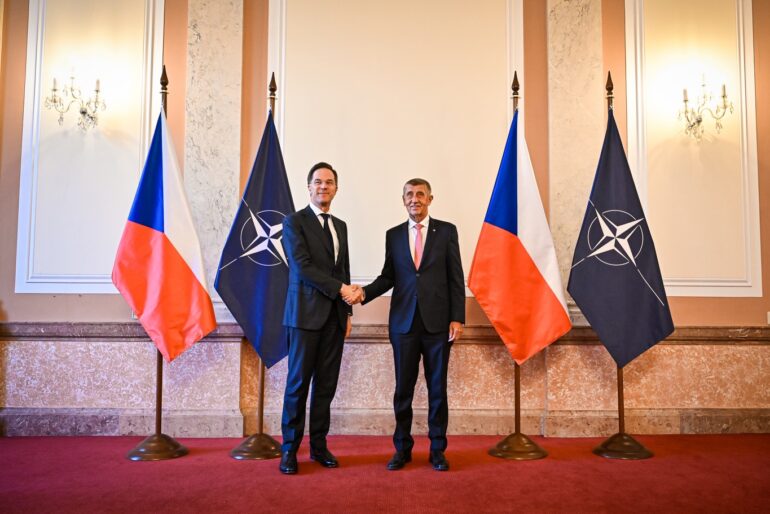

After meeting NATO Secretary General Mark Rutte in Prague yesterday, PM Andrej Babis (ANO) said the Czech government considers its defence capabilities and commitments to NATO to be important and a priority, and will do everything in its power to fulfill them.
Rutte noted that the Czech Republic has been a reliable ally since joining the alliance and is committed to contributing to collective defence. He recalled that NATO decided last year to increase defence spending due to the global security situation.
Babis’s three-party cabinet has faced criticism, including from U.S. diplomats, for allocating less than 2% of GDP to defence in this year’s budget.
Babis claims that the two sides have conflicting data on spending and its share of GDP, so they will exchange this information and discuss it ahead of the NATO summit in Ankara in July.
“It is important that we know each other’s expectations and capabilities,” said Babis at the press conference.
Rutte emphasised the importance of increasing defence spending, so that NATO countries have the forces, resources and capabilities to protect their citizens. “We know – and this applies to all allies – that making budget decisions and increasing defence funding is not easy. Ultimately, however, security is the foundation of prosperity,” he said.
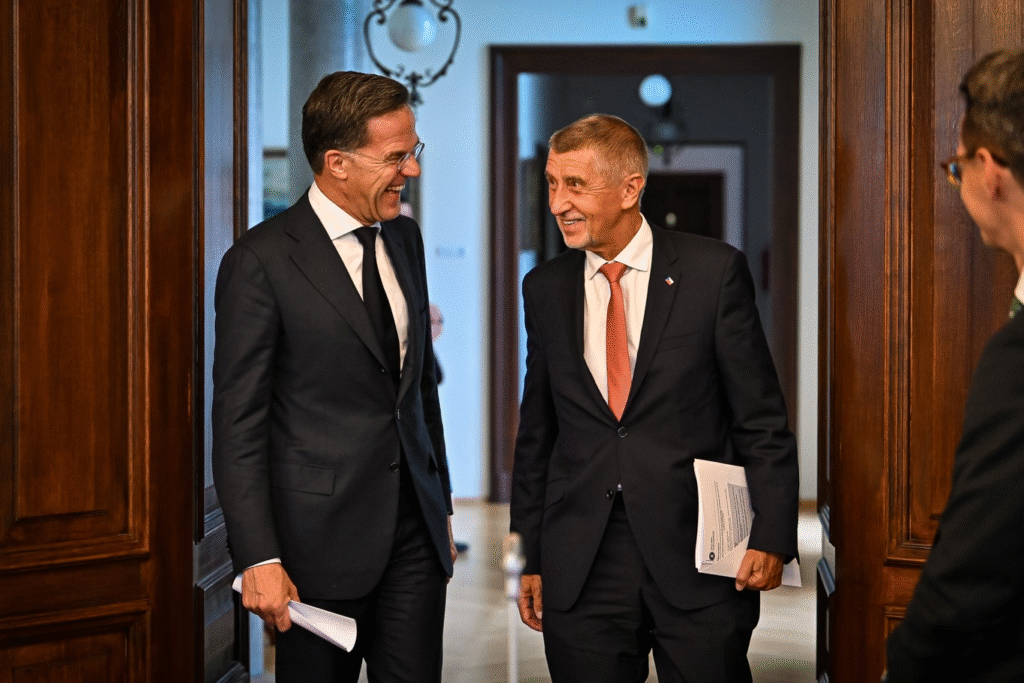
Credit: Andrej Babis, via Facebook
Czech Defence Minister Jaromir Zuna (SPD), who also attended the meeting with Rutte, told reporters after the press conference that the focus now is not on a detailed analysis of specific figures, but rather on coordination ahead of the upcoming allied talks.
Foreign Minister Petr Macinka (Motorists), also present at the meeting, told CTK that the meeting was “very friendly, very constructive and very important”.
Rutte praised the decision to continue the Czech ammunition initiative in aid of Ukraine, which he said is having a real impact. He called on allies to continue funding it.
“Ukraine needs our help so that it can deter Russia today, so that it is in a strong position to achieve peace, and so that it is capable of deterring any future aggression,” said Rutte.
Although Babis’s government did not terminate the initiative after taking office late last year, it stopped contributing funds from the Czech budget.
Last June, at a NATO summit in The Hague, member states agreed on a new target to increase total defence and security spending to 5% of GDP within ten years, with 3.5% going toward military procurement. At that time, the cabinet of Petr Fiala (ODS) was in power in the Czech Republic, while Babis and the current governing coalition parties were in opposition.
Babis’s government has allocated 1.7% of GDP for defence spending in this year’s budget. It would only exceed 2% of GDP if funding for defence-related projects in other ministries were included. U.S. diplomats recently pointed out that the Czech Republic is not meeting its NATO commitments regarding defence spending in the approved budget. Babis claims he can explain the Czech government’s approach to its allies.
Opposition figures said the prime minister’s defence had been insufficient, and accused him of being “evasive”.
“Andrej Babis tried to defend the deplorable state of our defence spending in front of Mark Rutte,” wrote ODS leader Martin Kupka on social media. “But he was skating on thin ice. It didn’t look good. I do approve of one thing, however, and that is the assurance that we will fulfill our commitments to NATO. Now I just hope it doesn’t end up like it always did.”
Babis also drew criticism from Pirates MP Ivan Bartos, who told CTK that the prime minister was “being vague about the defence budget, even though he himself acknowledged the 2% of GDP commitment – which the government is not currently meeting – after meeting with [Rutte].”