


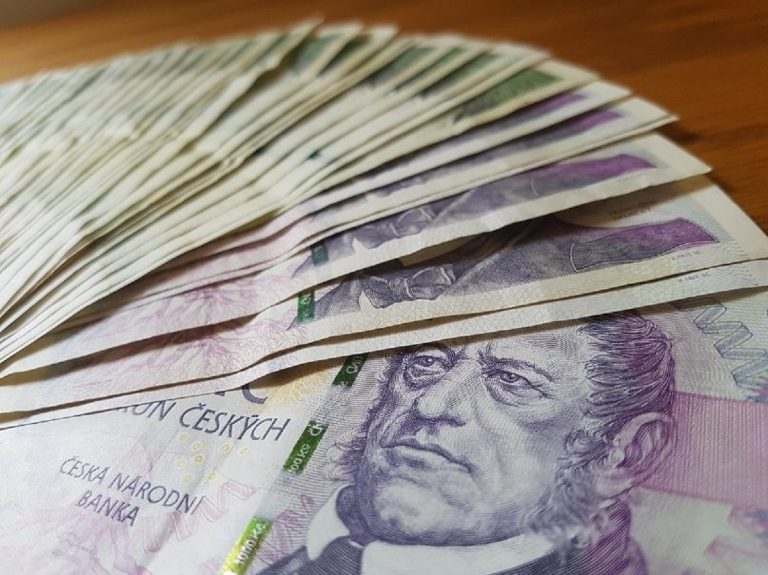

The ‘minimum decent wage’ for full-time work in the Czech Republic, enough to cover the needs of an adult with a child, leisure time and some savings, was CZK 48,336 before tax last year, a year-on-year increase of roughly CZK 2,500, as calculated by the Platform for a Minimum Decent Wage.
In Prague and Brno, the minimum decent gross income was CZK 56,912 due to high housing costs, an increase of nearly CZK 3,000 compared to the year before last.
However, some 2.5 million workers fell short of this level.
According to the Czech Statistical Office (CSU), the average gross wage in the Czech Republic reached CZK 49,215 last year, with half of the population earning less than CZK 45,523 in the final quarter. The minimum wage was CZK 20,800.
The minimum decent wage refers to compensation for full-time work of a person who supports another person – a child or an adult.
In calculating the minimum decent wage, the team of experts from the platform took into account the costs of food, housing, clothing, transportation, health and hygiene, mobile phone service, the Internet, leisure time, and modest savings.
“A significant portion of the population still remains below the minimum decent wage threshold,” said the group. “Last year, this amounted to approximately 2.5 million workers (63%). Nearly three-quarters of women earn less than the decent minimum wage.”
While purchasing power is rising, people will likely not return to their pre-COVID standard of living until this year, due to inflation and stagnant earnings in recent years, the platform noted.
The minimum decent wage rose by CZK 2,471 year-on-year, and by CZK 2,959 in Prague and Brno.
In the two largest cities, experts calculated the cost of a reasonable flat with utilities and services at CZK 21,392 and food at CZK 8,530. Elsewhere, these costs were CZK 15,342 and CZK 8,286, respectively. Thus, housing costs were CZK 1,300 higher per month in Prague and Brno year-on-year, and CZK 1,000 higher elsewhere, while food costs were 90 crowns higher.
Last year, typical monthly spending on clothing and footwear amounted to CZK 1,247, on transportation CZK 2,208, on health and hygiene CZK 1,730, on telecommunications CZK 1,378, on leisure CZK 4,030, and on savings CZK 5,082. Compared to 2024, spending on clothing fell by 250 crowns. For other items, it rose by 50 to 350 crowns.
The platform noted that teaching assistants, 86% of social workers, and four in five teachers in Prague and Brno do not receive the minimum decent wage.
“Even with a decent wage, it is essentially impossible to buy one’s own home, and paying higher rent can also be a problem,” said social anthropologist Lucie Trlifajova.
Experts point out that low wages impact households’ resilience during economic fluctuations, as well as their health, relationships and political preferences.
“If people go to work properly, they should be able to provide the essentials for themselves – for many, this is perhaps the most important and tangible feature of a functioning democracy. If this isn’t the case, it’s no wonder that some people feel the system isn’t working and are becoming politically radicalised,” warned political scientist Katerina Smejkalova.