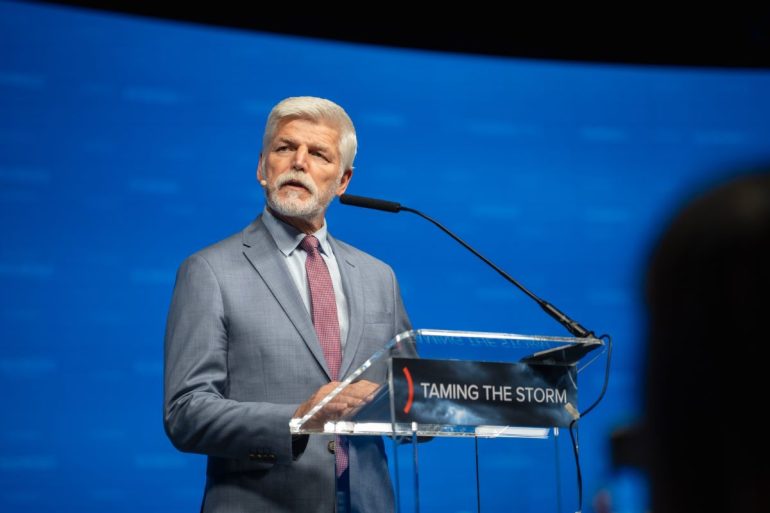

Czech President Petr Pavel has signed this year’s state budget with a deficit of CZK 310 billion, according to information published on the Chamber of Deputies’ website.
The signed budget will take effect the day after its publication in the Collection of Laws. This will end the stopgap budget under which the state has been operating since the beginning of the year.
Last year, the forecast deficit was CZK 241 billion, and the budget ultimately ended with a deficit of CZK 290.7 billion.
The president previously stated that he would not veto the budget. Following Tuesday’s meeting between him and Prime Minister Andrej Babis (ANO), the Presidential Office announced that he would sign it today. Pavel, however, criticised what he considered to be low defence spending this year, while Finance Minister Alena Schillerova (ANO) defended it in the Chamber of Deputies. Nevertheless, the Presidential Office said that if defence spending in the next budget did not meet the Czech Republic’s commitments, it would necessarily trigger a debate on rejecting the budget.
The Presidential Office communications department stated in a press release today that Pavel had serious reservations about the budget but decided not to stand in its way, as budgetary policy is primarily a matter for the government. “Given his constitutional powers in foreign and security policy, the president views the state of the defence budget with particular concern,” his office announced.
President Pavel did not veto the 2025 budget either, despite reservations expressed by the Czech Fiscal Council as well as his then economic adviser David Marek.
The council also had reservations about this year’s budget, saying it violates the law on budget responsibility. The deficit exceeds the limit permitted by law, it warned.
Schillerova has repeatedly rejected this claim, arguing that the rules do not apply to a situation where the Chamber of Deputies returned the draft budget to the government for revision.
The previous government of Petr Fiala (ODS) submitted the draft of this year’s budget to parliament last year after the general election, but the new governing coalition returned it to Fiala’s team for revision. Babis’s cabinet therefore submitted its own draft budget.

Budget revenues are increasing year-on-year by CZK 31.7 billion to nearly CZK 2,118 billion, and expenditures are set to rise by CZK 100.7 billion to nearly CZK 2,428 billion in the new 2026 budget.
During the final approval, the Chamber of Deputies supported only the changes proposed by the coalition, including an additional CZK 800 million to the National Sports Agency to support sports infrastructure and CZK 120 million to the MEDEVAC medical humanitarian programme. MPs also approved an additional CZK 50 million for organisations working with youth, as well as a separate proposal from Babis adding CZK 100 million to anti-drug policy.
The publication of the state budget in the Collection of Laws will end the nearly three-month stopgap budget, the fourth in the history of the Czech Republic.
A stopgap budget regime takes effect if the Chamber of Deputies does not approve the state budget bill before 1 January of the year in question, and is replaced when the new state budget is passed. During the stopgap budget period, state finances are managed according to the last approved budget. Each month, individual chapters of the state budget receive funds for expenditures up to one-twelfth of the total annual sum from the previous year.