

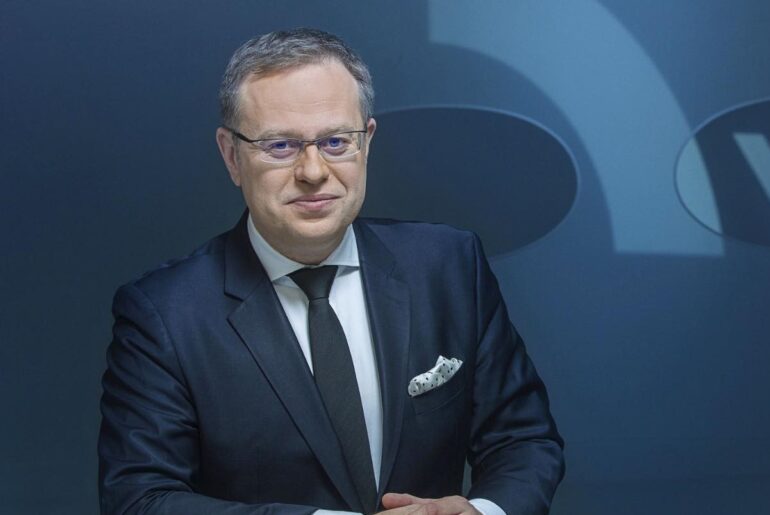

Czech Television’s veteran political interviewer and presenter Vaclav Moravec yesterday announced his departure from the public broadcaster after more than 21 years, at the end of his regular Sunday evening discussion show, ‘Questions from Vaclav Moravec’. He said that under the current conditions, he can no longer guarantee the editorial independence of his show and critical reflection in accordance with the public television code.
Czech Television (CT) spokesman Michal Pleskot told CTK that neither the CT management nor its news department had been informed in advance of Moravec’s decision to resign. He denied that editorial independence is not guaranteed at CT.
“Our time is up—for part of our conversation, as well as for my time at Czech Television after more than 21 years,” said Moravec at the end of yesterday’s show. “Recent events have confirmed my belief that, under the current conditions, I can no longer guarantee the independence of editorial work and critical reflection on events, as mentioned in the preamble to the CT code.”
He added that he did not want to disappoint viewers of the most-watched Sunday discussion programme “by shifting to pseudo-balance, or blind balance,” and added that, in his opinion, such “balance” destroys public service.
According to Pleskot, CT respects Moravec’s decision. “The situation surrounding Sunday’s discussion programme will be addressed in the coming days. At this point, it is premature to comment further,” he said. “However, we categorically reject Vaclav Moravec’s claim that editorial independence is not guaranteed at CT. Vaclav Moravec, in his position as host of CT’s main political discussion programme, is subject to a completely standard editorial approach, just like all other hosts of other CT programmes.”
Some opposition politicians have expressed concerns about the independence of the Czech media. A wave of responses from opposition politicians appeared on social media in the afternoon.
“Every day we hear about attempts to destabilise and undermine the media,” said Pirate Party leader Zdenek Hrib. “Attacks, intimidation, insults. Even from politicians. This is unacceptable.”
ODS leader Martin Kupka wrote that the opposition would closely monitor developments at CT.
Moravec hinted at his possible departure from CT at the beginning of the year, in connection with discussions about balance on his show. Because of these discussions, the CT management dismissed the long-time chief manager of the programme, Hana Andelova, at the end of January. Her dismissal was related to the fact that Tomio Okamura, long-standing leader of Freedom and Direct Democracy (SPD) and since last autumn the speaker of the Chamber of Deputies, had not been invited onto the debate show for nine years. Some members of the Czech Television Council had also been pointing this out for a long time.
Yesterday, after many years, Okamura appeared as a guest in the discussion, along with his three predecessors at the head of the parliament. During the debate, he came into conflict with Moravec, who claimed that Okamura was not following the rules of the discussion.

“You don’t even know what question I asked you because you keep talking about your own agenda,” Moravec said to Okamura, who objected in turn to the presenter’s words.
In reaction to Moravec’s announcement, Okamura told reporters that there are many presenters in the Czech Republic who would be able to host high-quality political programmes on CT after Vaclav Moravec leaves.
He said Moravec’s departure from CT would have no impact on the government’s plans to abolish license fees, which currently finance the public broadcasters Czech Television and Czech Radio. He said this was an election promise, which he would like to see implemented by the beginning of 2027.
Critics of the plans have warned that abolishing the fees would leave Czech Television and Czech Radio financially dependent on the government via the state budget, thereby weakening their independence. Okamura insisted the plans were not a threat to democracy and were in line with European Union trends.