


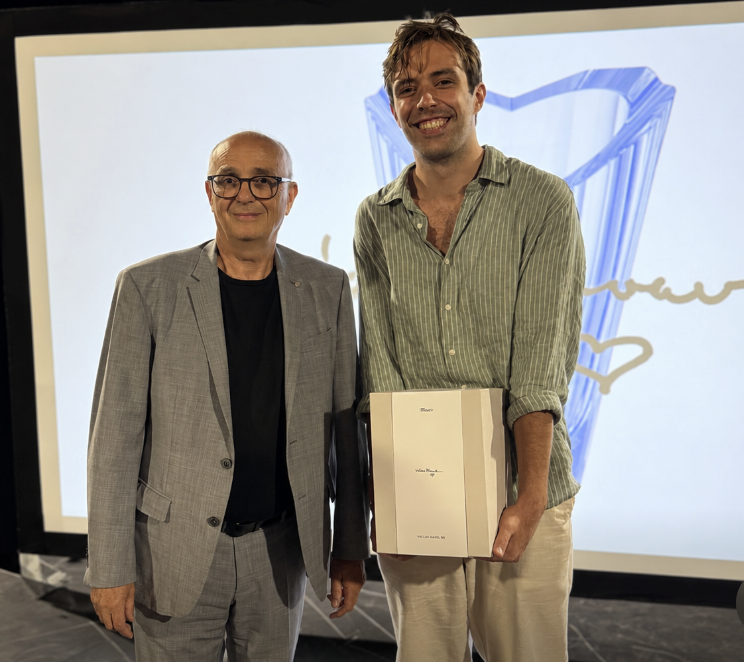

Lilac, a previously unpublished play by the late Czech playwright and President Vaclav Havel, premiered at the Avignon theatre festival yesterday, and the international Vaclav Havel Prize was awarded for the first time, going to Ukrainian actor and playwright Viktor Kyrylov, the Czech Centre in Paris told CTK.
The commemorative event was held in anticipation of the 90th anniversary of Havel’s birth in October.
The unfinished one-act play Lilac, which Havel (1936-2011) also referred to in his notes as ‘Warning’, remained hidden for nearly 40 years before it was discovered among the estate of writer Zdenek Urbanek, a fellow signatory of the Charter 77 human rights manifesto.
“It’s actually a gift that Mr. Vaclav Havel gave us for his 90th birthday,” commented David Dusek, who discovered the manuscript.
The play was completed by playwright, actor and director Jiri Havelka, who wrote about 20% of it. The text was presented yesterday in the form of a staged reading by former students of the 73rd class of the French theater school ENSATT, which bore Havel’s name from 2011 to 2014 in honour of legacy. Staged under the artistic direction of French director Frederik Poty, the text was translated by Katia Hala, who has previously translated Havel’s other works into French.
In a press release, the Czech Centre in Paris wrote that the play, which features Havel’s alter ego Ferdinand Vanek, presents “a dialogue between a cat and a mouse, that is, between a member of the secret police and a dissident writer, conducted precisely in the spirit of Havel.” The name Lilac refers to the secret police officer who came to visit Vanek.
Last night the Avignon festival also saw the announcement of the first recipient of the Vaclav Havel Prize, presented by La Manufacture theatre and the Czech Centre in Paris, in collaboration with the Prague National Theatre and the Dagmar and Vaclav Havel Foundation. An eight-member international jury led by Prague National Theatre director Jan Burian selected the winner from among five finalists.
In addition to Kyrylov, the finalists included Brazilian director Christiane Jatahy, Palestinian poet and playwright Hind Joudah, French writer Edouard Louis, and French-Iranian journalist and author Delphine Minoui.
According to Burian, the jury made its decision “across a broad spectrum of painful topics from around the world…Despite the different genres and the varied experiences of the individual authors, most of them demonstrated the courage to portray the world truthfully, regardless of how comfortable that might be for anyone. Vaclav Havel would certainly have been pleased by this.”
The jury selected Kyrylov as the inaugural winner of the Vaclav Havel Prize. His play ‘Now I Write Only in French’ depicts the shattering of his theatrical dream in Moscow, which turned into a betrayal due to the Russian invasion of Ukraine.

“From among many interesting and high-quality candidates, the jury selected Viktor Kyrylov, whose work combines artistic quality with painful personal experiences from the contemporary world, in which former friends become enemies due to changing social circumstances,” said Burian.
Kyrylov’s play is being staged at the Festival Off Avignon.
At the ceremony, Kyrylov said he found deep inspiration in the story of Vaclav Havel, as well as the conviction that the artistic profession can serve a greater purpose, and that it is precisely from small theatres, only half-full, that dictatorships can be overthrown.
The other finalists also spoke yesterday of Havel as a source of inspiration. “Havel is a man who refused to remain silent in the face of the system’s violence,” said Louis, whose work is known to Czechs through translations of his books as well as through plays staged in Czech theatres. Louis noted that Havel, as a playwright and dissident, turned writing into a weapon against state lies and oppression.