


A Prague district court today imposed a fine of CZK 3 million on the junior coalition party Freedom and Direct Democracy (SPD), for its controversial election posters which the court ruled amounted to incitement of hatred. The verdict has not yet taken effect.
SPD denies any wrongdoing, arguing that it was merely expressing its views on the migration pact and the abuse of benefits.
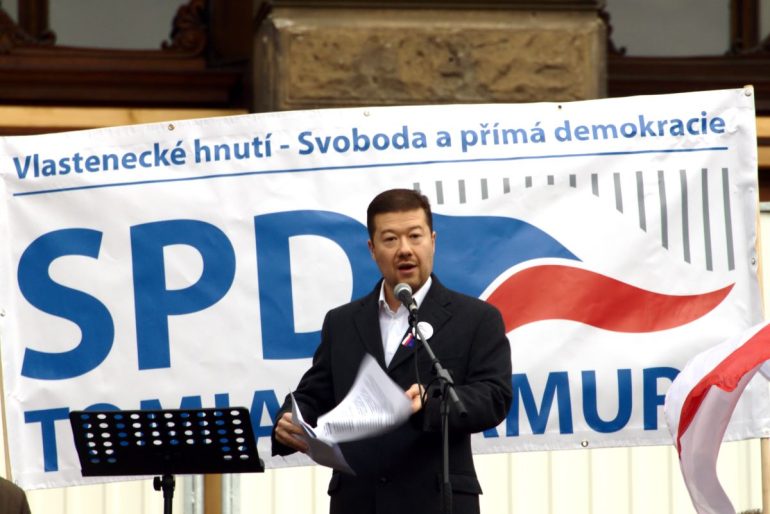
SPD leader Tomio Okamura, who is currently the Speaker of the Chamber of Deputies, has also been charged, but his prosecution has been halted as MPs refused to lift his immunity.
One of the posters featured a dark-skinned man holding a bloodied knife and wearing a bloodstained shirt, accompanied by the text “Shortcomings in healthcare will not be solved by imported ‘surgeons’” and “Stop the EU Migration Pact.” Another poster showed two Roma boys smoking a cigarette, with the accompanying text reading “They tell us to go to school, but our parents don’t care…” and “Support only for families where children attend school!”
“Having an opinion and the way I express that opinion are two different things,” said Ivana Ticha, a judge at the District Court for Prague 1, explaining the ruling. “The problem with the defendant’s (SPD) election campaign is that it pitted those groups against the rest of the population of the Czech Republic in an ‘us versus them’ dynamic. This polarisation can lead, and in my opinion does lead, to an increase in fear or envy among people, which subsequently leads to hatred toward certain groups of people.”
SPD were represented in court today by lawyer Adam Batuna and legal representative Lenka Burgetova. Neither Okamura nor other party representatives or supporters appeared in court. Batuna stated that the movement considers itself innocent and that the acts do not constitute a criminal offence. According to him, the posters sought to truthfully address social issues. Burgetova briefly added that she is requesting an acquittal.
SPD disagrees with the CZK 3 million fine, Okamura told reporters. He said the party will appeal the verdict and is prepared to take the case all the way to the Constitutional Court. He also criticized Judge Ticha, who he accused of lecturing the party on how their campaign should look. He said he believed she had clearly prepared the verdict in advance.
“The goal of our posters was not to incite hatred, but to name problems that actually exist,” Okamura said. He said SPD was being unlawfully prosecuted for the free expression of opinion against illegal migration and against the payment of benefits to people who do not send their children to school. “We were in no way targeting racial motives,” he said.
“I believe that incitement to hatred has no place in politics, or indeed in any decent society,” said President Petr Pavel, responding to the verdict. “We should speak out unequivocally against it, regardless of who is responsible.” According to the president, the court’s decision must be respected, and everyone should learn from it that “this is not the way forward”.
Prosecutor David Jachnicky had sought a fine half a million crowns higher than that imposed by the court. He pointed to the movement’s complete lack of self-reflection as well as its reprehensible motive and financial gain.
“The defendant engaged in the aforementioned conduct in order to gain power, influence, and thereby material benefit,” he stated. He emphasised that freedom of speech, including political speech, has its limits. He drew a parallel with Nazi Germany, where, according to him, hate speech did not begin with violence, but with words. Because of this historical experience, he argued, a democratic state cannot wait until hatred turns into a concrete attack.
From the outset, Okamura has characterised the criminal proceedings against him and his movement as political. In his view, they are the result of the previous governing coalition’s efforts to influence last year’s parliamentary elections. He had previously described the campaign as an allegory.
In 2024, the coalition of SPD, Tricolour and PRO also faced attempts to halt its campaign through the courts due to the posters. People in various regions who were outraged by the posters filed motions, asking the courts to protect the democratic nature of the elections. The regional courts did not grant the motions. The Constitutional Court did not intervene either, finding no procedural grounds to do so.