
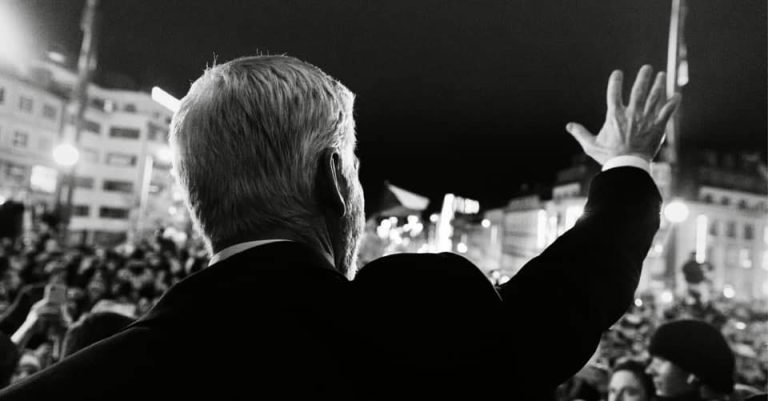

President Petr Pavel is the only potential candidate for the next Czech presidential election who could win more than 50% of the vote, according to a survey by the STEM/MARK agency. The researchers found that 53% of people in the Czech Republic would or might vote for Pavel, followed by Prime Minister Andrej Babis (ANO) who could win up to 44% in a presidential election.
The survey was conducted by STEM/MARK in late April and early May, and published on its website today.
Among the other figures presented to survey respondents, actor and TV host Marek Eben would receive 40%, Minister of Industry and Trade Karel Havlicek (ANO) 35%, and Minister of Finance Alena Schillerova (ANO) 30%.
Pavel was the only potential candidate rejected as president by fewer than half of those polled. 45% percent of people would not vote for Pavel as president, while 56% would not vote for Babis. This figure was 53% for Eben, 51% for Havlicek and 65% for Schillerova.
The most rejected potential presidential candidate included in the survey was former Prime Minister Petr Fiala (ODS), whom 80% of people would not want as the Czech head of state, followed by MP and government commissioner for the climate and Green Deal Filip Turek (Motorists) rejected by 79%, and the leaders of the junior governing parties, Tomio Okamura (SPD) and Petr Macinka (Motorists), rejected as head of state by 74% of respondents each.
Before presenting the options, STEM/MARK asked people to answer spontaneously when asked who should be president in 2028. 38% of potential voters were able to name a specific person in this way.
“The range of names that came up is quite broad,” the agency stated. “However, current President Petr Pavel dominated among the most frequently mentioned names, followed at a significant distance by Andrej Babis, Karel Havlicek, and Alena Schillerova.” The remaining respondents either could not think of any potential candidate or do not currently consider the presidency a relevant topic.
According to the survey, the perception of the importance of the president’s post has declined slightly since the previous survey in the fourth quarter of last year. This year, 67% of respondents consider it definitely or fairly important, compared to 76% last time. Approximately one-fifth view the office of the president as insignificant. 35% of people support strengthening the president’s role, while roughly 14% favour weakening it.
One in seven eligible voters is well-informed about the powers of the Czech president. This group more often consists of university graduates, Prague residents, and voters of the current opposition parties, according to the survey.
“Although the majority of the public correctly identifies the president’s power to veto laws and grant pardons, deeper awareness of specific constitutional powers, such as the appointment of judges and members of the Czech National Bank’s board, remains limited among a significant portion of the population,” noted Jan Burianec of STEM/MARK.
In terms of political experience, voters expect the future president to have practical political experience, but ideally to enter the race as a non-partisan who is independent of lobbyists and political parties, the survey authors stated.
Among the qualities offered for the next president, the largest share of respondents (21%), mentioned honesty, integrity and decency. According to 19%, the president should be impartial and non-partisan; 17% said they should be respectable; and 15% chose the option “is here for the people”. 11% would like the president to be intelligent and educated, and the same number would like a patriot who defends the interests of the Czech Republic.
The survey was conducted between 13 April and 4 May with more than 1,000 people aged 18 and older. As previously reported, the same survey found that people considered Vaclav Havel to be the best post-communist president, followed by Vaclav Klaus in second place, Petr Pavel in third and Milos Zeman in last place.