


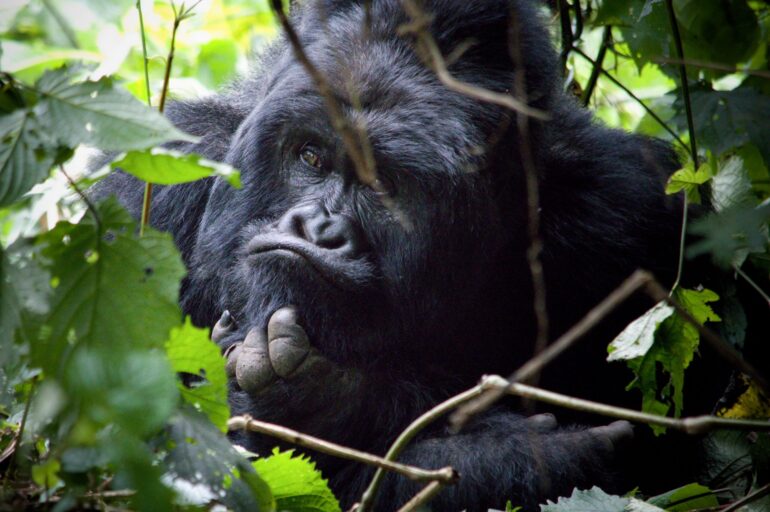

The conservation of mountain gorillas is one of the greatest conservation successes, reversing a long-term decline in their numbers and achieving steady population growth in the wild, but recovery of the population also brings new health risks. New research from an international team of scientists based in Brno has found that changes in parasite communities, specifically a significant increase in the Hyostrongylus nematode, commonly found in domestic pigs, are behind the increase in severe cases of gastroenteritis, including deaths. The results, published in the Journal of Applied Ecology, highlight the importance of long-term monitoring for the conservation of this beloved species.
A study analyzing parasites in almost two-thirds of the mountain gorilla population was conducted in 2018 in the Virunga Mountains on the border of Uganda, Rwanda, and the Democratic Republic of Congo. The study combined classical parasitology, genetic sequencing, and spatial analyses.
“Our results show that the incidence of the disease is not uniform. Most cases of severe gastritis occur in high-altitude areas between the Karisimbi and Bisoke volcanoes, where the problematic nematode of the genus Hyostrongylus occurs at the highest infection rates,” explained Klára Petrželková from the Institute of Vertebrate Biology at the Czech Academy of Sciences.
“It is not that we have discovered completely new parasites. The problem is changes in the composition and abundance of parasitic communities that have been present in the mountain gorilla population for a long time, but currently some species are becoming dominant and clinically significant,” explained Barbora Pafčo from the same institute. “We are well aware of similar processes from livestock farming, where the combination of high density of individuals, spatial restrictions and environmental changes often leads to the overgrowth of previously inconspicuous parasites and the development of diseases.”
A similar mechanism is observed in mountain gorillas today, but this time in a conservation context. Historically, Virunga gorillas, especially on the Rwandan side of the mountain range, were pushed from lower elevations to higher elevations, where conditions are cooler and wetter, due to habitat loss through the expansion of agriculture. Temperature and rainfall have been shown to be key factors in the composition of parasite communities. Combined with the very low genetic diversity of mountain gorillas, the result of a historical population bottleneck (i.e. when the population suffers a drastic decline and future generations are descended from only a few survivors), these factors may increase their susceptibility to developing parasitic diseases.
The possible role of livestock also warrants attention, according to the scientists. Nematodes of the genus Hyostrongylus are typical parasites of pigs, and cattle and pigs are commonly found around the borders of national parks. The fields surrounding the national park are also fertilized with organic fertilizers of animal origin, which may be a source of parasitic infections in the surrounding natural habitat of gorillas. In addition, gorillas occasionally enter agricultural fields, which may facilitate the indirect transmission of parasites between wild and domestic species.
Recommendations for gorilla conservation
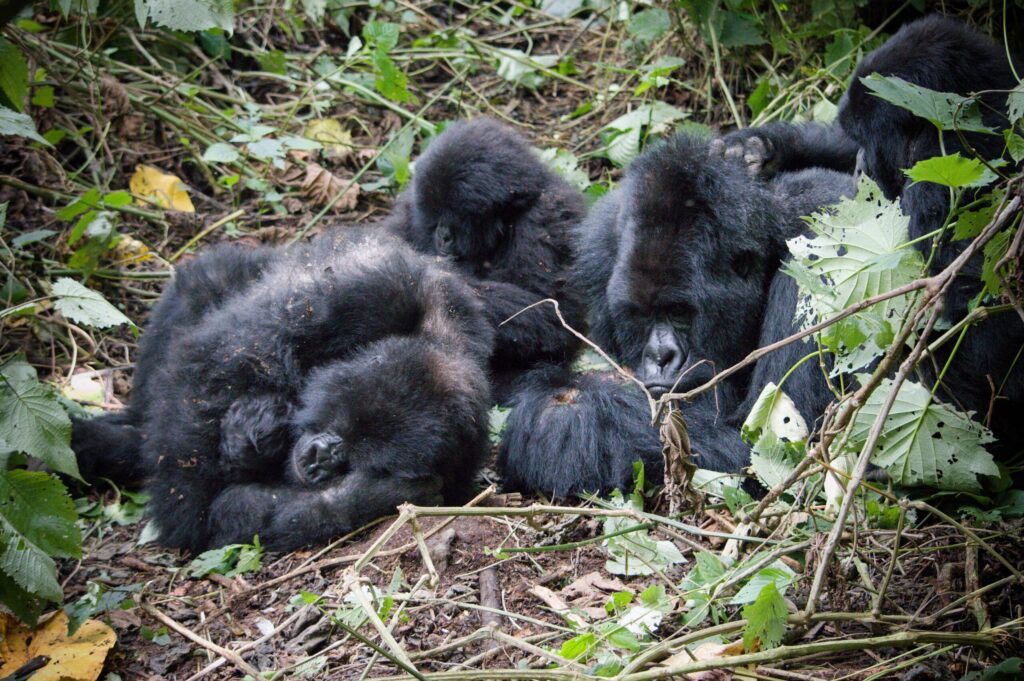
The authors of the study point out that the increase in the population of mountain gorillas due to intensive conservation brings with it new challenges that were not relevant until recently. The increasing number of individuals in a spatially limited and environmentally heterogeneous environment may affect the dynamics of infectious diseases, including parasitic infections.
The study therefore highlights the importance of long-term and systematic monitoring of gorilla health. Effective monitoring combines modern pathogen diagnostics with routine health monitoring of habituated gorillas, which is carried out in Virunga by field veterinarians from the Gorilla Doctors organization, who participated in and initiated the study. Special attention should also be paid to pathogens in livestock around national parks, which may act as potential reservoirs for parasites shared with wild species.
“The protection of mountain gorillas is one of the most successful examples of protecting endangered species, but it also shows that in small and spatially limited populations, new ecological conditions can also lead to health problems,” said Petrželková.
“Our results point out that parasites common in livestock can, under certain conditions, also pose a risk to wild populations, especially in areas strongly influenced by human activity. Similar mechanisms therefore do not only affect gorillas, but can also threaten other small and isolated populations of protected species,” added Pafčo.
The full article is available at this link.