


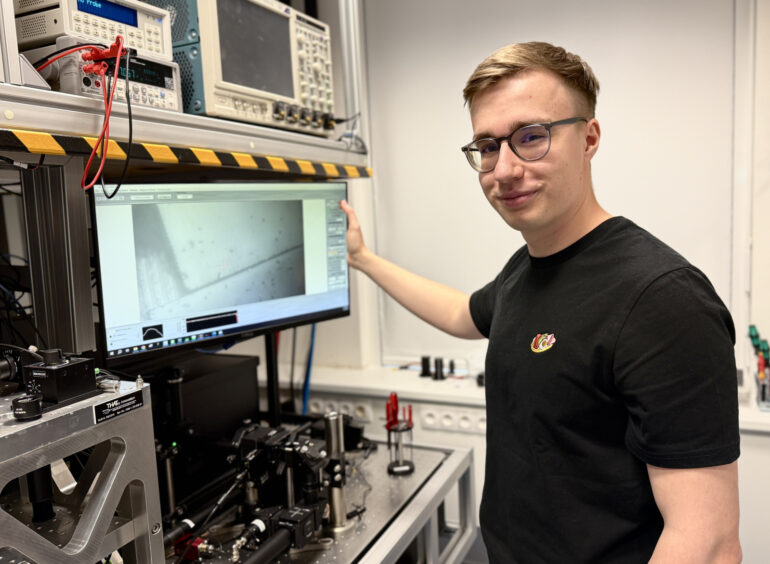

Scientists at CEITEC Brno University of Technology have announced a breakthrough that could accelerate the development of a new generation of faster, smaller and significantly more energy-efficient computer chips. The technique, which enables researchers to measure extremely short spin waves for the first time using standard laboratory equipment, has been published in the prestigious journal Science Advances.
The research was carried out by physicists from CEITEC BUT and the BUT Faculty of Mechanical Engineering, who focus on the emerging field of magnonics. Magnonics studies spin waves: tiny waves that travel through magnetic materials and can transmit information without relying on electric current.
Spin waves can be imagined as coordinated movements of countless microscopic “compass needles” inside a magnetic material. Unlike conventional electronics, which use moving electric charges to carry information, spin waves transport data without generating heat. This makes them a promising candidate for future computing technologies, particularly as today’s chips approach physical and energy-efficiency limits.
Until now, however, a major obstacle stood in the way of real-world applications. The most commonly used technique for studying spin waves, Brillouin light scattering microscopy (µBLS), can only detect waves with wavelengths longer than about 300 nanometres. While that may sound extremely small, it is several times larger than the transistors used in modern computer chips. Crucially, the shorter spin waves needed for advanced chip miniaturisation remained effectively invisible.
Attempts to overcome this limitation relied on large-scale facilities such as synchrotrons (massive particle accelerators) that are expensive and difficult to access. Even then, reliably measuring the shortest spin waves proved impossible, leaving researchers facing what many considered a fundamental experimental barrier.
That barrier has now been broken. In their newly published study, the CEITEC team introduced a novel approach known as Mie Brillouin light scattering, or Mie BLS. The method enhances the existing optical technique by placing ultra-thin silicon nano-resonators directly onto the surface of the material being studied.
These nano-resonators act as microscopic amplifiers and lenses for light. By exploiting a physical phenomenon known as Mie resonance, they allow light to interact with spin waves that are far shorter than its own wavelength, something previously thought to be unattainable.
With this innovation, researchers can now observe and measure short spin waves using conventional laboratory microscopes, without the need for specialised large-scale infrastructure. The result is a practical, accessible tool that opens entirely new possibilities for experimental research in magnonics.
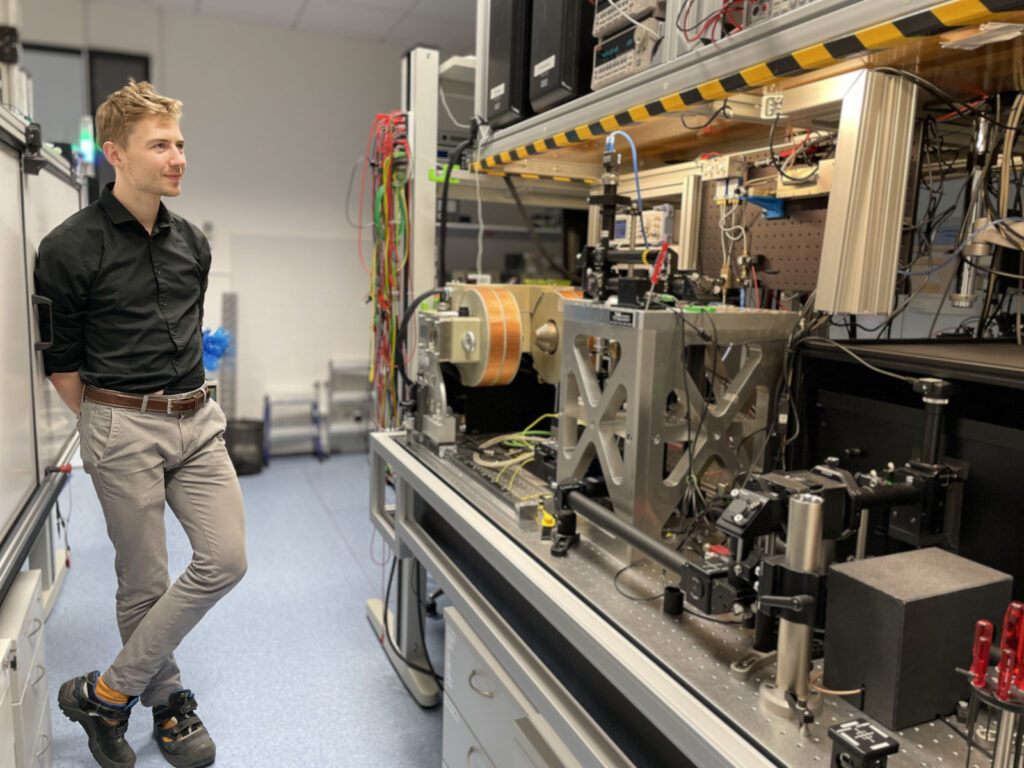
The implications are far-reaching. Being able to study short spin waves makes it possible to design so-called magnonic chips, in which information processing is based on spin waves rather than electric currents. Such chips would generate far less heat and could consume up to 20 times less energy than today’s electronics – an increasingly critical advantage as global demand for computing power continues to grow.
Beyond computing, the new method also has potential applications in other fields. It could be used in materials science to study microscopic structural changes, in biology for analysing complex systems at very small scales, or in industrial diagnostics, such as detecting microcracks in critical aerospace components.
The discovery underscores Brno’s growing role as an international research hub in advanced physics and nanotechnology. By refining an existing optical technique rather than replacing it entirely, the CEITEC team has delivered a solution that is not only scientifically significant, but also practical and scalable, bringing futuristic technologies one step closer to everyday use.