

There are two extraordinary, moving and meditative Nativity Scenes, or Betlém, near Brno city centre, two blocks apart, and equally evocative, but stylistically worlds away. One is in a historic, sacred Christian space, and one in a modern, very secular commercial space.
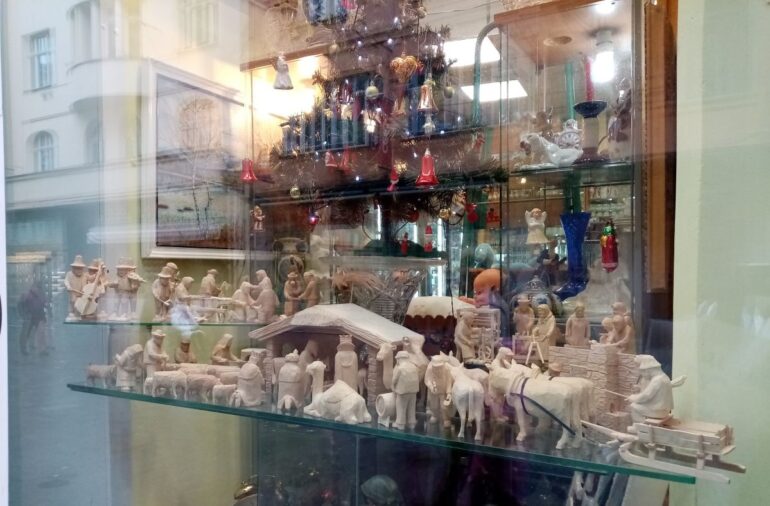
The first can be seen in the 13th century Minorite Church of St. John, at Minoritská 2. The second is in the window of the Bazar second-hand shop at Kobližná 12.
Both scenes are labours of love, populated with carefully rendered figures and idiosyncratic characters and animals.
In each case the figures were carved by one sculptor, over many years. The Minorite Betlém was carved by Jaroslav Vaněk over a period of 52 years, from around 1948 to 1990.
The Bazar Betlém’s sculptor is an 84-year-old man, who has been carving these pieces for at least 25 years. He only produces a few of the little groups for sale now, and lives far away from Brno. The Bazar owner, Josef Jekel, wants to protect the sculptor’s privacy.
The Minorite Betlém is very complex, and structured. The base is formed of 16 panels decorated with friezes showing events leading up to, during, and after the Nativity.
It stretches along the left hand side of the church for about 18 metres. The actual nativity scene is visible at the top of the frieze, with quarter to half life-size figures in the front, and smaller figures and flatter scenery at the back, to suggest perspective depth.
Above the scene there is a wooden cornice of rosettes and cherubs, and above this, the permanent stone sculptures of saints in the church, who seem happy to partake in this scene, gesturing down to us, as if to say, “Take a look at this.”
This Betlém is a full-colour scene, with carefully carved, polished and very naturalistic figures.
There is so much detail, it needs more than a single visit. Each viewer will have their favourite characters. The figure of Mary is beautiful, and Vaněk conveys wonderment and love in her expression and posture.
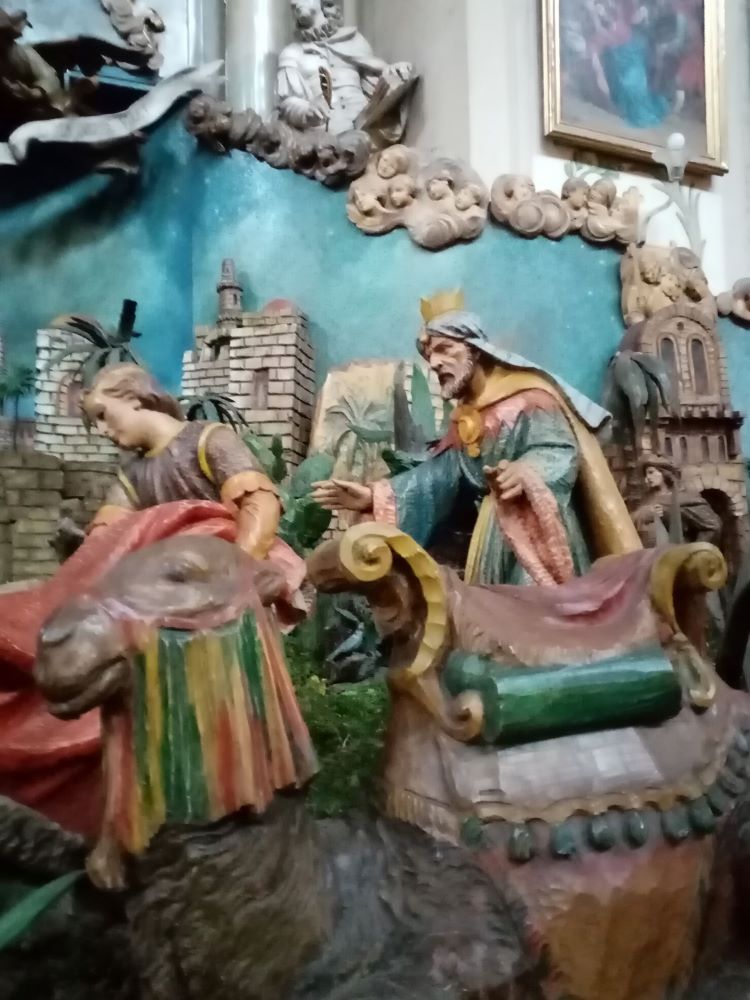
The three kings, are also outstanding and highly individualized. The first brings gold, and kneels offering his own crown on a cushion to the Holy Family. The second king carries an ornate box containing myrrh with his servant in attendance protecting and lifting the royal cloak off the ground. The third king’s servant carries an ornamental covered pot containing the frankincense, while the king himself has his arms outstretched, either with awe, impatience or concern, or all of the above.
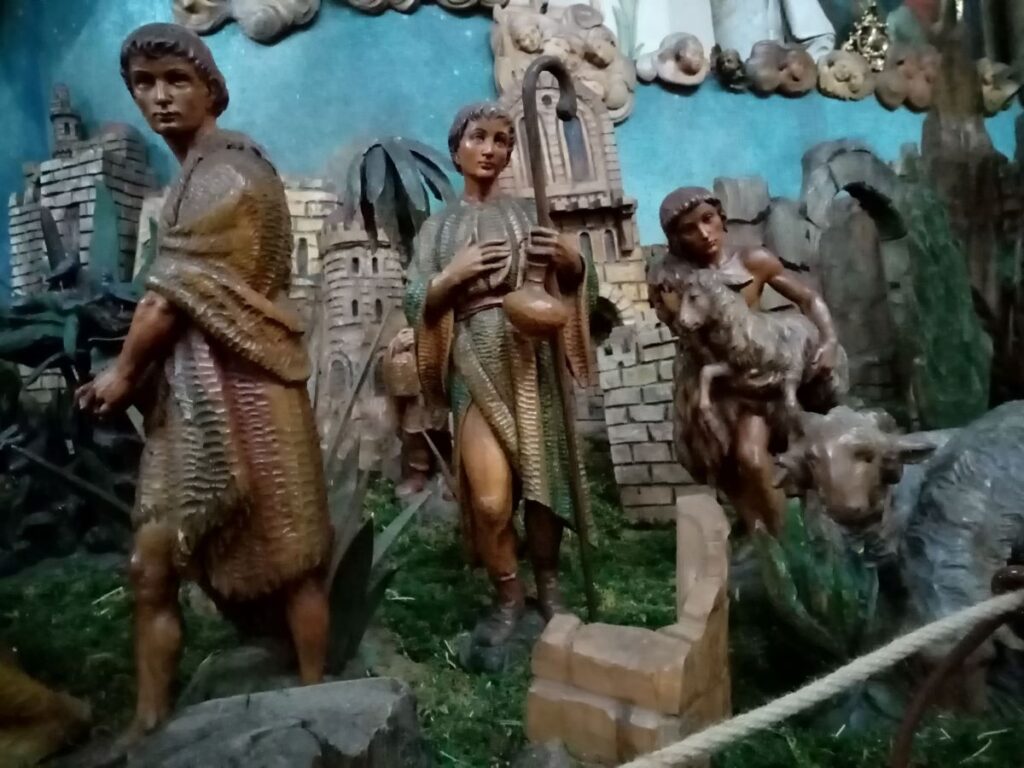
In sharp contrast to the colourful and decorated clothing of the kings, the shepherd boys wear rough, plain clothing, but their faces are finely featured and also suggest that they are witnessing something transformative. Apparently Vaněk included portraits of two of his sons in the Betlém. Possibly they feature in this group of shepherds, as there does seem to be a family resemblance.
Another novel inclusion is the figure of a former political prisoner and much-loved local priest, Father Norbert František Škrdlík, who encouraged Vaněk with this epic work. According to encyklopedie.brna.cz, Father Škrdlík had been in danger of losing his voice as a young man, but recovered fully, and gave very sonorous and popular sermons which filled the Minorite church to capacity.
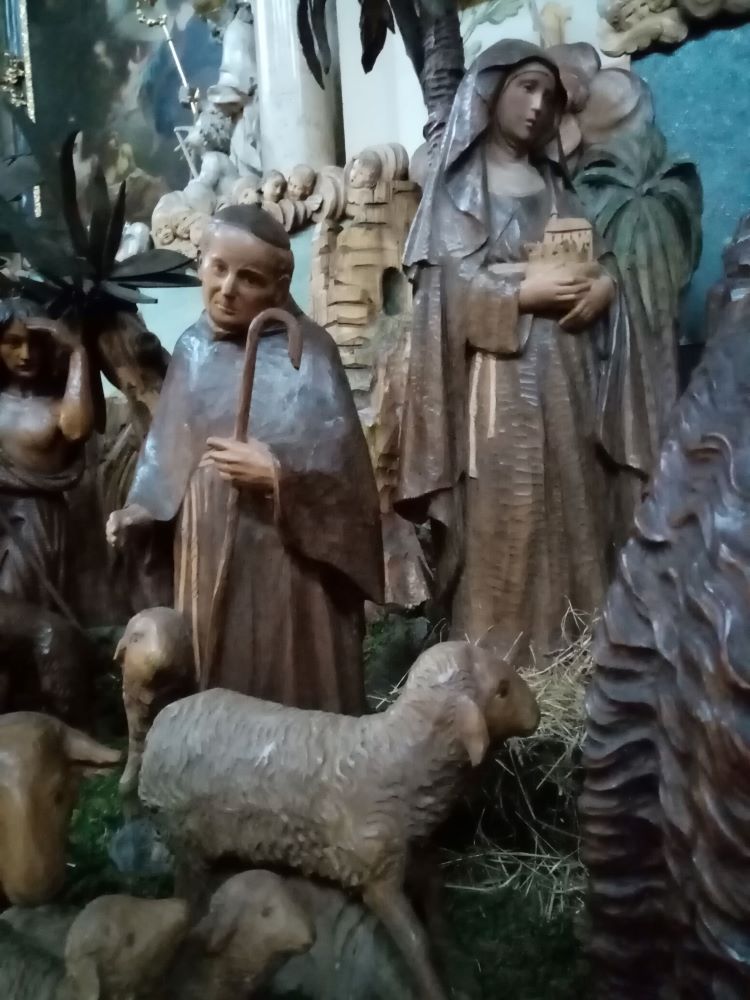
Today he looks at us, mute but with great expression, new visitors in his parish church.
Father Škrdlík stands near the shepherds and their flock of sheep. It is a carefully chosen, symbolic juxtaposition. He is also positioned next to a figure of St. Agnes of Bohemia, who carries a miniature model of the Minorite monastery she founded. She was canonized a saint just five days before the Velvet Revolution. For many Czechs, her officially sanctioned sainthood and thus new identity symbolically fulfilled the legend that “peaceful and merry times shall arrive in the Czech lands when the body of Blessed Agnes is found”, according to Alena Ježková, author of the book Czech Heaven.
The Bazar Betlém, in contrast, does not feature any well-loved Brno personalities or saints. Instead it is a folklore Betlém, populated by the conventional figures – the Holy Family, the Kings, the Shepherds and their animals – plus a wonderful panorama of traditional Czech musicians, craftsmen and tradesmen.
These figures are naïvely but skilfully carved miniatures, 10 to 15cm high, in a 2 metre long display. The Bazar Betlém is positioned on two glass shelves, along the length of the shop window. It is set among a display of the second-hand shop’s other brightly coloured and eclectic merchandise and Christmas decorations.
On the left side of the top shelf, there is a group of traditional Czech musicians, woodsmen and carpenters. On the right side there are the textile workers, the weavers and spinners, the grape crushers and potters.
On the lower shelf there is a wonderful group of two shepherds with a big herd of sheep, and at the back of this procession the poignant figure of a hunched over babička leading her single goat. Closer to the stable are the bakers of bread. One puts a loaf into the oven – just like bakers and pizza makers today – the other carries a baked loaf in a bowl.

On the lower right side there are the carriage sled drivers and their horses, a farrier shoeing a horse, a blacksmith shaping a horse shoe, and a cooper, preparing a cask for wine.
This is a wonderfully inclusive allegory – of everyone, in every station of life, coming to visit the Holy Family, and bringing the fruits of their labour, bringing their identities, as gifts. Not dressed up, just themselves, productive ordinary folk.
This sense of the everyday is also emphasized in the economical finishes, and the untreated, uncoloured and undecorated wood. Even the Holy Family and the Kings are not treated differently. It is a very egalitarian Betlém.
Many of the faces and postures are highly expressive, and convey a sense of hard work and fatigue, like the babička, the farrier and the cello playing musician.
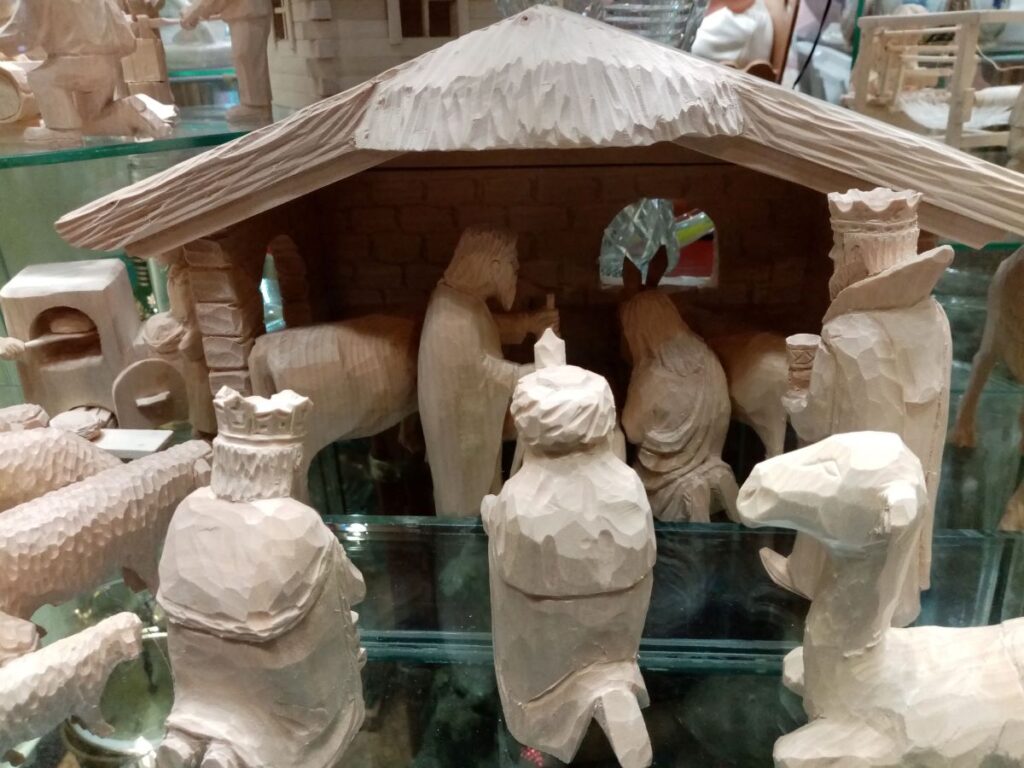
In the central piece, in a rough stable, Joseph stands protectively over the crib and the kneeling Mary, with a few animals looking in and the kings in front. A camel placed near them economically conveys the concept of the long journey made by the kings to Bethlehem. While the camel in the Minorite Church stretches out in glossy good health and has decorative saddlery, this Bazar beast of burden looks glad to be off his feet, and resting. However, placed near the kneeling kings, his tucked under legs also seem charmingly prayerful.
All of this powerfully harmonious work is situated among the other items for sale in the shop window. A brightly decorated Christmas tree is positioned above the Betlém, and it is surrounded by other knick-knacks, vintage items, porcelain figures, gadgets and glassware. The sales display changes from day to day, as items are sold.
These items are eye-catching, some beautiful, intriguing and distracting. This Bazar Betlém is a perfect visual allegory of our modern Brno life. It mirrors our search for enduring meaning and peace in the middle of a visual cornucopia of beauty and garishness, the historic and the now, the musical and the noisy, love and war.
Well done to the Nativity scene builders or “Betlémáři” of these two panoramic works. Both sculptors have created valuable and enduring visual gifts to all who have the privilege of seeing them.