
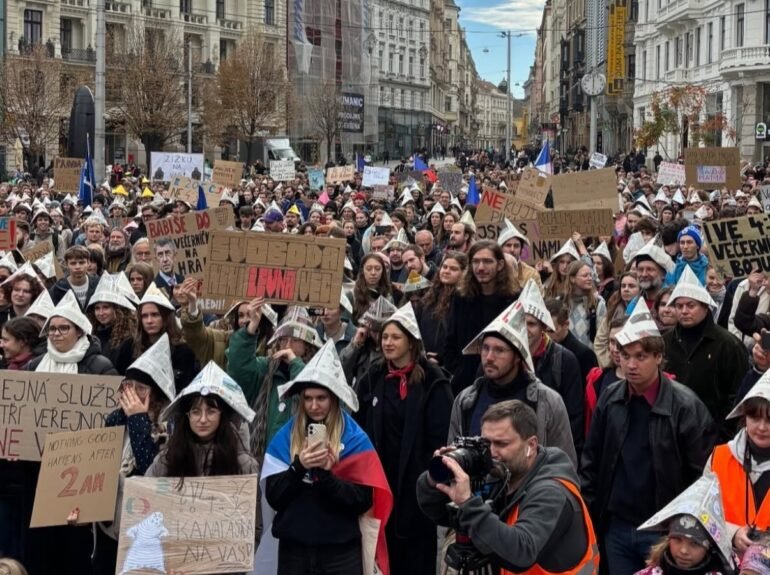

Last weekend was a turbulent time in Czech politics, as the Czech Government unexpectedly pushed forward with plans to transfer funding for Czech Television (ČT) and Czech Radio (ČRo) to the state budget. Critics of the move are concerned that the move could be a serious risk for media independence in the Czech Republic, as it would bring the organisations under the financial control of the government. Many emergency protests were organised across the country last Saturday, including in Brno, called by the Million Moments for Democracy movement (Milion chvilek pro demokracii). Approximately 4,000 gathered on namesti Svobody in support of the striking ČT and ČRo staff.
In the proposed legislation, these two media outlets would receive funding directly from the state budget, abolishing the licence fees that Czech citizens currently pay, and bringing them under the influence of political pressure. The protesters criticised both the legislation itself, and the way the legislation was brought forward in the middle of the night to reduce discussion. Prime Minister Andrej Babiš has stated that media independence will remain intact, and that the government will not interfere in the work of these two institutions.
Over the weekend, opponents of the bill circulated an open letter condemning the decision, which has already gained more than 4,700 signatures. Earlier this week, they released a video on social media declaring a strike alert in case the situation deteriorates. This was supported by the Rector of Masaryk University, Martin Bareš.
Many other initiatives have been found in support of the media workers, such as Media nedáme!, the initiative led by MUNI students and pedagogical workers.
Babis’s government argues that public media is funded from the state budget in many EU countries, and media independence will not be threatened by the measure.
However, the consequences of politicised state media are evident looking at other examples from around Europe. Over the past two years in Serbia, many protests have been held against the government, but some media networks entirely ignored the protests, misrepresented the numbers of people gathered, or blatantly disregarded the protests on the air.
The government’s media plans have met with the strongest resistance yet from the Czech public, with protests across the country and threats of wider strike action. The protesters hope that sustained pressure will lead to a change of direction and a reprieve for the threatened organisations.