

Masaryk University is restoring more than 500 hectares of endangered wetlands in the agricultural landscape of South Moravia. In addition to supporting biodiversity and improving conditions for protected species, the LIFE in Salt Marshes project will also focus on the quality of the water flowing into these areas. This year, special biofilters capable of reducing the amount of pesticides, fertilizers and other pollutants in water by up to 95% will be installed at four locations.
The project has also been added to the initiatives of the European mission ‘Restore Our Ocean and Waters’, which connects projects aimed at restoring aquatic ecosystems across Europe.
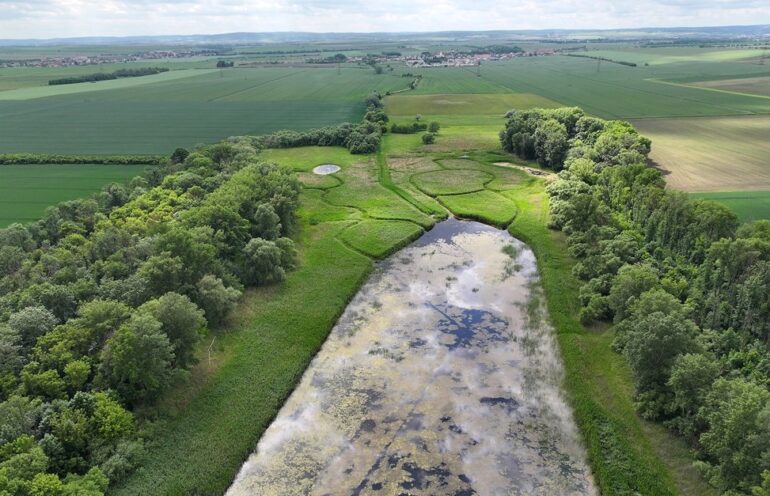
The Vrbovecký Pond project site is a protected natural area with the occurrence of rare wetland species of plants and animals, especially amphibians and birds. The biofilter here will help purify the Vrbovecký stream which flows into the pond, and thus create a better environment, especially for protected species.
The project by scientists from Masaryk University addresses the loss of biodiversity, the decline in populations of protected species, and the problems associated with wetland drainage and water pollution.
“Nitrates and phosphates in water support fast-growing plant species such as reeds and goldenrod, which then crowd out other species from wetlands,” said Marie Kotasová Adámková, head of the LIFE in Salt Marshes project from the Faculty of Science at Masaryk University.
“Pesticides are toxic, especially to aquatic organisms,” she added. “In high doses, they cause death, and in lower doses, damage that prevents populations from reproducing and surviving. Most wastewater treatment plants today are unable to remove these substances. By installing biofilters, we can significantly reduce the entry of pollution into valuable protected areas.”
“At the project sites, we monitor the groundwater level, tributaries and water quality and propose specific measures,” explained Antonín Zajíček, a team member of the Research Institute for Soil Monitoring and Protection, which is a project partner. “The most applicable is the creation of a protective grassed zone between agriculturally used land and a protected wetland. At four out of ten project sites with a point source of pollution, we are installing biofilters in which water slowly flows through a filter substrate. Filtration is provided by bacteria and the physical properties of the material. Biofilters can reduce the amount of nitrates and phosphates from agricultural and municipal pollution by up to 90–95% and the content of pesticides by 70–90%.”
The project to restore more than 500 hectares of protected wetlands in the agricultural landscape of South Moravia, coordinated by Masaryk University, has now been included among the initiatives of the EU mission ‘Restore Our Ocean and Waters’. The aim of this initiative is to protect and restore the health of oceans, seas, rivers and aquatic ecosystems by 2030 through research, innovation, sustainable management and citizen engagement. More than 1,100 projects across Europe have already joined the mission.

“The public and stakeholders are an integral part of the project,” added Kotasová Adámková. “Local communities, farmers, land managers and volunteers are already involved in project activities. Our goal is that after the project is completed, optimal care of wetlands will be ensured in the long term thanks to cooperation with local entities. Participation in the Restore Our Ocean and Waters mission will allow us to transfer and replicate our experience at the pan-European level, which will significantly strengthen the impact of the project.”
The LIFE in Salt Marshes project is being implemented by Masaryk University, the Research Institute for Soil Monitoring and Protection, the South Moravian Branch of the Czech Ornithological Society, and the company World from Space. The project implementation period is 2023–2029 and the budget is 4.74 million euros.