


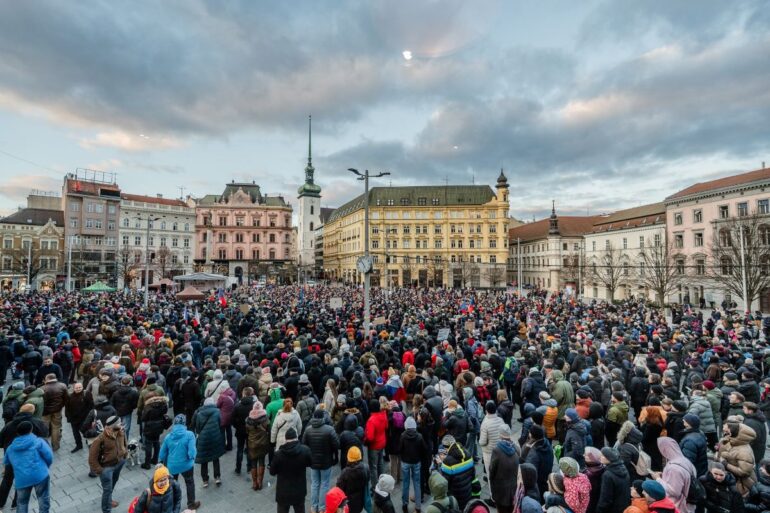

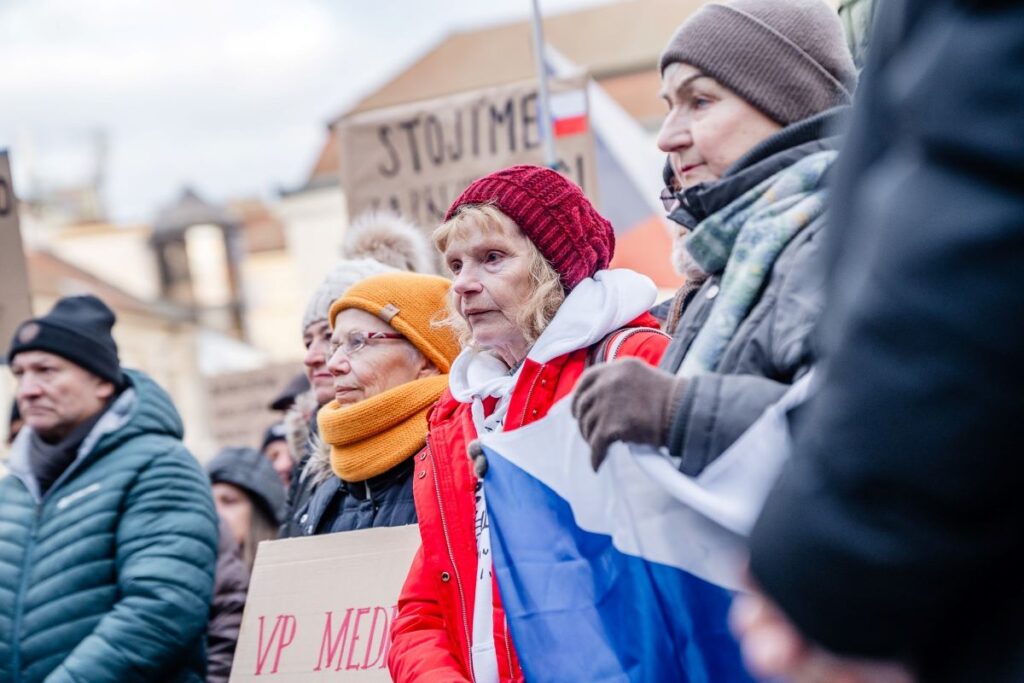
Thousands of people gathered in Brno’s náměstí Svobody yesterday to show their support for President Petr Pavel, organised by the Million Moments activist group. Similar gatherings were held in hundreds of other cities, towns and villages across the Czech Republic.
The protests follow on from a demonstration held in two squares in Prague on 1 February, where up to 90,000 people gathered, according to estimates. The protests were a reaction to a dispute between President Pavel and Foreign Minister Petr Macinka (Motorists) over Pavel’s refusal to appoint Motorists MP Filip Turek as environment minister.
On Saturday, Macinka said that citizens have a sacred right to protest. “I see these as opposition protests,” he said, adding that no pressure from the opposition would change the direction of the current government, as the government’s voters would expect.
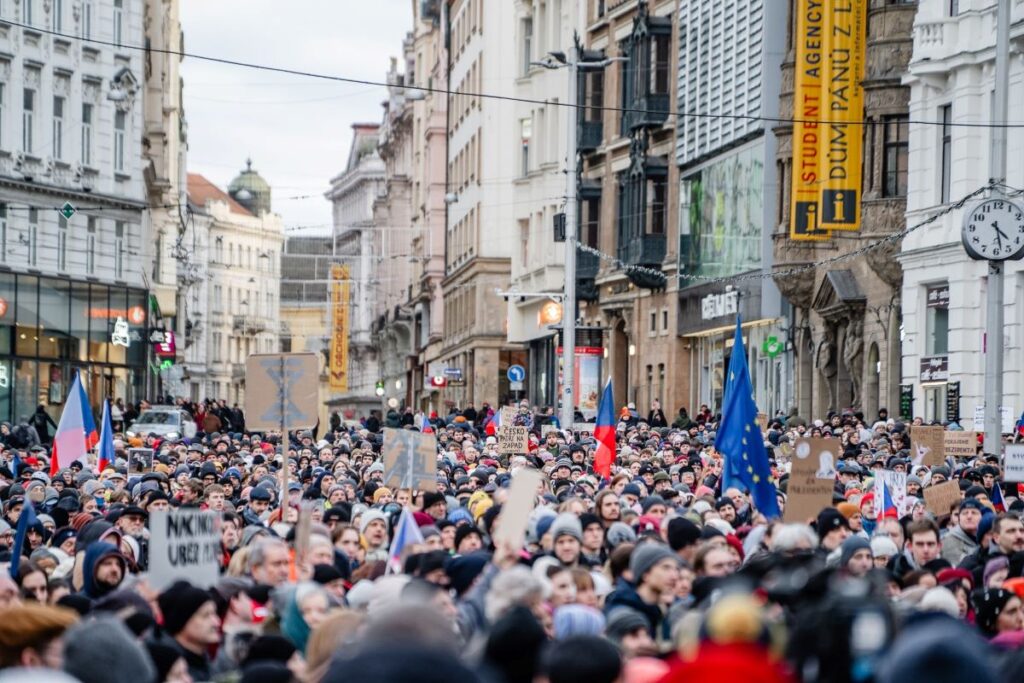
Petr Stika, secretary of the Brno-stred district municipality, told CTK that roughly 9,000 people took part in the gathering in náměstí Svobody, which lasted about an hour and a half. People began arriving at the square long before the official beginning, as early as 15:00 CET, carrying Czech flags.
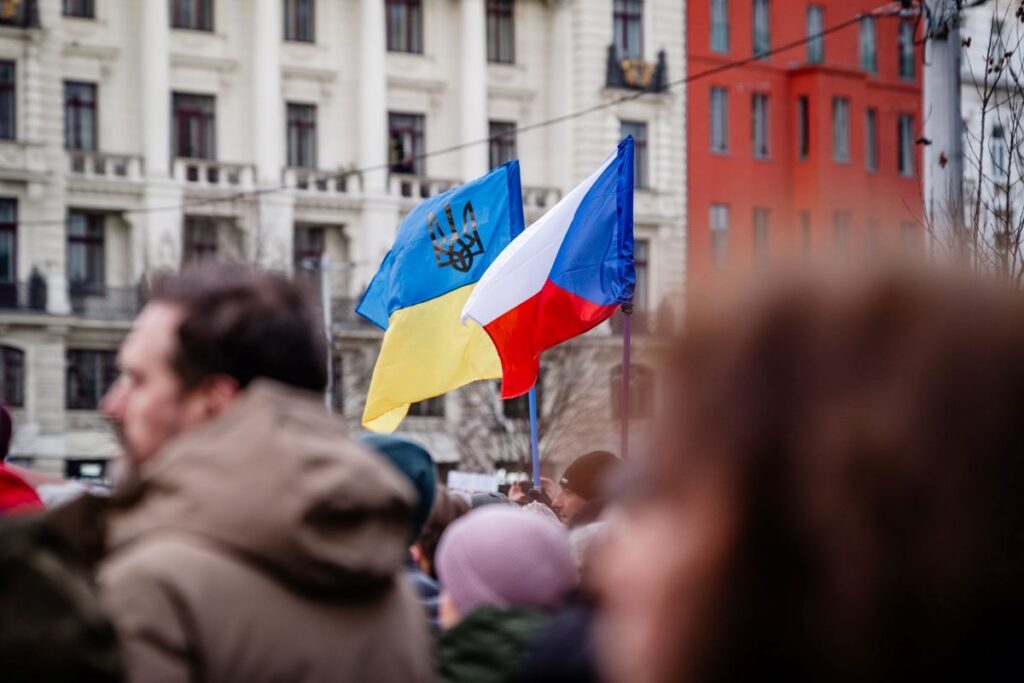
The speakers at the event expressed support for the President, but also for Ukraine, whose flags were also visible in the crowd. They spoke about freedom of the media, honesty, decency, democracy, and bending the rules.
“Democracy does not disappear overnight. It crumbles piece by piece. First, they bend the rules, then they take control of the media, then other institutions follow. Before we know it, we may find ourselves in a semi-authoritarian state,” said the final speaker Marija Wazi.
At the end of the event, the Czech national anthem was sung by well-known singer Hana Ulrychová, now 76 years old.
“We want to show that we in Brno are not indifferent to the direction our country is taking,” said the organisers in their invitation to the event. “As citizens, we can no longer remain silent when pressure is being exerted on the head of state in a way that simply has no place in a democratic culture.”
In Ostrava, both supporters and opponents of President Pavel gathered in a square in the centre of the city. At the beginning of the gathering, whistling could be heard in the square. However, most people in the mostly full square applauded the speakers or loudly supported the president.
In the city of Olomouc, the protest was attended by 2,000-3,000 people. “We believe that we are heading down the same path as Slovakia and Hungary, and in our opinion, that is not right,” said Zuzana Novotná Sandnes, who helped organise the event.
According to Million Moments, more than 400 cities, towns and villages joined the event, which began simultaneously at 4pm. The participating locations can be seen on this map. There was no gathering in Prague.
“This is no longer just about the President. It’s about the path the Czech Republic will take,” Million Moments leader Mikulas Minar wrote on social media.
Million Moments has also been collecting signatures for an appeal entitled We Stand Behind the President. If 1 million people sign the appeal, the group plans to hold a large demonstration on Letna plain in Prague. The appeal had 620,000 signatures two weeks ago and more than 769,000 as of yesterday. Minar announced yesterday that a gathering called We Will Not Let Our Future Be Stolen From Us will be held at Letna on 21 March.
In a letter to Prime Minister Andrej Babis (ANO) in early January, President Pavel stated that he refused to appoint Turek as a member of the cabinet because Turek had repeatedly shown a lack of respect for the Czech legal system.
The dispute between Pavel and Macinka escalated at the end of January when Pavel announced that Macinka had sent him text messages which he considered an attempt at blackmail. The Presidential Office published the communication. Macinka denied that his messages constituted blackmail, arguing that trying to influence someone’s position is the essence of any negotiation in politics. The opposition is demanding Macinka’s resignation and called a vote of no confidence in the cabinet in early February, which the cabinet survived as expected, thanks to its comfortable majority in parliament.