


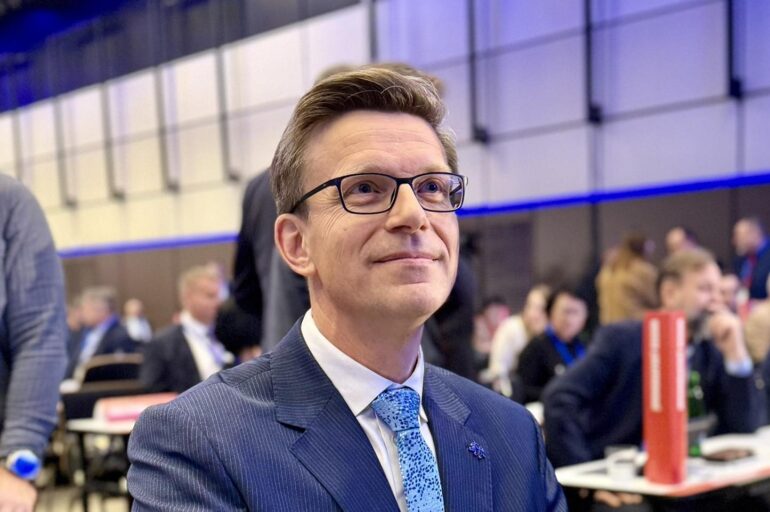

Former Czech Prime Minister Petr Fiala has been replaced as leader of the Civic Democratic Party (ODS) by the party’s current deputy leader, Martin Kupka, who defeated Radim Ivan in a secret ballot at the party’s congress in Prague on Saturday.
Fiala left the post after 12 years. Kupka thanked Fiala for his service to ODS and said he wants to continue his work.
Kupka received 327 of 508 valid votes, against 138 for his competitor Ivan, a municipal politician in Ostrava.
“It is a clear message from the congress. Yes, this is the chairman we want to trust to lead ODS forward,” he said at a press conference after the results were announced. The position of chair of ODS is held for a two-year term.
Fiala endorsed Kupka before the election in a statement to journalists. After the election, he wrote on social media: “I believe that you will succeed in fulfilling your vision and moving the party forward. ODS will be in good hands. Good luck!”
According to Kupka, ODS must now focus on its work in opposition. Kupka said the Civic Democrats will be a clear and consistent opposition that delivers substantive solutions to people’s problems while maintaining a strong position in foreign policy. ODS should be a strong point in difficult times, he said. The party will now prepare proposals to lower the tax burden on labour and reforms to healthcare and education, and will hold a programme conference in June.
Kupka sidestepped a question about the future of the Spolu electoral coalition (of ODS, the Christian Democrats and TOP09). “We will strengthen the ODS brand, but at the same time I say we will work with our partners in the opposition,” he said. The Civic Democrats will rely on direct, clear and unambiguous communication, he added.
ODS will seek voters among active people, the middle class and businessmen. “Deep blue is the most accurate name for ODS in the coming period,” said Kupka.
He said that now the party does not have to make coalition compromises in government. “We will push through the right-wing agenda as sharply as possible, but we will also reach out to those in the centre of the political spectrum and to those who gave votes to ANO or the Motorists last time.” He said a vote of 20% in the next parliamentary elections is realistic.
Kupka said he wants to present ODS as a comprehensible and clear anchor, and will announce a shadow government composed of both experienced experts and newcomers within a few weeks.

Kupka’s opponent Ivan thanked everyone for their support and announced that he would continue his work on the ODS opinion platform, Czechia Plus. He did not rule out running for the party leadership again in two years.
Changes are now very likely in the leadership of the ODS parliamentary group, which is currently chaired by Marek Benda. “The leadership will definitely be re-elected, and there will certainly be new people there. I don’t know when the parliamentary group meeting will take place, but it will be relatively soon after the congress,” said Kupka, confirming the plans announced by the parliamentary group when it was formed after the elections.
According to political analyst Ales Michal from the Faculty of Social Sciences at Charles University, Kupka’s election represents continuity with the outgoing leadership of Petr Fiala, while at the same time it is clear that the new leader is aware of the need for change.
Michal said ODS are facing a period of reflection after their cooperation with the Christian Democrats (KDU-CSL) and TOP 09 in the Spolu coalition. “If ODS wants to continue running independently, it will have to debate with the public what it represents now,” he said. “At the same time, Radim Ivan has certainly built up some capital. His Czechia Plus initiative came up with vigorous demands, and I expect that he will not completely give up the fight for a more honest and lively intra-party debate.”
Michal said the first important test of Kupka’s leadership will be the autumn local and senate elections. “In the municipal ones, much of the attention will be focused on Prague City Hall. But other big cities will also be important,” he said.