

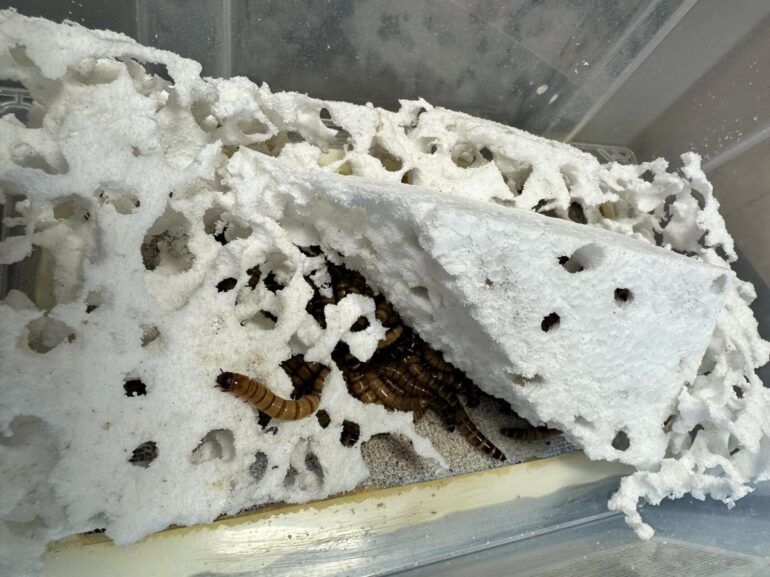

Researchers at Mendel University’s Faculty of Agronomy are studying how the larvae of the darkling beetle Zophobas morio (commonly known as “superworms”) are able to break down different types of plastics. The project aims to uncover the biological mechanisms behind this unusual ability and explore whether it could one day be scaled up to support safer and more sustainable plastic recycling technologies.
Worldwide plastic production now exceeds 400 million tonnes a year, and only a small fraction is effectively recycled. Much of the material ends up in landfills, incinerators, or the environment, where it accumulates for decades.
“Plastics remain one of the most persistent types of waste,” said Tomáš Do of the faculty’s Institute of Chemistry and Biochemistry. “We are investigating how superworm larvae can degrade several types of synthetic polymers. Our findings could provide a foundation for environmentally friendly, biologically based approaches to plastic recycling.”
Superworms are saprophagous insects adapted to feeding on low-nutrition materials, which makes their digestive systems unusually flexible. Recent studies have shown that Zophobas morio larvae can consume and partially break down plastics including polystyrene (PS), polyethylene (PE) and polyethylene terephthalate (PET).
The larvae begin by mechanically chewing the material, after which a combination of their own enzymes and microorganisms inside their intestines chemically decomposes the damaged plastic. Researchers now want to map these processes in detail.
“If we identify the key enzymes and metabolic pathways the larvae use, we may be able to apply them independently, without relying on the larvae themselves,” Do explained.
To achieve this, the team is employing a suite of modern omics methods, which allow scientists to analyse genes, proteins, and metabolites all at once. “We examine the larvae’s intestines and their microbiome after they feed on different plastics. Omics approaches give us a comprehensive view of what is happening inside their bodies,” said Do.
Artificial intelligence also plays a central role. Specialists from Mendel University’s Institute of Informatics are developing algorithms to process and interpret the large sets of proteomic data that emerge from the analyses. These tools help identify which proteins are involved in plastic breakdown and reveal previously unseen patterns. “AI will allow us to analyse the data more accurately and efficiently than standard bioinformatics methods,” Do noted.

Initial results show that superworms can not only digest various plastics but also survive long-term on a plastic-based diet. The team is now working to optimise the larvae’s living conditions to maximise the rate of plastic consumption, with more detailed analyses to follow.
In the long term, the research could support the development of specialised enzymes and microbial systems capable of breaking down plastics far more effectively than current industrial technologies. Such methods could be especially valuable for biotechnology companies working on enzymatic or microbial recycling.
Further information can be found here.