
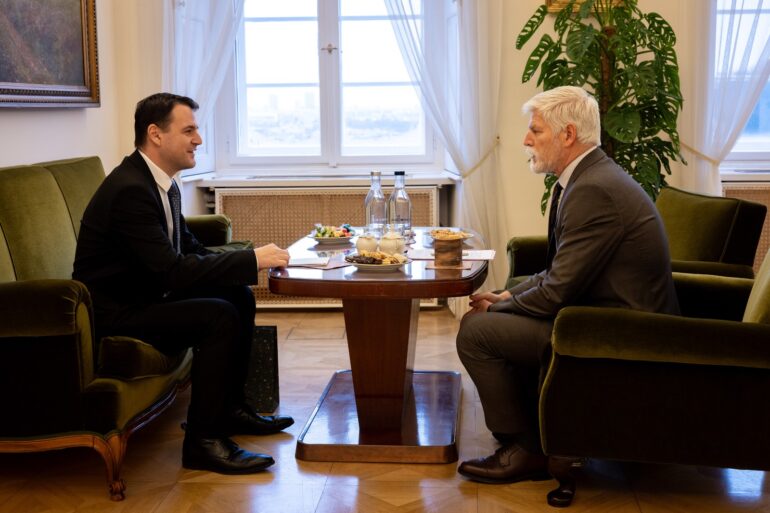

President Petr Pavel has rejected comments by Motorists leader and Foreign Minister Petr Macinka regarding the impartiality of senators and constitutional judges, saying he considered it highly inappropriate for a minister to question constitutional institutions in this way.
According to the Presidential Office, Pavel described Macinka’s statements on Czech Television’s Interview CT24 on Wednesday as a “political foul”.
In response, Macinka told CTK yesterday that he could perceive the President’s decision not to appoint Motorists MP and honorary chair Filip Turek as environment minister as a constitutional foul. “If the president considers this to be my political foul against him, then I can perceive what he is doing as a constitutional foul against the parliamentary election results,” said Macinka.
The Constitutional Court is “independent and impartial”, its chairman Josef Baxa and former constitutional judge Jaromir Jirsa told CTK yesterday, dismissing Macinka’s suggestion that the court would favour President Pavel in its decision-making as nonsensical.
In the Wednesday interview, Macinka responded to the president’s decision not to appoint Turek and spoke about his party’s next steps. He again ruled out filing a competence lawsuit against the president with the Constitutional Court, but said “I understand that this may be what the president wants. Perhaps, he has some connections with his judges whom he appointed to the Constitutional Court.”
“Perhaps, the president hopes that since he has appointed people close to him or close to his worldview to the Constitutional Court, he may be basically asking the Constitutional Court to add him some powers,” Macinka concluded.
The statement from the Presidential Office strongly disputed these allegations.
“Constitutional judges are approved by a vote in the Senate, nominated and, after the senators’ approval, appointed by the president,” it read. “The process is democratic, extremely transparent, and fully in line with the constitution. The president considers questioning constitutional institutions, the impartiality of senators and selected constitutional judges to be extremely inappropriate. The president categorically rejects any allegations of agreements with constitutional judges.”
Former justice minister Eva Decroix (Civic Democrats, ODS) wrote on social media that the Ministry of Justice should clearly and publicly distance itself from Macinka’s statements, which cast doubt on the independence of the courts. “This is not a personal dispute or a political skirmish, but about protecting one of the fundamental pillars of the rule of law,” she said.
Political analyst Josef Mlejnek, from Charles University, said neither Babis nor the Motorists want to take the matter to the Constitutional Court because they expect that they would lose the lawsuit. “So the Motorists, through their chairman Macinka, had to come up with some kind of explanation as to why they did not want to turn to the Constitutional Court. And their ‘explanation’ calls into question the impartiality and legitimacy of both the Constitutional Court and the Senate,” he told CTK.
Mlejnek said the president had to defend himself. “The president does not reject a possible constitutional lawsuit against him, because it could clarify the whole controversial situation. Which is also a very strong point in his position in the Turek case,” he added.
Both Baxa and Jirsa emphasised the impartiality of the Constitutional Court, and stated that its decisions are not influenced by the person appointing the judges.
“I certainly did not have the impression that any friendships played a role there. Macinka probably lives in a different world,” said Jirsa, who cooperated with the judges appointed by Pavel before his 10-year term ended last year.
Turek remains the Motorists’ only nominee for environment minister. On Wednesday evening, the Motorists’ parliamentary group agreed on further steps, of which it will inform its coalition partners, ANO and the far-right Freedom and Direct Democracy (SPD), at Monday’s meeting of the Coalition Council.
The Presidential Office said in December, after a meeting between Pavel and Turek, that the head of state expected Prime Minister Andrej Babis (ANO) not to nominate Turek as minister again. The statement also implied that if the prime minister did so, the president would not appoint Turek, even though he considered this an extraordinary step.
On Wednesday, Babis again submitted Turek’s cabinet nomination to the president after reaching an agreement with the Motorists, but Pavel’s position did not change.
Turek has faced criticism for racist and homophobic posts on social media. He has apologised for the remarks, but denied authorship of some of them. He has also met with controversy over his property declarations, and reports that he threatened an employee of the Saudi Arabian embassy eight years ago.