


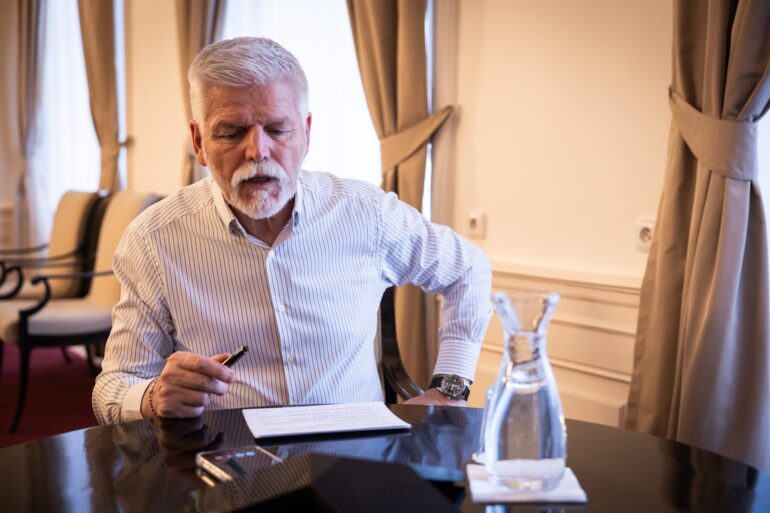

Czech President Petr Pavel and his Ukrainian counterpart Volodymyr Zelenskiy discussed continued support for Ukraine and the progress of peace talks in a phone conversation yesterday. The two presidents also discussed the continuation of the Czech ammunition initiative, thanks to which Ukraine has received 1.8 million pieces of ammunition this year. More deliveries are expected as part of the scheme, Zelenskiy said on social media.
The heads of state agreed that it was in their mutual interest that the peace agreement would bring a dignified peace to Ukraine, according to the Presidential Office (KPR). “President Zelenskiy thanked the Czech Republic and its citizens for their long-standing support,” KPR wrote.
Zelenskiy said he appreciated Pavel’s close attention not only to diplomacy but also to the situation on the frontline. “We discussed the strong operation of our fighters in Kupyansk, which clearly showed the real value of the words coming from Moscow,” said Zelenskiy. “It is very important for us that the world knows the truth – the Ukrainians are holding their positions, which provides the basis for diplomatic efforts, which we also discussed today.”
Ukrainian commander-in-chief Oleksandr Syrskiy said yesterday that Ukrainian troops control nearly 90% of the city of Kupyansk, and have been defending Pokrovsk for 17 months, where they have regained control of the northern part of the city.
“We also discussed the continuation of the Czech initiative, which has already delivered 1.8 million rounds of ammunition to Ukraine, with more deliveries expected by the end of the year. There is also a possibility to secure ammunition supplies for Ukraine next year,” Zelenskiy said.
The future of the Czech munitions initiative is uncertain with the arrival of the new government of Andrej Babis (ANO), which has expressed scepticism about the scheme.
Last week in Liberec, Pavel said that the Czech Republic should continue to support Ukraine, not only for ideological but also for practical reasons. He said that failing to do so would close the path for the Czech Republic to be involved in the reconstruction of Ukraine after the end of the war.
At a summit starting in Brussels on Thursday, EU presidents and prime ministers will decide between two options proposed by the European Commission for financing Ukraine in 2026 and 2027. The first option is a loan from the EU, and the second is a reparations loan secured by frozen Russian assets.
Babis said it would make more sense if the frozen Russian assets were used for reparations after the war. Babis reiterated in the parliamentary European Affairs Committee yesterday that the Czech Republic is helping Ukraine with its contribution to the EU budget.