

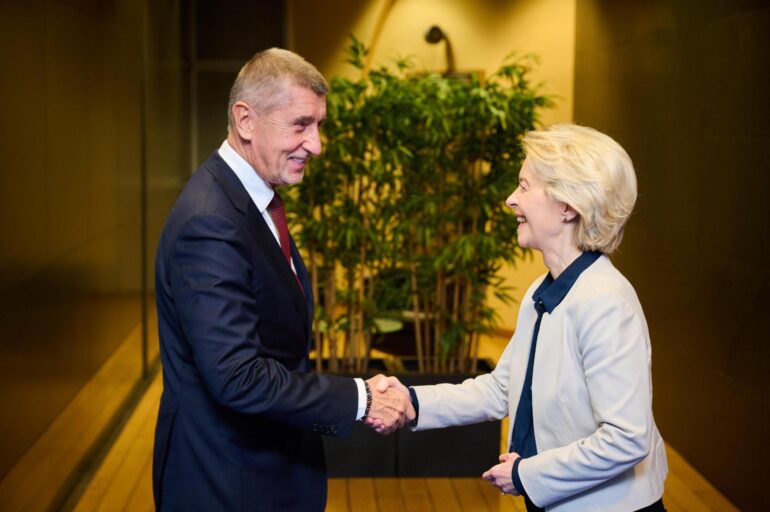

Incoming Czech Prime Minister Andrej Babis (ANO) met European Commission President Ursula von der Leyen in Brussels this morning, for the first time since his new appointment as head of government.
Writing on social media, Von der Leyen praised Babis’s support for strengthening Europe’s competitiveness. She described their meeting as good and said they had also discussed strengthening Ukraine on the road to peace.
Von der Leyen welcomed Babis at the European Commission building, where they shook hands, took a photo together and left for the meeting. Babis presented her with flowers and they spoke French together.
“Good meeting with Andrej Babis. I appreciate your support to boosting Europe’s competitiveness,” the Commission chief wrote on social media afterwards.
“We also discussed strengthening Ukraine on its path towards a just and lasting peace. Because Ukraine’s security is Europe’s security. We’ll continue this work at the European Council next week,” she added.
After the meeting with Von der Leyen, Babis held further meetings with Belgian Prime Minister Bart De Wever and European Council President Antonio Costa. Babis’s spokesman said this would be a working meeting related to the upcoming EU summit.
Babis is meeting the top EU representatives for the first time since President Petr Pavel appointed him as prime minister on Tuesday. The appointment of his entire government is scheduled for Monday, 15 December.
Babis has indicated in recent weeks that he wants to attend the European Council summit, which begins in Brussels on Thursday, 18 December, as the prime minister.
The meeting of the EU heads of state and government is to discuss further financial support for Ukraine, which has been defending itself from Russian aggression since 2022. Costa said this was a priority.
The summit will have a choice between two options proposed by the European Commission. The first is a loan from the European Union, while the second is a reparations loan secured by the frozen Russian assets in the EU. The Belgian PM is opposed to the latter option, as the Russian assets are largely located in Belgium and its officials are concerned that Russia could demand compensation.