
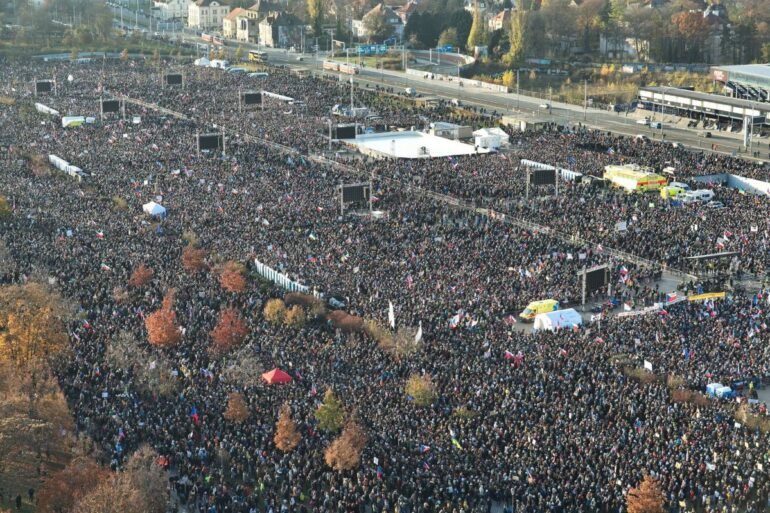

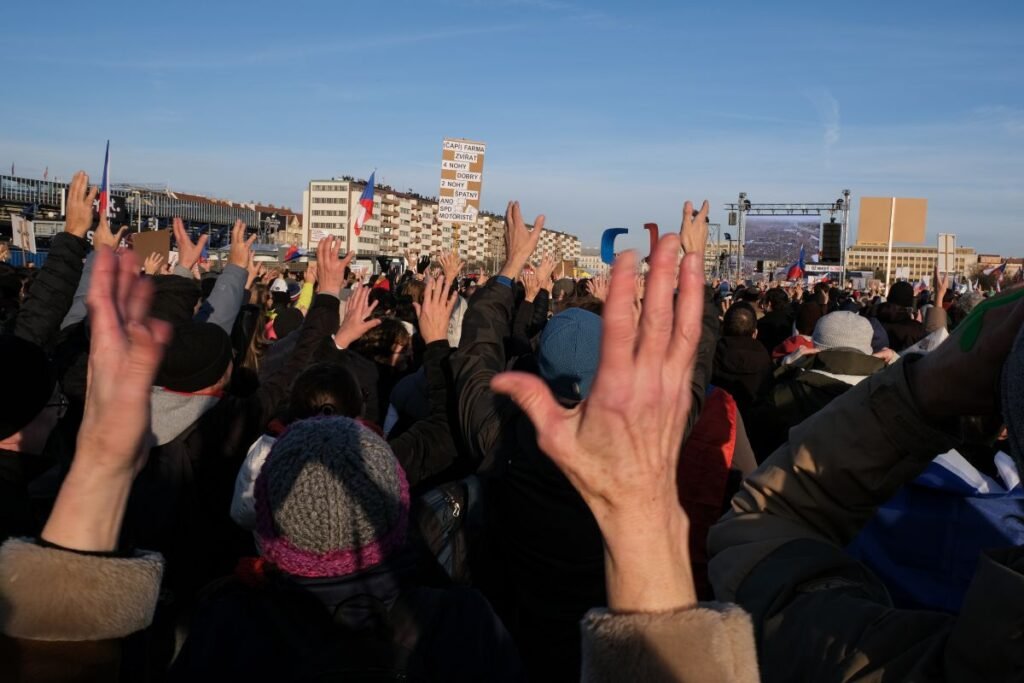
Around 400,000 people attended a demonstration on Prague’s Letna Plain yesterday in support of public media in the Czech Republic, according to organisers from the Million Moments civic organisation.
If this figure is confirmed, it would be the largest demonstration in the Czech Republic since the end of 1989. At the start of the event, Minar said that the Czech people had risen up against the reckless push to pass key laws behind closed doors, hastily, and without debate.
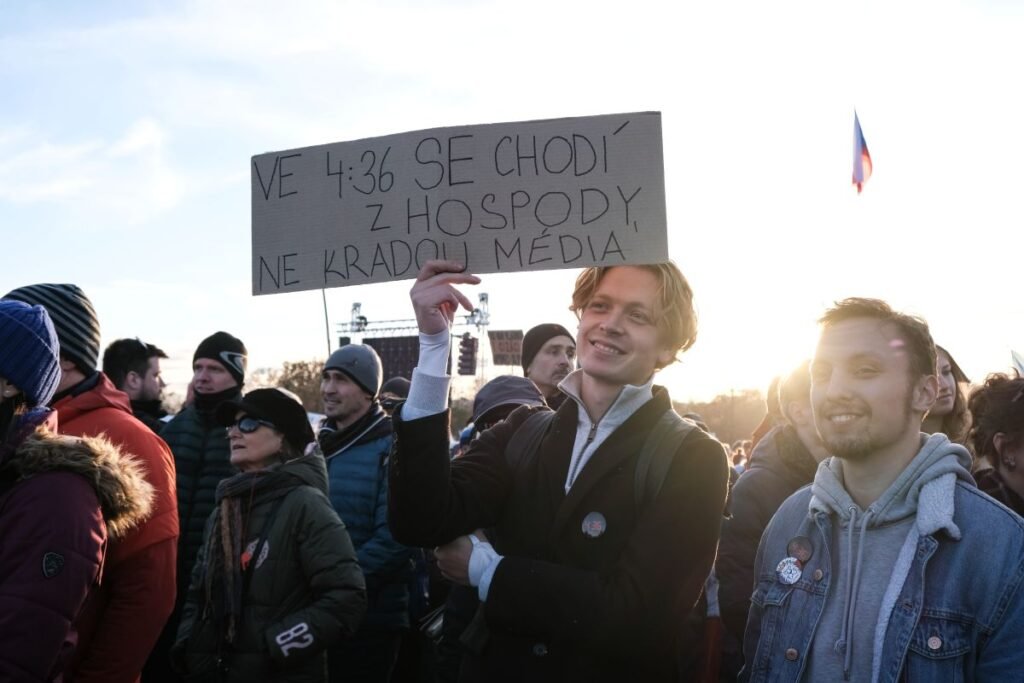
About three weeks ago, the governing coalition unexpectedly pushed through the first reading of a bill in the Chamber of Deputies that would eliminate the licence fee for Czech Television and Czech Radio. The name of yesterday’s demonstration, ‘Letna Against 4:36’, referred to the time of 4:36 am on Saturday, 24 October, when the coalition scheduled the vote.
The bill would leave the broadcasters reliant on funding from the state budget, which has raised concerns among opponents about a loss of independence for these media outlets. Prime Minister Andrej Babis (ANO) and other coalition politicians reject these concerns, as well as suggestions of political influence over CT and CRo.
Prague police spokeswoman Eva Kropacova told CTK that the police do not publish figures on attendance at protests, and yesterday’s protest would be no exception.
The event lasted about two and a half hours, and the police reported no significant problems, handling only a few minor conflicts among participants during the demonstration. They also seized four drones, which are prohibited as Letna is within a no-fly zone.
According to the organisers, demonstrators filled all the designated sections on the plain shortly after the protest began. “We are here to stand up against high-handed governance in the style of 4:36,” said Minar, referring to the controversial early morning hour of the vote.
People responded to Minar’s opening speech by chanting “We Do Care.” Many of them brought Czech flags or banners with slogans such as “We won’t give up the media” or “Common sense is looking for a government.”
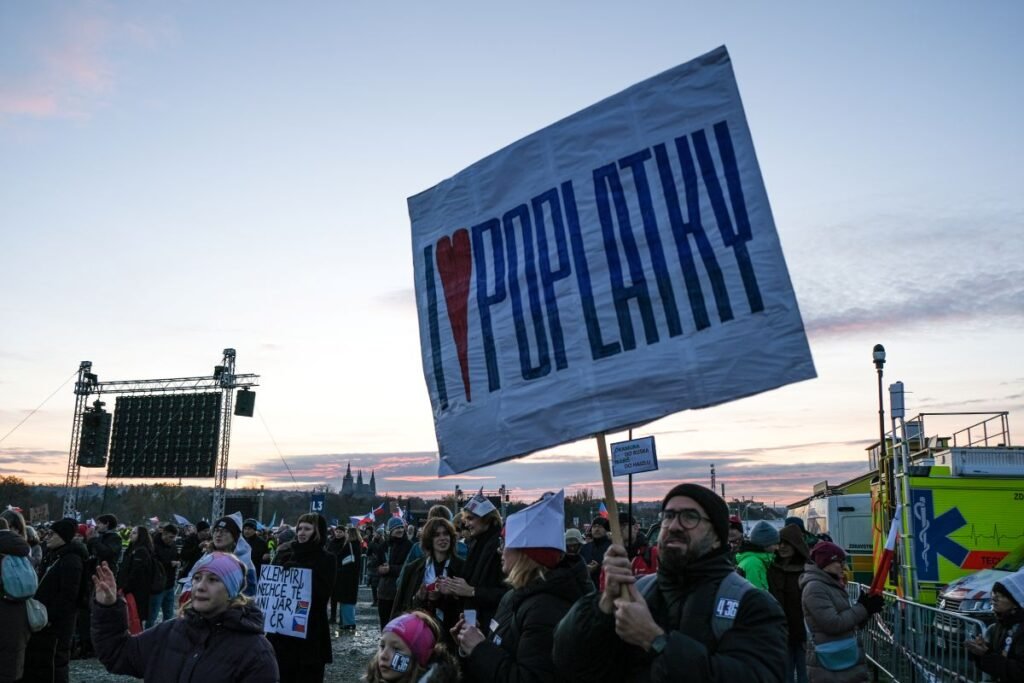
Minar called for the gathering to remain peaceful. “Let’s not give anyone an excuse. If you see any provocation, call the police or the anti-conflict team,” he said. He emphasized that people should not allow themselves to be provoked in the coming weeks either. “They have nothing but the hope that something will go wrong. They’re panicking, making mistakes, and getting tangled up in their own lies. We won’t defeat this ruthless government with ruthlessness; we’ll defeat it with determination and calm,” he added.
Slovak actress and director Tereza Nvotova warned against a repeat of the situation in her home country.
“I come from a country where the government has only just begun dismantling public media. I didn’t come here to scare you, but to warn you how quickly you can lose your own country if you don’t stop this in time,” said Nvotova. She said that by abolishing media fees, the previous Slovak government turned the media into hostages of whoever happens to be in power.
“Then Robert Fico and his Smer party won the election; they simply took control of the media and created their own media outlets, run by their own people, spreading only their version of the truth. Immediately afterward, they took control of the entire cultural sphere,” Nvotova said. She called on those present to persevere.
Representatives from student groups, the media, theatre, business, the church, and the sporting community also took to the stage to deliver speeches.
Responding to the protest, Babis told CTK that the government would continue with its plans to abolish television and radio license fees. He said he respected people’s right to protest, but disagreed with the reasons behind the demonstration and did not consider them to be true.
“The funding system is changing, no one wants to control public media, no one wants to dictate what they should say or do, and no one wants to nationalise them. We’re doing this because the system is outdated, and most of Europe is following the same path today, with others joining in,” said Babis.
Million Moments issued a statement and petition yesterday calling on the government to withdraw the bill that would eliminate fees. It also called for the removal of Tomio Okamura (SPD) as Speaker of the Chamber of Deputies and for the Ministry of Defence to be taken away from SPD.
The association called on the cabinet to engage in dialogue with the public, and put an end to high-handed governance carried out hastily, in secret, and without discussion. They invited the entire cabinet, comprising ANO, SPD, and Motorists, to the Svandovo Theatre on 2 December for a debate with 16 experts, public figures, and citizens.
At the demonstration, Minar issued a nationwide alert for the first Wednesday of the month, 2 December, at 16:36. He called on citizens to hang signs in their windows or to approach ANO politicians and voters and ask them whether the price of governing with the Motorists and SPD is too high.
Minar also sent a message to the opposition parties, stating that people expect them to present their own well-developed vision and programme for governing the Czech Republic within six months.
STAN leader Vit Rakusan wrote to CTK that his movement takes the challenge from Letna seriously and is not afraid of it. “Our Cabinet of the Future is preparing reforms and specific legislation so that we can competently govern the country from day one and avoid repeating some of the mistakes of the past. That is the essence of our strategy, which we call ‘a different kind of opposition,’” he added.
Numerous foreign media outlets reported on yesterday’s protest, highlighting the criticism directed at Babis and Okamura, and the concerns that funding media through the state budget could lead to a reduction in their independence. Many outlets drew parallels with similar efforts by populist governments in Slovakia under Prime Minister Robert Fico, and in Hungary under former Prime Minister Viktor Orban.
Political analyst Josef Mlejnek, of the Faculty of Social Sciences at Charles University (FSV UK), told CTK that the size of yesterday’s demonstration could prompt Babis to amend the bill so that the abolition of licence fees is accompanied by safeguards to preserve the independence of the broadcasters.
Mlejnek acknowledged that parts of the governing coalition, particularly SPD, will continue to insist on abolishing the fees, as the protest will have no impact on their voters. “But still, I think Andrej Babis, in particular, is quite sensitive to public opinion polls,” he said, adding that some ANO voters also certainly view the government’s plans negatively. “So it’s possible that in the final version of the new legislation, the government will still try to include some safeguards to at least partially quell the criticism,” he added.
Political scientist Michal Pink of Masaryk University agreed that the government is unlikely to back down from abolishing the licence fees, but may introduce some changes if Babis’s support were to begin to decline due to a shift in public sentiment.
Withdrawing the bill at this point, according to Jan Kubacek of the Faculty of Social Sciences at Charles University, would seriously weaken Babis in the eyes of his voters. “Andrej Babis cannot accept the arguments from Letna, because that would be the end of him politically,” he said on Czech Television.