


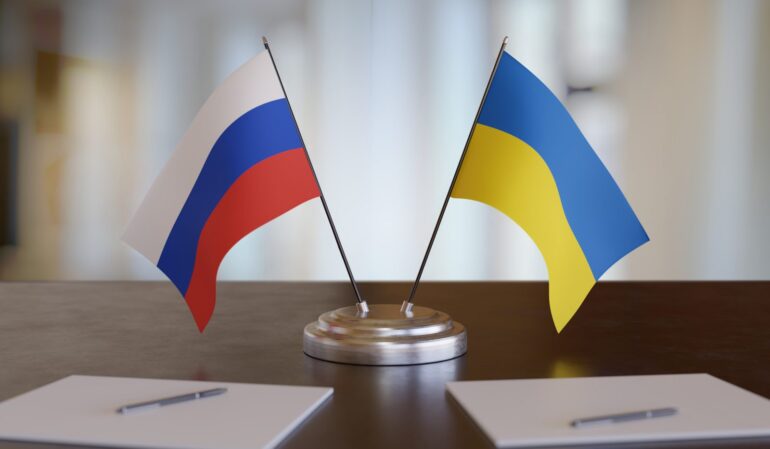

Even if we move far away from where we grew up, most people carry with them a deep connection to their homeland. This affinity is elevated for many Russians and Ukrainians living in the Czech Republic, especially given that many of their family members and friends are still living in war-torn countries.
Although Ukrainians and Russians have built new lives in Brno, or in other places around the Czech Republic, they obviously still think about the conflict in their native land and how it is affecting the people they love. In particular, both Russians and Ukrainians have their own personal takes on how they view the propaganda put out by their respective governments.
Helen, born in Ukraine, believes that although the government often “puts out a form of nationalistic propaganda, the people do not buy it.”
Her family is among the Ukrainians who are unfazed by the messages their government is trying to push. They have an understanding of what they believe are the real reasons behind the war being dragged out for more than four years.
She believes that “Russia wants to free Ukraine from what they view as an embedded nationalist ideology.” She went on to highlight that, in her view, financial backing from NATO countries is another reason the war is ongoing. Helen says these factors are the opposite of the propaganda put out by the Ukrainian government.
Other Ukrainians, including Maryna and Borgs, have different perspectives on how propaganda has affected them. They said, “Our older family members needed to learn Russian because the Soviets wanted to influence Ukraine through propaganda.” They believe Russian propaganda is still prevalent in Ukraine even after the fall of the Soviet Union in 1991.
Alex believes the Russian people are, in fact, impacted by their own government’s propaganda. “The Russian government is in complete control of the media,” he said. “Therefore, it is pretty much impossible to hear any alternative narratives.”
Alex added that, from his standpoint, “the Russian people are very apathetic.” He went on to explain that many Russians he knows typically cannot be bothered with getting involved in politics, given their view that they cannot do anything to combat the narrative from a government that has suppressed people’s voices for years.
He went on to point out that Russian media has consistently pushed a narrative that says America is the enemy and that their European allies in NATO are basically America’s lap dogs. He is confused as to why these two countries that, in his view, could do a lot of good if they worked together, instead have painted each other as adversaries throughout recent history.
Propaganda and media narratives aren’t the only things affecting the people of Ukraine and Russia. Many situations are much more personal. For instance, Helen’s brother is currently of military age, and her family is nervous about the possibility of him being forced to fight on the front lines.
Men in Ukraine who want to avoid being drawn into the conflict have to be extremely careful if they venture outside. The same goes for Helen’s brother, who has been largely confined to his home for nearly four years.
There have been multiple occasions where police have knocked on her family’s door for hours on end, hoping that someone will answer. Helen is nervous that the law preventing police from entering a domicile without a warrant will change, and that they will be able to drag men out of their homes against their will.
Men who are forced to fight are at high risk of never returning home. They could be killed, severely injured, or end up as prisoners of war. Luckily for one of Helen’s friends, after spending a month as a POW, he eventually returned home as part of a prisoner exchange between the two countries.
Others haven’t been so lucky. “The Russian government gave students the opportunity to have their tuition paid for if they enlist for a year,” said Alex. One of his friends accepted this offer, was sent to the front lines, and unfortunately never made it back. The family was then given the money that was supposed to be for tuition.
Alina’s Russian family had a different experience: “My brother got into a university and was able to escape the military registry,” she said.
Family members who are not of military age are still affected by the conflict. For instance, Maryna’s mother lives very close to a railway in Kyiv.
Railroads have been a main target of the Russian military, given their importance for supply chains. Her house has sustained major damage because of nearby rocket and drone strikes. Nevertheless, she remains resilient and refuses to leave her home.
Similarly, Alina spoke about family members who still live in Moscow. Although her mother moved from the city, her father and grandma have not. They go about their daily lives as usual despite the increase in Ukrainian missile and drone attacks on the capital in recent months.
Alina said, “They are pretty unfazed by the attacks at this point; it’s amazing what people can get used to.”
Should missile attacks be something people should have to get used to? That answer is most definitely no. Unfortunately, this is the reality for many citizens who remain in Ukraine and Russia.
Alex, Helen, and Alina have left their respective countries, hoping to avoid being caught up in the conflict. Maryna and Borgs have decided to stay. Whether they decide to stay or leave, one thing stays constant: the conflict remains extremely personal, as all of them have family members still dealing with life in war-torn nations.